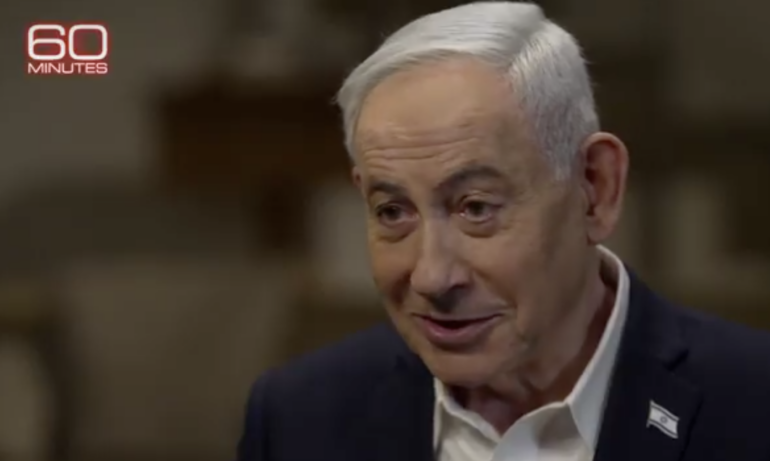
In a wide-ranging 60 Minutes interview that aired on Sunday, Prime Minister Binyamin Netanyahu (Likud) stated that he seeks to wean the State of Israel off of financial aid from the United States.
When the interviewer, Major Garrett, asked Netanyahu if he thinks it’s time for Jerusalem to “reexamine and possibly reset its financial relationship” with Washington, the prime minister responded by saying “Absolutely. And I’ve said this to President Trump. I’ve said it to our own people.”
When asked by Garrett for clarification, Netanyahu obliged.
“I want to draw down to zero the American financial support, the financial component of the military cooperation that we have.”
“Because we receive $3.8 billion a year,” he continued.
“And I think that it’s time that we weaned ourselves from the remaining military support.”
When Garrett asked Netanyahu for a time table, the prime minister answered that he is eager to begin immediately.
“Let’s start now and do it over the next decade, over the next ten years,” he said. “But I want to start now. I don’t want to wait for the next Congress. I want to start now.”
In a January interview with The Economist, Netanyahu declared his intention to phase out Israel’s reliance on US military and economic aid within a decade.
Although the prime minister had previously tested the political waters by making several statements about reducing Jerusalem’s dependency on Washington, the interview with The Economist was the first time he stated his intention not to renew the $3.8 billion US military assistance package that Israel’s been receiving each year.
While the aid package is due for renegotiation in 2028, Netanyahu said he plans to definitively end Israel’s reliance on US support within the next ten years – a move that he claimed to already be “in progress.”
The prime minister further expressed interest in the State of Israel being “as independent as possible.”
While many Israeli and US Jewish leaders have long regarded the aid as an important sign of a strong relationship between Washington and Jerusalem, clear signs that the next generation of American decision makers will be far less supportive of Israel has begun to challenge the ability of Jews to continue relying on a “special relationship” or “unbreakable bond” between the two nations.
Because the likelihood of future US administrations being overtly hostile to Israel is high, it stands to reason that militarily dependency on Washington would land Jerusalem in a precarious position.
Israeli independence from Washington is actually something Netanyahu has long been seeking to achieve. Unlike most Israeli political leaders, Netanyahu may have always understood financial and military support to be imperialist tools to maintain control over Jerusalem.
When he first entered office in 1996, Prime Minister Netanyahu spoke openly about Israel becoming economically independent but he met opposition from the Clinton administration and received no domestic support for ending the aid. He was forced to abandon the idea at the time but, since returning to office in 2009, may have been carefully and quietly working to create the conditions to free Israel from American control.
Now that so many American voices have been publicly questioning the benefit that the aid brings to the United States, the prime minister likely sees an opportunity to free Israel from the aid while avoiding a major confrontation with Washington. Knowing better than most leaders how to take the political temperature of a society, Netanyahu likely recognizes that the current conditions are as conducive as they will ever be for Jerusalem to attain independence in a way that avoids openly antagonizing the empire.
US President Donald Trump has meanwhile been reported to oppose the notion of ending the aid, expressing skepticism that doing so would benefit either nation.
Because it’s ultimately a US government subsidy to its own arms industry that moves exorbitant public taxpayer funds into the hands of private weapons companies, military aid to Israel has enjoyed bipartisan consensus for decades. The aid currently stands at $3.8 billion per year and has become the target of increased political scrutiny as a result of rising animosity towards Israel across the American political spectrum.
Administration officials must know how the aid serves as Washington’s primary tool of control over Israel but also likely see how unpopular it’s become among the American public – including growing camps within Trump’s own MAGA base. Pushing for the aid to continue while the Israeli prime minister loudly calls for its end risks revealing its actual function and the true nature of the US-Israel relationship.
But permitting Israel to stop accepting the aid could weaken Washington’s grip over Jerusalem and threaten the empire’s interests in West Asia.
By choosing a moment when American public support for sending aid to Israel is at an all time low, the prime minister has given Trump little room to maneuver. If Netanyahu succeeds in freeing Israel from economic and military dependency on Uncle Sam, this would be his most significant achievement as Israel’s head of state.