
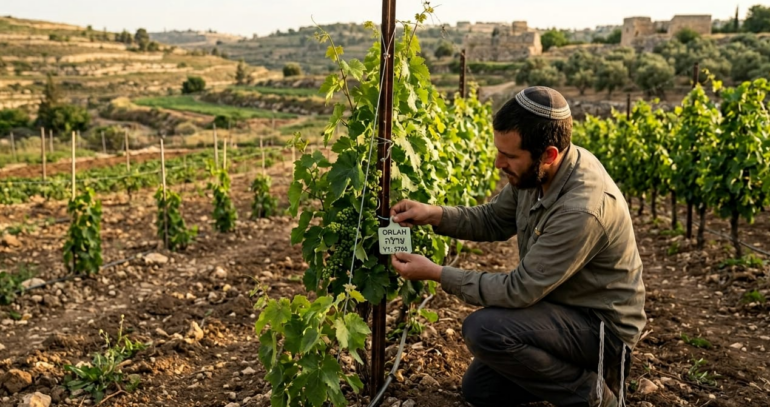
A beautiful fragment of Jewish indigenous identity is the mitzva of orla.
Like many of the Torah’s commandments, it is explicitly addressed to the children of Israel as pertaining to when they’re in their own land.
Orla — the very term for the “foreskin” removed from the male organ as part of Israel’s covenant with the Creator — refers here to the first three years of a fruit tree’s life, when its fruit are prohibited.
The process of becoming permitted is thus like an “opening” and the “cutting” of circumcision itself, analogizing the tree and the human body, both growing out of the land. The tree bears an orla just as the body does.
On the fourth year, the fruit is brought to Jerusalem and dedicated to HaShem. Only afterward does it become permitted to eat.
The Kabbala sees the first three years as graded levels, or shells, that the tree — and the soul itself — must pass through in a process of spiritual purification inseparable from the cyclical rhythms of the land.
What follows is a meditation on how this structure — of growth, return, and rootedness — reappears in the halakha, Jewish mysticism, and contemporary political thought.
From the Maharal of Prague to contemporary scholars, we see how the Jewish relationship to the land of Israel is not incidental but structural — and why antizionist ideology, in seeking to sever that structure, enacts a deep form of cultural erasure.
The Maharal & the Center
Our sages understand the land of Israel to be placed precisely at the hinge between Shamayim (the sky) and Aretz (the earth).
It is the holiness — kedusha — of the land, the singular instance in which materiality itself attains sanctity without collapsing into idolatry, that binds these poles at the center.
The Maharal, too, consistently held the center — the emtza (middle) — as the inner sustaining essence: the crossing-point of the cardinal directions through which geula (redemption) is secretly maintained, even in the midst of galut (exile).
To integrate the olamot (worlds) within the person, across the long history of the world and through modernity itself, thus becomes part of the cosmic vocation of the children of Israel — a ceaseless movement of return that, at every moment, bears within it the possibility of redemption.
Laws of the Land
If the Maharal offers a metaphysical account of the center, Rav Eliezer Melamed provides a halakhic (legal) explanation of that same structure through the sanctification of territory, law, and ethical responsibility.
Rav Melamed’s understanding of the messianic promise is particularly noteworthy. For him, the settling of the entire land of Israel is not merely a nationalist aspiration — it is one of the Torah’s most central Divine commandments.
At first glance, this may appear disturbing, even seeming to confirm the “Greater Israel” libel often cited by antizionists. After all, the prophetic Divine promise to Avraham includes territory stretching to the Euphrates in the north and down to the Sinai Peninsula in the south.
But upon closer reading, Rav Melamed’s thinking is far more nuanced. Far from endorsing a rogue-state ideology, he grounds the legitimacy of creating Jewish communities in the territories won in the 1967 Six Day War in halakhic principles that take international law seriously. Referencing Tractate Sanhedrin, he argues that Jewish conduct must be bound by universal legal norms — there is nothing permitted to Jews that is prohibited to gentiles. Israel, in his view, is not to engage in aggressive conquest, but rather to build on and sanctify areas that have already come under Jewish control through legitimate means.
His halakhic treatment of non-Jews in the land also refutes the common charge of collective punishment or Jewish supremacism. Rav Melamed draws on the legal category of Ger Toshav — the gentile resident who accepts the seven Noaḥide laws — as a moral and legal framework for distinguishing between enemies of peace (such as Hamas, whom he identifies with idolatry, murder, and false witness) and ordinary Palestinians who renounce violence.
The Ger Toshav, Rav Melamed writes, is to be treated with dignity, love, and full legal equality — no less than an Israelite.
What therefore emerges is a theology and ontology of settlement that affirms the sanctity of the land of Israel in its fullest ideal expression, while simultaneously integrating a commitment to legal equality, self-defense, and the moral integrity of international norms. For Rav Melamed, these norms are not foreign impositions but crystallizations of the Torah’s ethical core.
Antizionism as Cultural Erasure
Today, antizionist racializations of Jews as “white settlers” erase Jewish presence.
Constructed within a narrow and highly ideological subfield, “settler-colonialism” functions less as an analytic tool than as a political weapon — one that casts Jewish return as conquest and Arab hegemony as natural.
This cannot be dismissed as “academic theory” operating at the margins. Settler-colonial constructions of “Zionists” — developed within a narrow and highly ideological subfield — are being laundered through elite academic journals and amplified by mainstream media institutions, where they function to legitimize racist stereotypes and the erasure of Jews and Israelis in the most influential public forums.
As many others have pointed out, even the term hitnaḥalut — settlement, referring to a Jewish presence in the West Bank — comes from the ancient Hebrew term naḥala, which refers to the sacred inheritance of the tribes of Israel. Associations with “white settlers” of settler-colonial theory are mistranslations. That inheritance was overcoded and erased by the Islamic conquest, whereby the land was redefined as Islamic waqf and as Dār al-Islām, land conquered and owned by Islam.
Indigeneity matters for Jews not as a claim to exclusive rights to land, but as an affirmation of the legitimacy of Jews as a distinct civilization and people.
It is precisely this that antizionism seeks to erase, oriented as it is toward logics of forced assimilation and cultural genocide.
Conclusion
And so orla, with its spiral of growth, restriction, and sanctification, returns us to the core.
The cutting of the tree’s fruit, like the circumcision of the flesh, is a rite of passage not only for individuals but for a people aligned with the rhythms of its land.
Jewish indigeneity is not a weapon of exclusion, but a call to integration — a cosmic topology of return. To inhabit it is to stand at the center, where Shamayim and Aretz meet, and from where redemption radiates.
Antizionism seeks to sever that root. But the Jewish tree is older, deeper, and still bearing fruit.




This is perhaps my favorite article ever published here at Vision.
The expressive integration of rooted Torah ideology, modern moral sensibilities, and depth of thought is a harmonious pleasure of the spiritual and material.
More ALK please.
Inspiring and beautifully said.