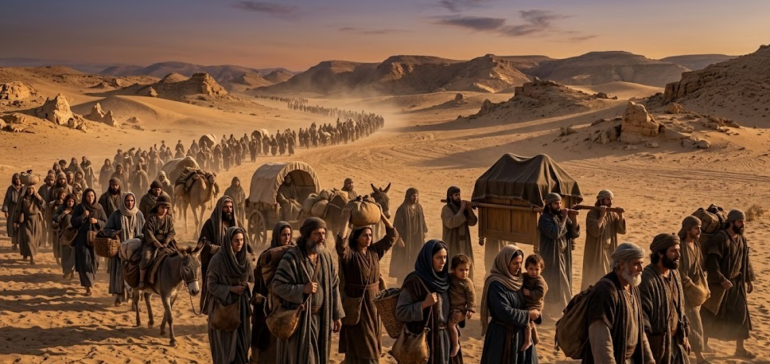
HaRav Zvi Yehuda HaKohen Kook would often say that the Book of Bamdbar is the Book of “traveling on the way.”
What did he mean by this?
As opposed to the first three Books of the Torah (B’reishit, Sh’mot, and Vayikra), which emphasize the wondrous order of the world, from creation to the appearance of humanity to the formation of Israel – leading up to the revelation of the Sh’khina in the Mishkan and our service there – the Book of Bamidbar seems like a unit onto itself.
Until reaching Bamidbar, one might think that the Torah was given to a well organized human species, in a stable world with few disruptions. But this Book describes a series of challenging crises that are typical of desert life – a life of movement.
In this context, society breaks down into its various components and each one pulls in its own direction.
But in addition to the negative features of such a breakdown, there is also a positive side. A desert can serve as a laboratory, where the function of every part of the collective can be individually analyzed and then put back into its proper place.
To effectively account for the dangers that stem from a lack of organization, the first step is to take a census of the nation before it embarks on its journey. This census exists as a reminder that complete order existed at the beginning of the process, even if it later unraveled in travel as a result of desert life’s pitfalls. The people of Israel will ultimately return to an ordered life in the census carried out in Parshat Pinḥas, as we prepare to leave the desert.
When it comes to counting, the Torah presents us with something deeply meaningful. When a community is counted, there can be a feeling of discomfort because such a census, by its very nature, is impersonal and doesn’t take individual identities into account.
This is especially true about totalitarian forms of government that trample over the value of the individual person. It might be possible to replace a general number by using every person’s name, but that could be seen as threatening unity.
The Torah therefore commands that the children of Israel should be counted, “by the number of names” (Bamidbar 1:2).
A number is a general element, emphasizing the unifying factor, while the names take note of the individual value of each person. The same is true in regards to the methods by which the Torah is interpreted, such as “a generality that is in need of detail, and a specific detail that needs the general rule.”
This is the kind of approach needed in order to confront and withstand all of the challenges that could be encountered during one’s lifetime.
During the journey in the desert, the main tribe that leads the nation is Levi, which occupies the center of the camp.
This tribe has unique qualities that play an important role during times of crisis and doubt. Lavi is intimately linked to the entire Israelite nation as a collective unit, since it is not connected to any specific element of the whole.
Levi is not priestly or aristocratic, but it is also not linked to a specific piece of ancestral land, as the other tribes are. It is an intermediate figure with the capability of uniting all Israel.
Once the nation arrives in Eretz Yisrael, however, the tribe of Levi – the tribe of movement – no longer plays such a central role. It’s actually replaced by the tribe of Binyamin, which occupies the geographic center of the country.
Since Binyamin was the only one of the twelve brothers who was born in the land, this tribe is uniquely qualified to teach Torat Eretz Yisrael.
Translation by Dr. Moshe Goldberg