
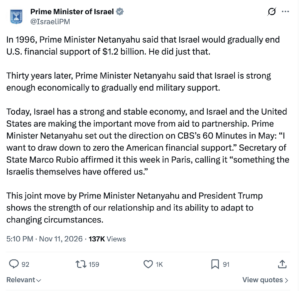
Israel is “strong enough economically to gradually end military support,” the PMO wrote on X 30 years after Netanyahu’s initial promise.
US President Donald Trump was reported at the time to have opposed the notion of ending the aid.
Because it has actually been a US government subsidy to its own arms industry that has moved exorbitant public funds into the hands of private arms companies, the military aid to Israel has enjoyed bipartisan consensus for decades.
The aid, which was an annual $1.2 billion in 1996 when Netanyahu first committed to ending it, currently stands at $3.8 billion per year and has become the target of increased political criticism in the US as a result of rising hostility towards Israel across the American political spectrum.
Netanyahu has masterfully leveraged this public sentiment to outmaneuver Trump and gain his administration’s cooperation in ending the aid.
While US officials understand that the aid has served as Washington’s primary tool of control over Jerusalem and its policies in recent decades, they also see how unpopular it’s become among the American public – including Trump’s own MAGA base. Pushing for the aid to continue while the Israeli prime minister calls for its end would have risked revealing its actual function and the true nature of the US-Israel relationship.
December. While this announcement didn’t appear to help Republicans in the midterms, it did create a new political reality in which continuing the arrangement is more difficult than ending it.
Understanding that ending the arrangement would weaken Washington’s grip over Jerusalem and allow Israel greater independence, Netanyahu chose a moment when American public support for sending money to Israel was at an all time low. Trump was left with little room to maneuver and even saw short term political benefits to ending the aid.
If Netanyahu succeeds in freeing Israel from economic and military dependency on Washington, this would be his most significant achievement as prime minister.