The Book of Bamidbar teaches us how to behave in the desert, when we’re confronted with challenges that destabilize life’s routine static order.
Parshat Nasso begins with the problems that tend to destabilize the normal life of an individual. Although the Torah often first addresses a general situation and only afterwards examines particular cases, in times of crises it can be necessary to start at the individual level. This is because it’s difficult for an individual soul in crisis to be positively involved in the general life of the collective.
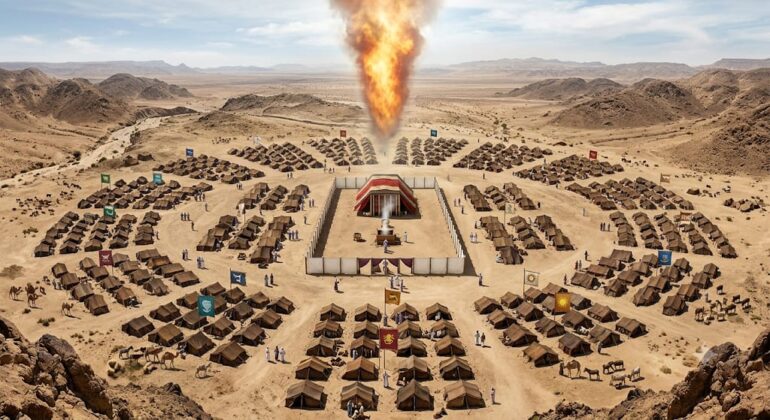
The criterion for analyzing the problems of an individual is that person’s proximity to the source of holiness – the Mishkan. Once the tribes organize around the Mishkan, the physiology of the national body is revealed.
It could happen that being too close to the holiest site can put a person in a difficult situation, because he or she is personally impure. The best way to solve this problem is to increase that person’s distance from holiness in order to successfully rebuild his or her identity under conditions free from the demands that direct contact with kedusha requires.
“Send away from the camp all who have a blemish, who have an impure flow from their bodies, or who have come into contact with the dead.” (Bamidbar 5:2)
Here is the order of things: One with a blemish – a “tzaraat” – that is caused by a person’s ethical failure with in the community (spreading slander for example) must spend time in solitude, removed from all three camps, in order to reunite with his own self and become pure.
On the other hand, the “zav” – who has an impure bodily flow – has a problem that is less serious, but he is somewhat embarrassed due to his human frailty. He is sent out of the camp of the Levites, because to remain there would require a level of psychological purity that he wouldn’t be able to maintain in that state.
And while a person who is impure as a result of contact with the dead has not been harmed mentally or ethically, his contact with death has still put him in touch with the b’diavad (“after-the-fact”) world, where death is a reality due to humanity’s original sin. Such a person is therefore prevented from entering only the camp of holiness – the camp of the Sh’khina – which is associated with life and not with death.
From that point on, the Torah discusses the opposite situation. There are cases when too great a distance from sanctity leads to human complexity and failure, so much so that a person shows no respect for anything that belongs to others. This can be compared to a person with tzaraat, who used his tongue to harm others. The solution is to bring the person to the Temple and to require him to bring a korban – specifically the asham which is related to theft.
Forcing an encounter with kedusha teaches a person that causing harm to another person’s property also harms the sanctity of the world.
In parallel to the situation of a zav, there are times when human relationships – especially intimate relations between a married couple – become even more complicated. Shalom in the home must be founded on the understanding that for a good relationship “the Sh’khina must appear among them.” If this foundation is lacking, the relationship breaks down. And the couple must therefore be brought to the Temple, to see that even the holy name of the Creator can be erased in order to bring peace back to their home.
The asceticism of the “nazir” is a way to elevate an individual to a personal level of sanctity, where there is no room for the impurity of contact with death, similar to the laws for the High Priest, in order to correct problems with his personality.
The different ways of healing an individual soul in distress come with a dangerous side effect of focussing too heavily on the individual. Parshat Nasso therefore transitions to Birkat Kohanim – in an effort to unite all Israel with the blessing of the revelation of the Sh’khina for the entire nation as a whole.