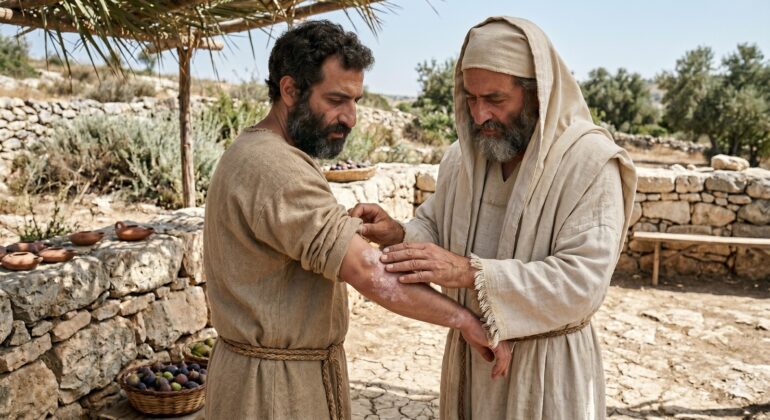
In Parshat Tazria, the various forms of tzaraat are described, from lighter to more severe, as representing different modes of moral decline:
A) “When a person has on the skin of his flesh a swelling… and it turns white.” (Vayikra 13:2-3)
The metzora is first and foremost a person, but he has an affliction on his skin. He is fundamentally good, but flawed. He is called a “person” (“adam“) due to the dominance of his imagination.
B) “When the affliction of tzaraat is in a person… and behold, a white swelling.” (13:9-10)
Unlike the first case, here the affliction precedes the person. This marks a worsening condition: “it is an old tzaraat.” (13:11)
The person is entrenched in his error, not a one-time lapse. The defect has become central to his personality, yet he is still a person.
C) “When the flesh has on its skin a boil… and in the place of the boil there is a white swelling or a reddish-white spot.” (13:18-19)
Here, the person has been replaced by “flesh.” This reflects a moral descent from the rule of imagination to the rule of emotions. In the previous cases, the afflictions were white. Though impure, some purity remained, as “if it all turns white, it is pure.” Here, the affliction is no longer purely white, it has a reddish hue, representing the attribute of judgment stretched over this person.
D) “Or when the flesh has a burn from fire, and the healed area of the burn becomes a reddish-white or white spot.” (13:24)
Now the white color is only the secondary possibility.
E) “When a man or woman has an affliction on the head or in the beard… it is a netek.” (13:29-30)
Until now, the discussion concerned a person defined by imagination and flesh – the emotional dimension. One cannot justify succumbing to the evil inclination, but it is understandable that the emotional side can sometimes fail. Here, however, the Torah speaks of “a man or a woman,” meaning the intellectual dimension. This form of tzaraat is called a “netek” (“disconnection”). A person who is intellectually disconnected experiences a much deeper corruption.
F) “When a man or woman has spots on the skin of their flesh… it is a bright spot… he is pure.” (13:38-39)
Not all intellectual flaws are impure. Some do not actually damage the essence of the person, who remains pure.
G) “When a man loses the hair of his head… he is a metzora; the affliction is on his head.” (13:40, 44)
Only the man is mentioned, not the woman. The person has already lost half of himself, the disconnection is complete.
H) “When a garment has an affliction.” (13:47)
One must distinguish between the person and his garment. If a person identifies himself with his clothing, seeing himself as entirely dependent on external appearance, the affliction spreads to the garments as well. Later it says: “it is a spreading affliction in its bald patch or its worn area.” (13:55)
Do garments have baldness? Rather, at this stage there is no longer any distinction between a person’s inner self and outer appearance. This is the lowest level of moral decline.
And from all of these, one can return.