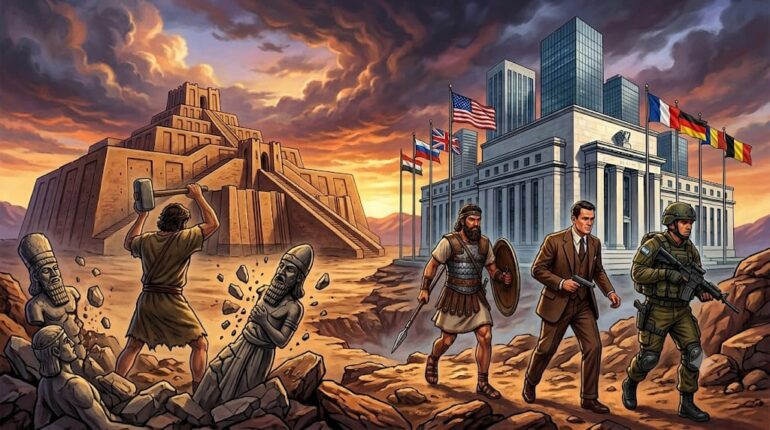
The setting was Ur Kasdim. The idol shop of a refugee from the land of the Hebrews named Teraḥ. He shrunk and compartmentalized his Hebrew spiritual traditions to attain success in his new Mesopotamian environment. He knew that the gods he sold to the locals couldn’t actually do anything. It was just good business.
He instilled the values of Ur Kasdim in his sons, hoping they’d be decent citizens, chasing the Mesopotamian dream, whilst clinging to the awareness of HaShem as the true Creator of the universe. He even hoped they’d find nice Hebrew girls to marry.
For at least one of his sons, Avram, the contradictions were simply too great to bear. He smashed the idols in his father’s shop.
Our sages teach us that, when confronted, Avram blamed the other idols, showcasing the nonsense of it all. He was calling out more than his father’s hypocrisy. He was calling out society’s inequities. He was calling out Mesopotamian civilization itself. So much so that he was taken to the king’s court and sentenced to be burnt alive for his crime.
Avram was of course saved and his tradition of challenging oppressive societal orders lived on in the identity of the Hebrew nation he later sired – the nation of Israel (where the archetype of Teraḥ is also present and sometimes finds expression).
The people of Israel exemplify Avraham’s brazenness throughout our storied past.
Moshe’s striking of an Egyptian moved him from a Hebrew of the palace to a persona non grata. His own people, enslaved by Egyptian whips, wanted to shut him down. He rocked the boat too much and risked a worsening situation for the Israelites of Egypt. This psychological unwillingness to go against the Egyptian grain would carry on until the Israelites were finally set free.
Less than a millennium later, the Jews of Persia were also hesitant to compromise their delicate place in the Persian Empire. The Judean population celebrated the Pax Persica that Aḥashverosh maintained, at the direct expense of their own national aspirations.
The Jews merrily ate at the king’s feast, as “Persians” who had, a generation earlier, chosen to remain when the opportunity to return to Judea presented itself. Mordekhai, the hero who then made our salvation and emancipation possible, refused to bow to Haman. It wasn’t just a personal insult. It was an act of defiance against the Persian system and a rejection of the Persian Empire’s legitimacy.
The heroes of the Maccabean Revolt followed a similar pattern.
Most Judeans living under the hegemonic Seleucid-Greek Empire’s cultural dominance didn’t initially resist its culture, values, or social norms. Some chose to work within the Hellenist system so long as their ancient folkways would be respected and permitted.
Other Judeans, however, chose to accept the Greek cultural framework as superior to their own. But the heroes of the story acted as a counterforce and a disruptor to the power and spirit of Greece. The Maccabi underground resisted the cultural and political dominance of the Seleucid-Greeks by waging a 26 year guerilla war against the empire.
The way we learn our history and celebrate our festivals today condition us to reject the Hellenist Greek ideological paradigm. And this rejection ultimately served as a blueprint for later generations to resist Rome.
While much of the Rabbinic leadership, as well as historian Yosef ben Matityahu (Josephus Favius), sought to adapt Jewish identity to work within a Roman Empire that would birth Western civilization, others – most notably Rabbi Akiva – led radical factions that challenged the forces of empire and ultimately wrote our people’s history with their blood.
From dragging imperial Rome into a protracted conflict to the Sicarii’s heroic final stand at Masada, the Zealot movement served as inspiration for the end of the exile – playing larger than life in Zionist imagination.
The potential for this disruption was relatively dormant, but not extinct, for most of the nearly 2,000 year exilic experience. Flashes of disruption naturally remained as part of Israel’s metaphysical DNA.
We can see this pattern repeat itself during the British Mandate period. fight against British imperial control for restoration of Jewish sovereignty in our ancestral homeland.
An urban guerrilla struggle for freedom led by Leḥi (“Loḥamei Ḥerut Yisrael” – “Fighters for the Freedom of Israel”) forced the British Empire to relinquish Palestine and allowed for the Zionists to declare an independent Jewish state.
By adopting the anti-colonial framework and methods of its predecessors in the Maccabi and Zealot movements, Leḥi showed itself to be connected to something deep in the Israelite identity.
While the Zionists had sought to establish a Jewish state under British patronage, Leḥi understood that British interests demanded a permanent presence in the country.
After nearly eight decades of a liberal world order led by the United States, humanity once again seems to find itself at a moment of transition.
A recent Axios report highlighted a curiously worded distinction between US and Israeli objectives in the so-called joint War against Iran.
Per White House officials, the main difference between the two is fundamentally philosophical. Washington is seeking to preserve and create stability while Jerusalem doesn’t “hate the chaos.”
This speaks to a deeper truth about how the children of Israel traditionally view war itself. In Orot HaMilḥama, HaRav Avraham Yitzḥak HaKohen Kook explicitly points to the Messianic potential unleashed in the chaos – the potential to break free of old chains. The potential exists for Israel to liberate humanity from what’s left of the current global order.
As is common for waning imperial powers, the US is lashing out and desperately seeking to reassert dominance. But this behavior itself is likely to accelerate the American decline.
Understanding that future US administrations will likely be more hostile to Israel, Prime Minister Binyamin Netanyahu (Likud) has already made clear his objective to be free of US “aid” by 2036.
Beyond the crucial need for Israel to free itself from Washington, it’s likely that Jerusalem also sees an opportunity to step into a regional leadership role in West Asia as US influence continues to wane.
An ascendent Israel would fundamentally challenging Pax Americana. Israel is actively creating a region in our image, even if it sometimes falls short of our historic mission.
By embracing, rather than denying, the contradictions between Roaring Lion and Epic Fury, Israel could fundamentally weaken the Pax Americana and step into the vacuum created by Washington’s shortened reach – something that could greatly benefit the entire region if Israel focuses on building regional alliances based on what we share in common with our neighbors.
Ahead lie two distinct paths. The first is that of Teraḥ, the Egyptian Hebrews who resisted liberation, the Hellenized Judeans, the collaborators with Rome, and the Zionist establishment that collaborated with British rule. This path, the one of least resistance, would dictate that Israel fight alongside the United States against Iran and its proxy network.
But despite its short term benefits, this path would only serve US imperial interests.
The second path is the one paved by the heroes of our people – those we honor and celebrate on our festivals. It’s a far more radical path. Far more difficult. It requires Jerusalem to see itself as replacing Washington – at least in the region – as the dominant power. But unlike the exploitative conduct of the US Empire, an Israel that rises to lead the Semitic Region should focus on how to cooperatively work towards improving West Asia for all of its peoples.