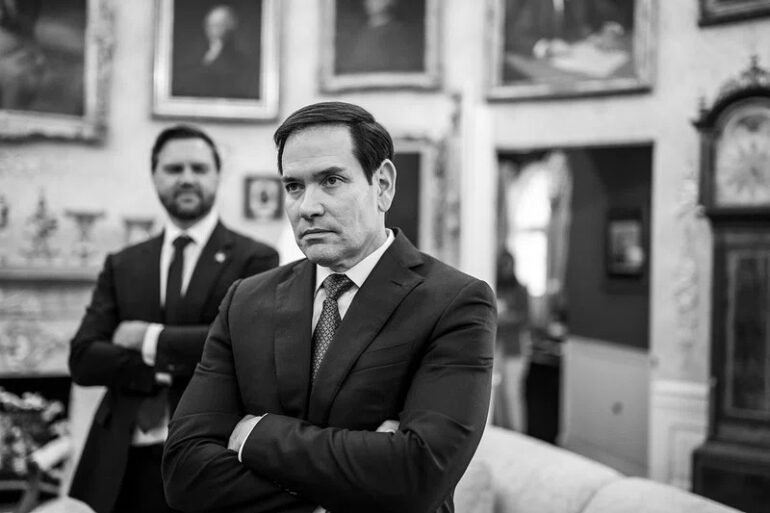
With the Trump administration’s decision to strike Iran alongside Israel, many rightist Jews are hopeful that the more traditionally conservative wing of the party, represented by figures like Secretary of State Marco Rubio and Senator Ted Cruz, can beat out the isolationist American nationalists represented by figures like Vice President JD Vance.
Rubio has garnered excitement among Republican insiders – with a recent report suggesting that in a room of twenty five decision makers, all favored the secretary of state over the vice president to lead the party following President Donald Trump’s second term.
From the nod at Trump’s State of the Union address to his rising poll numbers, Rubio’s ascension is eliciting a sigh of relief from many Jews in the United States who hope it signals the restoration of an America “out of control” – a restoration of the type of normalcy that offers stability and a sense of security to an increasingly insecure Jewish Diaspora community.
If the discourse on the American right over the last couple years had become increasingly dominated by voices questioning the US-Israel relationship and the loyalty of America’s Jewish population, the possibility of a “friend” like Rubio replacing Trump allows Jews who had begun to fear that “even the Republicans are lost” to delude themselves into thinking that they can still hope for a secure future in the United States.
From overt Nazism in young Republican campus clubs to anti-Semitic conspiracy theories surrounding Jeffrey Epstein to an isolationist wing growing more overtly anti-Israel, Western supremacists are turning on some of their strongest cheerleaders by deploying powerful anti-Jewish tropes.
Rubio’s pro-Israel rhetoric, hawkish attitudes toward Washington’s adversaries (especially those deemed “communist”), and his commitment to “free market” capitalism has broad appeal for right-wing US Jews.
Rooting for his success, however, would be a dangerous calculation for several reasons.
For starters, the electoral considerations do not align with the interests of the neocons and the party’s donor class – the Republicans that a growing cohort of Jewish Americans feel most comfortable with.
Polls consistently show the American public to be sick of foreign wars. Even as early as 2008, backlash to the Iraq War catapulted upstart Barack Obama over favored presidential candidate Hilary Clinton in the Democratic primary.
Eight years later, Donald Trump’s denunciation of that same war helped him crush the Republican establishment on his way to the White House.
This current war is significantly less popular with the American public, with polls already indicating that a majority oppose it.
As gas prices climb, even Republicans are growing wary. Worse yet, many Americans feel that this is – and should be – Israel’s war. That Israel somehow convinced Trump to participate. A feeling that Rubio egged on in comments shortly after this war’s initial strikes.
“We knew that there was going to be an Israeli action, and we knew that that would precipitate an attack against American forces, and we knew that if we didn’t preemptively go after them before they launched those attacks, we would suffer higher casualties.”
Even if the Republican Party’s corporate donors were seeking a neoconservative for 2028, such a candidate would likely face a tough battle in the general election. This race will likely be won by someone bringing Trump’s “America First” rhetoric to its natural conclusion; more viscerally ramping up hostile language against Israel.
JD Vance is clearly in a stronger position to do this.
The vice president can carry a stronger coalition with his ties to the now-martyred Charlie Kirk’s Christian nationalism, the populist wing, and a reputation for quietly opposing this war.
In the post-Trump era, pro-Israel Jews are expected to align with the establishment war mongering Bush-era Republicans.
While Jewish support for Rubio could succeed in delaying the inevitable full throated anti-Jewish trajectory of the American right, it would also likely intensify the scale of the blowback.
Rubio, a so-called moderate, represents the very system and policies that oppress everyday Americans.
The crushing realities of late capitalism and its heightened contradictions, paired with a growing disconnect between the ruling class and the general public, sets up a violent electoral (or otherwise) backlash to establishment candidates. It would be shortsighted for Jews to cling to the establishment, especially when we are already being blamed by much of Trump’s base for his apparent betrayal of his values and campaign promises
From a structural perspective, this might be part of Washington’s war calculus.
US participation in the war should be understood as converging policies – interests that appear similar to Israel’s but are actually radically different.
Washington is likely seeking to “protect” (control) the global oil supply and gain leverage against the People’s Republic of China.
Jerusalem, on the other hand, is seeking to neutralize a hostile actor that’s been actively working towards Israel’s destruction for decades.
If Trump fails to install a friendly regime in Tehran, he could pay a political price at the midterm elections this November. Israel and – by extension – US Jews appear positioned to absorb blame for President Trump’s failed legacy.
Finally, the assumption that the “moderate” conservative position in US politics is in line with Jewish values and interests is a manifestation of deep assimilation and an offensively ahistorical understanding of Jewish identity.
Pitching our Jewish tent within American conservatism is itself advancing the ideological and civilizational tilt of Israel’s historic adversaries. While Jews were the perpetual persecuted minority in Western civilization for so much of the last 2,000 years (following the rise of the West on the ashes of Jerusalem), so many Jews appear to have forgotten the imperative to remember that we too “were once oppressed in Egypt.”
Systemic anti-Semitism has conditioned a traumatized Jewish people to constantly seek the approval and protection of a powerful gentile. Most recently, it’s caused Jews to buy into the mythology of American exceptionalism and has even made us comfortable with US imperialism (to the extent that so many Jews are proud to see Israel participate in it). It’s caused us to ignore the differences between our values and those of the West.
On some level, we should understand that the anti-Israel voices on the American right are actually expressing something deeper and truer than those “friendly” Republicans. They’re expressing the collective consciousness of a civilization in crisis and an empire in decline.
Even if it were in the Jewish people’s long-term strategic interests to temporarily align with establishment Republicans, the concessions this strategy demands of Jews in terms of identity and ideology would still be incredibly steep at a time when we need greater clarity on those fronts.
With true internal independence, however, the children of Israel wouldn’t seek a Vance presidency, or a Rubio one, or a candidate from the Democrats. Israelis with internal freedom would demand separation from the empire as an external expression of that freedom. And a liberated US Jewish population would simply give up the fleeting material comforts and the pursuit of the “American Dream” in favor of finally forging a path home to the land of our life’s blood.