“The Sephardim are proud to be Shasnikim!”
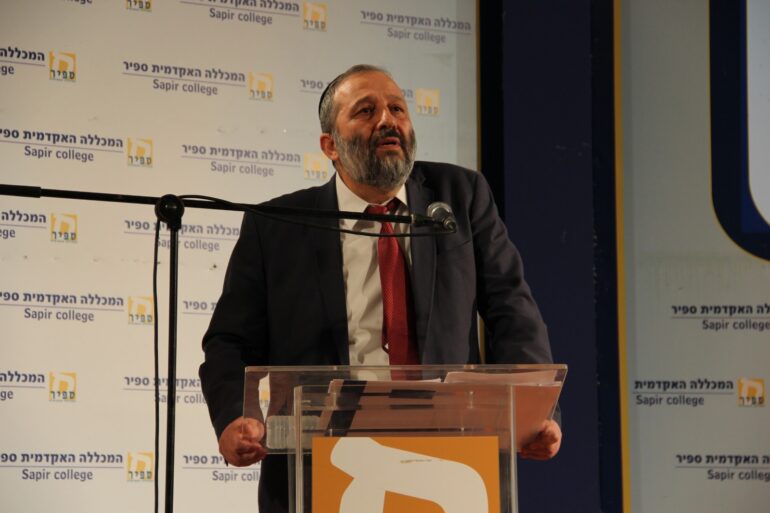
Thus cheered party chairman Aryeh Deri, microphone in hand at the 2022 Shas election party following the movement’s best performance since the passing of its founder and spiritual leader, Rav Ovadia Yosef, nearly a decade earlier.
Today, the Shas party is singing a very different song: the party’s support nearly halved from 11 to 6 mandates in Israel’s recent election.
Deri has reportedly withdrawn from his party’s list for the 26th Knesset and will not serve as a lawmaker in the upcoming term. The party has been battered into somber introspection.
Shas is a fixture of Israel politics, the longest continuously-active political brand outside of the Likud. Simultaneously a Ḥaredi party and a populist movement, the seeming contradiction has really been the secret to its success and longevity.
Shas’s structure as a Ḥaredi party is actually what allows it to be a populist movement. Its reliable Ḥaredi base and structural basis allows Shas to focus outreach on the broader public and messaging on broader kitchen-table issues.
Shas’s strength has long been its balance between being a Ḥaredi party and a populist movement. But when this balance is compromised, the party is fundamentally enervated.
Such was the case after the passing of Rabbi Ovadia Yosef in 2013 and the eruption of a public inter-party battle between co-leaders Deri and Eli Yishai.
While Deri eventually succeeded in stabilizing the party around his singular leadership, filling the void of Rav Ovadia’s ultimate leadership, he failed in maintaining the image of Shas as a rabbinically-led party.
Now without Rabbi Ovadia and the party organized around Deri, was Shas still a Ḥaredi party or just another populist movement? Could Ḥaredi voters still rely on Shas to represent their interests? Could voters from the broader public still trust Shas on social issues?
At the same time, Shas participated in an official capacity in large protests against the Shaked Committee. Was Shas truly a populist movement if it invested the bulk of its energy and resources in securing Ḥaredi draft exemptions, community funding, and sanctions relief; or has its populism just become an aesthetic pretense?
These hanging questions crashed Shas from 11 mandates in 2013 to seven seats in 2015 (after polling below the threshold leading up to that election), slowly recovering to eight mandates in April 2019, nine mandates in September 2019 and 2021, and finally back to 11 mandates in 2022 as that lost trust was rebuilt.
Shas partisans may well be suffering déjà vu: 2026 sure looks a lot like 2015, though even more dramatic.
The backdrop of an inter-party power struggle (now between Deri and Rav Yitzḥak Yosef) and excessive preoccupation with the Ḥaredi draft issue have again brought Shas’s balance into question and its electoral power into a state of collapse.
Shas might be able to heal this imbalance and repair this broken trust as it did after 2015.
Other existing parties like the Likud, Otzma Yehudit, and United Torah Judaism (UTJ) might continue to eat away at Shas’s voter base. There might even be space emerging for a new party in Shas’s image, like Eli Yishai’s failed Yaḥad party in 2015.
Whatever the case, Mizraḥi Israelis appear no longer proud to be Shasnikim, at least not at the moment.
What fills this gap in Israeli politics, be it a revitalized Shas or something else, will remain a major question for the foreseeable future.