The mitzva of hearing Parshat Zakhor is a unique imperative for the people of Israel, appropriate for all generations, in or outside the homeland.
The obligations to hear the commandment to remember what Amalek did to us on our way out of Egypt centers a collective memory that appropriately captures the Jewish historiographic lens. It takes for granted that, while we can’t biologically identify Amalek in our times, the force of Amalek nevertheless represents something powerful and serves a unique function in every chapter of history that pushes it to attempt Israel’s destruction.
For many Israelis, it felt surreal to stand in the Beit Knesset this past Shabbat and recall this ancient foe, while hearing our warplanes flying overhead on their way to assassinate Ayatollah Ali Khamenei.
Israel taking down the Islamic Republic of Iran’s supreme leader just ahead of Purim, as we recall Amalek, is nothing less than a Divine sign – and many Jews appear to fully acknowledge this.
This trend within Israeli society – and even amongst Diaspora Jews – expresses a healthy advancement over the last few years.
Just a decade ago, talking about our obligations regarding Amalek was an uncomfortable topic for many Jews, as it undermined efforts to brand Israel as part of the West. What appears to be a primitive call for genocidal vengeance against an ancient foe felt like a point of tension between Jews and the Western societal norms we strove to ape.
The instinct for many Jews – both in Israel and the Diaspora – to connect the events of this past Shabbat to the reading of Zakhor and to the upcoming festival of Purim is also one that showcases tremendous growth in Jewish identity since the Hamas attacks of Simḥat Torah (October 7) of more than two years ago.
This discourse, however, is also lacking in that it appears to be limited to shallow symbolism.
For many Jews, Amalek was reduced to a caricaturish anti-Semite that we’ve long applied to anyone who threatens us. Hamas took that role in the wake of the Simḥat Torah attacks, in the rhetoric of a growing contingent of the Israeli public, including Prime Minister Binyamin Netanyahu (Likud) himself.
This phrasing actually served as part of the legal case before the International Court of Justice that accused Israel of genocide, as well as a proof of concept for Tucker Carlson, that Israel’s values contradict those of the West in regards to individualism and collective punishment.
For thousands of years, Amalek has served as an evil archetype threatening the people of Israel. From the Exodus from Egypt, to King Shaul’s battle with Agag, to Haman’s rise in Persia, to Hitler’s Nazism in Europe, this historic force serves as a mirror against Israel.
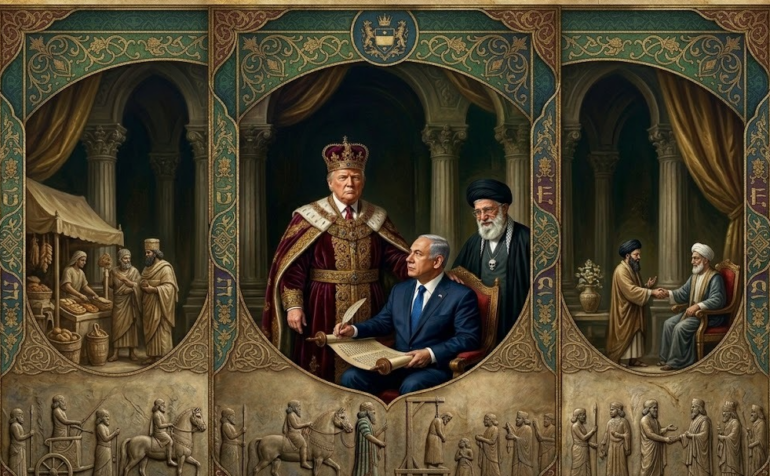
Starting the week of Purim off with the elimination of Iran’s supreme leader certainly promises a sense of short-term comfort. Shortly after Shabbat, one AI-generated image even successfully expressed how many Jews were understanding the situation. In the image, Prime Minister Netanyahu was depicted as Mordekhai. The Aḥashverosh figure behind him resembled US President Donald Trump. And Haman, of course, looked like the Ayatollah.
The caption said it all: “Same story, different cast.”
The setting of Iran makes the comparison even stronger, creating many surface-level comparisons between current events and the Scroll of Esther. Many of them, coming from people who appear to proudly advocate for the dismantling of the Islamic Republic in exchange for one more representative of the ancient Persians.
The problem is that these comparisons miss something fundamental about Megilat Esther and the Purim story, and actually obstruct Israel’s internal liberation. They push us into deeper psychological dependency under the guise of attaining a sense of safety.
Many tenets of the Purim story are negated in Diasporic tellings. After all, it’s a Diasporic story that on the surface appears to have a happy Diasporic ending.
The Jews are saved from the evil poritz, with apparently nominal internal development or growth. In discussing why Israel doesn’t recite Hallel on Purim, our Talmudic sages relate to the salvation as only partial. We were still subjects of Aḥashverosh, and of Persia itself.
In this sense, perhaps the comparisons we’re now seeing are actually more correct than intended.
While some commentaries present Aḥashverosh as simply naive, or a simple-minded ruler, we should understand him as representative of empire itself.
The arc of the story curves the way every exilic story does. At the start, we find Diaspora Jews deeply embedded in the largest and most successful empire of its time. We sat at the emperor’s party – with kosher food! – celebrating the empire’s success at the expense of our own national interests. We adopted Persian names to blend in. Then a dark force arose to destroy us. Finally, the empire woke up, and allowed us to defend ourselves and fight back (after seeing our worth).
In this context, shallow analyses fail us.
The current representative of empire, the quintessential challenger to Israel assuming our rightful place on the world stage, is not in Tehran but in Washington.
Trump embodies this transactional figure of Aḥashverosh, who is happily complicit in the genocide of the Jews until he discovers a good one within the palace that he likes. Aḥashverosh isn’t actually a fool. He represents a “Persia First” policy that, by necessity, conflicts with the Jewish national interest. He’s willing to sell his values to the highest bidder, so long as they don’t undermine his perceived interests. He’s someone who can be used to advance our survival but can’t be a harbinger of actual redemption.
The essence of what Aḥashverosh represents demands a confrontation, but the Jews prefer to avoid one.
Indeed, Purim is a day of great celebration, but one missing Hallel and seemingly incomplete.
Unlike Pesaḥ or Sukkot, it doesn’t celebrate the overthrow of a hegemonic empire from the world stage. It instead commemorates mere survival within the confines of that empire. Should these archetypes hold true today, an ominous picture emerges.
Trump does not want Israel to reconstruct the Semitic region in a way that meets Jewish interests – certainly not in such a way that attains our ancient aspirations or the universal vision of our prophets.
Trump’s interests appear to be military pressure to force a regime to submit to American demands. After the first wave of strikes over Shabbat, the US president offered an immediate ceasefire conditioned on full surrender. He has on the one hand threatened a prolonged war, whilst seeking a quick retreat. This is likely a divergence between Netanyahu’s perception of this war and Trump’s.
Finally, our misunderstandings of the Purim story, and the roles that its archetypes actually perform, have played into a full-throttle acceptance of a Christianized eschatology.
With several nations in our region responding to desperate Iranian strikes on their soil by more overtly joining the US sphere of influence – a sphere many Jews somehow consider to be our own – many in Israel are seeing this as cause for relief and jubilation. Many have bought into the erroneous assumption that the more westernized and US-dependent our region becomes, the closer we come to some “end of history.”
The expectation that Iran should experience the same liberalization that has superficially taken hold in other parts of the region exposes a Jewish adoption of a foreign eschatology. Worse yet, many westernized Jews see that eschatology and worldview as their own. We have been conditioned to see survival within the confines of Aḥashverosh’s world order as redemption itself and don’t recognize the daylight between Jewish and Western visions for what a just world should look like.
The internal national development Israel has experienced in recent years is something we can be proud of. But after the fighting, we must avoid a return to Aḥashverosh’s table. We should instead seek to clarify our own vision for how history should advance by creatively drawing from our own ancient sources.