Why was Moshe slow in returning to the people?
There is, of course, the fact that it takes time to climb down a mountain. But why then did Moshe not receive the Tablets at the foot of the mountain, so that they would be available immediately without any delay?
The answer to this is that there is a par between the ideal and reality, and this is expressed in the physical distance between the mountain peak and the land below.
Moshe is not given the Tablets down below because he is at a higher spiritual level than the nation. The difference between the ideal and reality creates a situation in which a powerful light is trying to enter into a vessel that is not able to receive or hold it. This can be compared to the mystical concept of “shattering the vessels.”
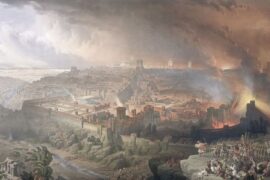
Similarly, when the year 5600 (1840) approached, there was a great tumult in Jerusalem, since it is written in the Zohar HaKadosh that the wellsprings of wisdom would open up in that year and the nation of Israel would experience redemption. But because limited vision prevented the people from seeing that this was in fact taking place, some lost their faith in the redemption and fell away from the people of Israel. With the hindsight of our historical vision today, however, it becomes clear that the redemption did indeed begin at that time, as had been predicted.
This pattern is often repeated in our history.
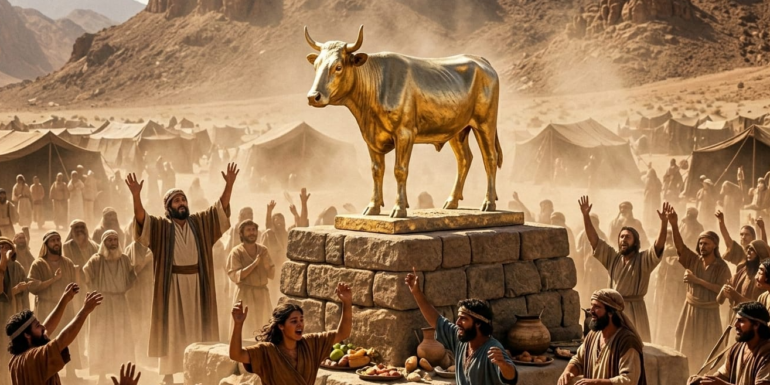
When something important begins, there exists a strong desire to complete it immediately, and any delays lead to despair. The result is that a negative reaction to the process appears – in this case the sin of the Golden Calf.
According to the sages, quoted in the Jerusalem Talmud, the sin of the Golden Calf happened at the exact same moment that Moshe received the Tablets.
The Creator “tried” to take the Tablets back, but Moshe was stronger and held on to them. The reason that he succeeded is that by its very essence the Torah must be given to the people of Israel.
The Torah is the spoken word HaShem to Israel. Speech is meaningless if nobody hears it. And therefore Moshe was able to hold on to the Tablets. If they had been taken away from the people, they would have no longer had any meaning.
The main lesson to be learned from the Golden Calf is therefore that it is impossible to revoke the Divine selection of Israel as the Torah’s receiver, even if the people of Israel commit grave transgressions.
The Maharal of Prague explains why the sin took place precisely when the Ten Commandments were being received, indicating an internal struggle between “HaNivdal” (“the seperate”) and nature.
Nature demands unity, while HaNivdal demands exceptional behavior. This characterizes the struggle between unity and the separate. The unified natural approach cannot tolerate anything that is abnormal and exceptional. The encounter between Moshe and the Creator and the giving of the Torah is an exceptional event from whatever angle it is seen, and nature rises up to ferociously resist it.
Prior to the sin of the Golden Calf, the Creator declares to Moshe that a mal’akh (what’s often translated into English as “angel”) would guide the people of Israel.
Rashi explains HaShem to be telling Moshe in advance that the people would sin, and that HaShem would send a mal’akh instead of leading Israel directly. This implies that the sin of Golden Calf was part of the original plan of giving the Torah. Whenever such a high spiritual level is achieved, it can be expected that serious failure would immediately follow.
Moshe’s descent is delayed because the ideal plane on which he existed couldn’t fully correspond to the level of the people of that generation. Time would be needed to close the gap. But Moshe’s delay and the sin of the Golden Calf demonstrate that HaShem’s choice of Israel isn’t like some human decision that could be revoked or reversed, but rather an act of the Creator that transforms the nation into the “chosen people” – a Divine creation that for all eternity won’t ever change.