
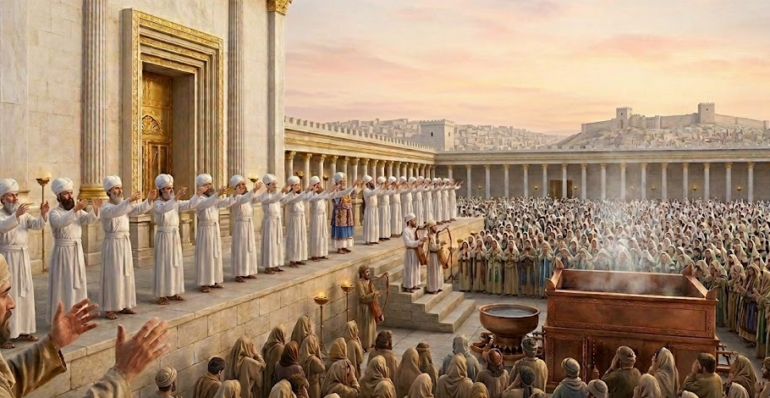
“And HaShem said to Moshe, say to the kohanim, the sons of Aharon, and you shall say to them…” (Vayikra 21:1)
The above verse, which begins Parshat Emor, is problematic. After the words “say to the kohanim, the sons of Aharon,” the verse does not immediately tell us what they should be told. Rather it continues with, “you shall say to them.”
What does this mean?
The answer is that these are actually two statements. The first one is a declaration to the kohanim that they are the sons of Aharon. It is necessary to remind the priests that the reason for their special status comes from the fact that they are Aharon’s descendants.
Since the kohanim are the sons of Aharon, they have an obligation to conduct themselves in a holy fashion that honors the legacy of Aharon and emulates his behavior and traits. The kohanim are noble men, sons of a noble man. Their sanctity stems from their pedigree, and this differentiates them from the rest of Israel.
This is the aspect of the priesthood that is emphasized in Vayikra, also known as Torat Kohanim – the Book of our Torah related to the kohanim.
The Book of Bamidbar, by contrast, relates to the broader nation of Israel and emphasizes the fact that Pinḥas ben Elazar achieved the status of priesthood by defending HaShem’s sanctity, which led to the atonement of the nation. His kehuna was a reward for the benefit that he brought to all Israel, and he became a kohen as a result of his relationship with the nation.
There are two sources for the authority of the kohanim. One is from above, separate from the nation, as we see in Parshat Emor. The other is a level of kehuna that stems from the strength of the nation, as is described in Parshat Pinḥas.
The fact that there is an aspect of the kehuna that is exalted and far removed from the people has positive value. For the kohanim to be empowered with the ability to elevate the people, they themselves must be somewhat external to the nation. The “separate” side of the kohanim is especially necessary to uplift the common folk.
For this reason, what is emphasized throughout Parshat Emor is the separate features of the kohanim and the extent to which they are not involved in what can be called the normal difficulties of life. They are not familiar with death since they have been commanded to avoid contact with the dead. They aren’t meant to have financial concerns, since they are meant to be supported by the people with priestly gifts. They are kept distant from the mental anguish of complicated family dynamics through the prohibition against marrying divorced women.
The ultimate level of all this is expressed through the High Priest, who does not even see death in his own immediate family. He’s not permitted to marry a widow, whose separation from her former husband wasn’t even caused by a spiritual failure, as in the case of a divorce.
The Book of Bamidbar, on the other hand, discusses in detail how to struggle against the difficulties of life, such as those encountered in the desert.
It’s within this context that Pinḥas ben Elazar attained the status of a kohen, due to the merit of his deep connection to Israel and the salvation he brought us. His priesthood stems from the power of the nation and his connection to the people.
Separation from the nation leads to separation from the land. At the “Covenant Between the Parts” Avraham was given a promise that the nation would receive the land of Israel after suffering through slavery as strangers in a strange land.
Because the tribe of Levi was not enslaved in Egypt but its tribesmen did experience being strangers there, they merited to enter the land of Israel with the nation but did not receive a tribal territory.
One tribesman of Levi in particular, our teacher Moshe, was not enslaved and did not even live as a stranger in Egypt, as can be seen from the fact that he lived in Pharaoh’s palace and was identified by Yitro’s daughters as an “Egyptian.” Moshe was so separate from the nation and its collective experience that he couldn’t enter the land.