
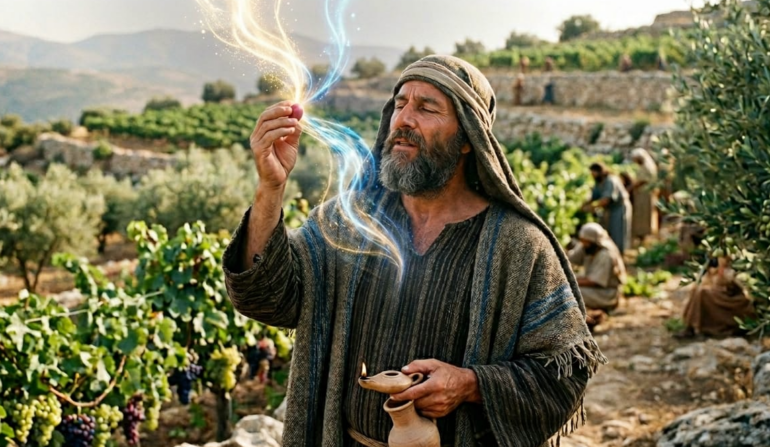
While it is true that in a straightforward reading, the verse “When you come to the land you shall plant any fruit tree” (Vayikra 19:23) is part of the introduction to the commandment of Orla (forbidding the fruit of the first three years of the tree), the Midrash also sees this verse as a statement on its own.
“‘Cling to Him…’ (D’varim 13:5) – From the beginning of the creation of the world, the Kadosh Barukh Hu occupied Himself first with planting. As is written, ‘And HaShem G-d planted a garden in Eden’ (B’reishit 2:8). So, when you enter the land occupy yourselves only with planting, as is written, ‘When you come to the land you shall plant any fruit tree.'” (Vayikra Rabbah 25:3)
We are used to understanding the concept of clinging to HaShem as carefully emulating His traits (Sifre Ekev 49) or as staying close to Torah scholars (K’tuvot 111b) – esentially through spiritual activities. But here we see a style of “clinging” through planting.
Forming a link with the Divine through nature is not an obvious feature of Hebrew culture and practice. Our ancient efforts to distinguish ourselves from the pagan world, which deified nature and turned humans into mere natural creatures without any connection to morality or self-awareness, has been an important facet of Israel’s existence and identity for thousands of years.
On the other hand, our understanding of the unity of existence requires us to recognize HaShem’s presence in everything that surrounds us.
This is the foundation of the holiness of nature, which operates in such a way that’s concealed in our world.
HaRav Avraham Yitzḥak HaKohen Kook teaches that the need for holiness to appear in nature is actually the inner cause for the phenomenon of so many Jews rejecting our sacred laws and traditions during the process of Israel’s national reawakening. And this was of course met with fierce backlash from the rabbinical establishment, representing “normal sanctity,” that struggles against nature. (Orot HaKodesh II, General Sanctity, chapter 23)
But because both of these movements drew their sustenance from the same roots – the “exalted sanctity” – neither one could ever defeat the other.
In a way, this is similar to the war between the Leviathan and the Wild Ox at the end of days, when they will both fall and be served at the banquet for the righteous souls, who watch the unification of these two levels of holiness from the sidelines.
On a personal level, everyone encounters the sanctity of nature by reciting a brakha over food.
Rabbi Akiva derived the obligation to recite a brakha from the phrase in this week’s Torah portion, “sanctified for praise” (Vayikra 19:24), with reference to “Neta Rev’ai” – fruits of the fourth year (Brakhot 35a).
The first three years during which a person abstains from the desire to eat in a natural way gives him a level of sanctity that lifts him up above nature. And this is the point of departure from which he recites a blessing for the food. A brakha is not a way of making the food holy, as the other nations often assume, but rather a way of removing the food’s sacred character.
In the Midrash quoted above, it is written: “Do not read the word as ‘hilulim’ (‘praise) but rather as ‘ḥilulim’ (‘not sacred’).”
The brakha removes the natural holiness of the food, which would have otherwise resulted in someone eating it violating the prohibition of making use of something holy.
The blessing instead removes the holiness so the food can be eaten.
This is why our sages teach us that “anyone who enjoys the pleasures of this world without reciting a blessing has sinned by partaking of something holy” (Brakhot 35a).
When food is eaten in a proper and moral way, it becomes holy with the sanctity of the human soul, as is described in the verse, “and you shall eat, you shall be satiated, and you will bless HaShem” (D’varim 8:10), by virtue of the brakha after eating. And this completes the cycle combining the sanctity of nature that exists before the first blessing with the sanctity beyond nature realized through reciting the “after brakha.”