
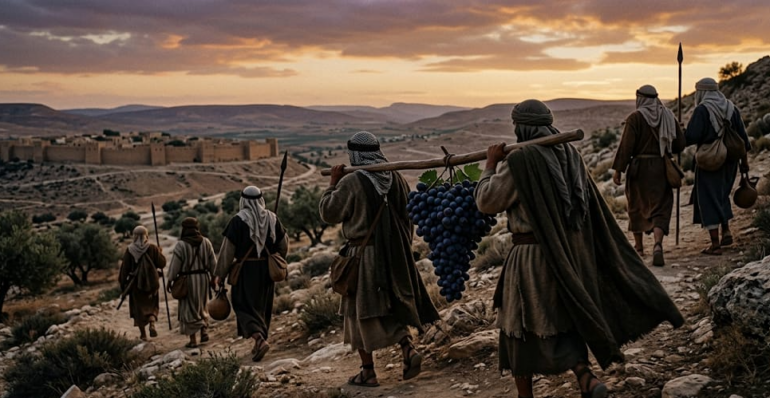
The episode of the spies is one of the greatest tragedies that has ever befallen our people.
Five terrible events happened to our people on the ninth of Av, and one of them was that it was decreed that our ancestors would not be permitted to enter Eretz Yisrael.
How can it be that ten of the most prominent leaders of Israel, who were considered great and holy men even in the era of Moshe, would become “disgusted with the desirable land” (Tehillim 106:24), and lead others in committing a terrible transgression?
The sin of the spies is more serious than other sin. Most transgressions are rooted in an attempt to “jump the gun” and rush the Divine plan – to cause an event to occur earlier than it’s meant to happen.
In the sin of the Golden Calf, for example, the people wanted the Sh’khina to appear earlier than the proper time. Likewise, Adam sinned by eating from forbidden fruit before it became permissible.
But a transgression of seeking to delay the Divine plan, such as in this case, when the proper time has arrived and the people didn’t want to partake of the good fruits of the land, shows that the people were apathetic and disconnected from Israel’s historic mission.
This is why the sin of the spies is such a serious matter.
The motivation of the spies was different than that of the people. They were important men, heads of their tribes, guided by spiritual considerations. They feared that becoming involved in managing a real country could bring the people to a state that would make them forget HaShem, and that they would not be able to attain any spiritual renewal after such a lapse.
The spies therefore felt that it would be preferable to continue living in exile rather than to contend with the real life difficulties of living in the land and running a society. While praiseworthy in certain contexts, this fear proved detrimental. It also reveals a lack of emuna on their part.
According to the holy Zohar, the spies sinned because they knew that in the new land Moshe would appoint new leaders who would replace them as heads of their tribes.
This was not a simple desire to maintain power, but rather a deep understanding that there are two types of leaders for the nation of Israel – those who are suitable for a time of exile and those who are suitable for dynamic national life in Eretz Yisrael.
Because the spies deeply loved the people and saw themselves as the best possible leaders for their tribes, they feared that the new leadership appointed in the land would not be as beneficial for Israel. They therefore supported as a “temporary ruling” that it would be best not to observe the commandment of entering Eretz Yisrael, so that they could continue to responsibly lead the nation.
In order to convince the Israelite masses that it was not in their interest to enter the land, the spies – for the first time in history – made use of the claim that “personal safety takes precedence over settling Eretz Yisrael.” In a war, people can be hurt, heaven forbid, and since the threat of mortal danger overrides all the mitzvot of the Torah, this war should not be fought.
Due to this, the spies were severely punished.
The Torah presents us with the erroneous claim that preserving life takes precedence over conquering our land so that we will know how to deal with it later in our history.
Yehoshua and Kalev were right when they said that the commandment to wage war takes precedence over any fear of mortal danger. They presented a minority legal position, opposed by most of the prominent men in the nation.
“Let us rise up and take possession of it.” (Bamidbar 13:30)
In a way that is different from how halakha generally works, the final ruling in this case follows the opinion of the minority – that the conquest of the land is a Torah obligation.
When the nation returns to the land, Yehoshua and Kalev are the leaders because of their strengths. They are from the tribes of Yehuda and Ephraim, and they carry within them messianic strength – Mashiaḥ ben Yosef and Mashiaḥ ben David.
They renew the honor of the nation and the honor of those who study Torah in the era of the redemption.