How do you create a socialist society in a non-socialist world?
The prevailing answer to this question following the Russian revolution, and especially after the death of its leader Vladimir Lenin in 1924, was “socialism in one country.”
The Union of Soviet Socialist Republics unilaterally sought to develop itself towards socialism through the worker’s dictatorship, and would thereafter serve as a living model for other countries to emulate.
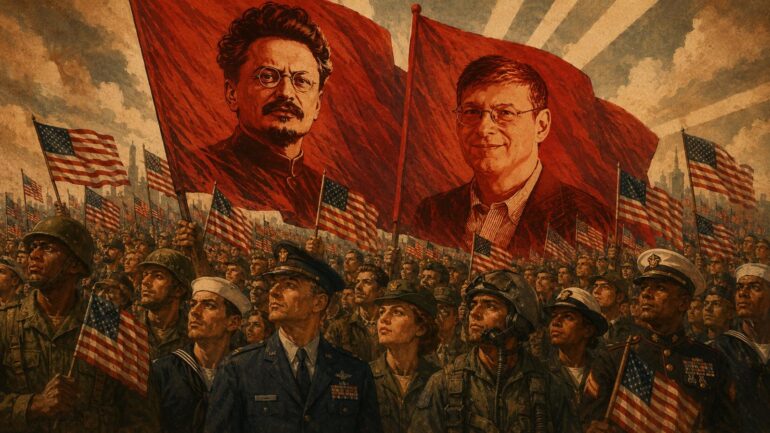
Dissenting against this view was Leon Trotsky, who argued that such a task was impossible to achieve and counterproductive to attempt.
Trotsky fiercely opposed the centralized economic and political planning of the worker’s dictatorship as authoritarian and reactionary deviations from the socialist path, instead asserting the theory of “permanent revolution” – the necessary liberation of the entire world from reactionary rule before socialism could be possible.
In this spirit, many US-based students of Trotsky broke with the political left in the late 1960s to support Washington in the Vietnam War.
This specific cadre of Trotskyists, many of them members of the Congress for Cultural Freedom, began to see the United States as the tool for permanent revolution, a liberal bulwark against “reactionary” or “authoritarian” forces around the world, from Vietnam to Iraq.
In breaking with the left over Vietnam, these thinkers began to be referred to as “neoconservatives.”
A rift within the neoconservative movement opened during the George W. Bush presidency over immigration during its sporadic attempts at amnesty and reform between 2005-2007.
Some neoconservatives began vocally adopting the demographic skepticism of their traditional conservative counterparts, arguing that the American political culture and institutions they so highly valued would not survive a rapid demographic overhaul.
This demographic-skepticist, immigration-hawkish, tepidly-nationalist undercurrent within the neoconservative movement eventually matured into the national conservatism put forward by Yoram Hazony.
Hazony, a student of preeminent neoconservative Irving Kristol, has elevated “the virtue of nationalism” for the West, and most of all for the US, to equal importance in which earlier neoconservatives assigned to “Iraqi freedom” or “Vietnamization.”
Ultimately, it’s the same principle applied inward: that it is in the interest of nations to self-determine free of interference, be that from authoritarian rule or from demographic or cultural displacement.
There is therefore no more precious national identity – which Hazony incidentally defines not on the basis of natio (a birth, origin, tribe, breed, or race) but as “a number of tribes with a common language or religion, and a past history of acting as a body for the common defense and other large-scale enterprises” – than American national identity, which can be distilled in the “common defense” of democracy around the world, from Berlin to Baghdad; the father of nations, the national identity which makes all other national identities possible.
This uniquely Jewish political tradition, which has evolved from Trotskyism to neoconservatism and now national conservatism, is the synthesis of two contradictory dispositions in the Jewish psyche – the messianic desire to perfect the world and the diasporic aversion to political power.
Israel now faces the same basic problem the Soviet Union faced in its inception: how do we create a just and good society in an unjust world?
Many Jews, armed with messianic desires and diasporic aversions, take the route of Trotsky and his intellectual offspring, declaring this task impossible and any attempt a self-defeating authoritarian deviation. Instead, Israel should join the American-led permanent revolution, investing itself in the global fight for “democracy.”
But Israel deserves to be more than a mere cog in the US imperial machine, an imperialism which structurally seeks to maintain Israel in a Semitic region suspended in chaos and existential insecurity.
The neoconservatives and national conservatives represent successive stages of the same error: substituting US imperial momentum for genuine national development, in the name of permanent revolution, democratic liberation, and national identity.
But none of these actually serve Israel or the world.
Eight decades after attaining independence, Israel must shed its diasporic aversion to power and invest in what this tradition has always deferred: the creation of “a kingdom of priests and a holy nation” – a just society in one country, national in form and international in content, a living realization of the Torah’s vision that can serve as a genuine social compass rather than a cog in the US imperial machine.