On the face of it, the date of the Sukkot festival appears to be out of place.
The Torah teaches us that the purpose of Sukkot is “so that your later generations will know that I caused the children of Israel to dwell in sukkot when I took them out of the land of Egypt” (Vayikra 23:43).
This could be a hint of the event that is described in Parshat Bo: “And the children of Israel traveled from Raamses to Sukkot” (Sh’mot 12:37), implying that the people sat then in sukkot (temporary huts).
This is true whether we accept the word at face value as meaning physical huts or if we say that it refers to the “Clouds of Glory” (which is the subject of a dispute between our sages). Either way, this event took place on the 15th of Nisan, on the holiday of Pesaḥ when Israel went free from Egypt.
Therefore, we might assume that Sukkot should take place during Pesaḥ. Why has it been delayed for a full six months?
To answer this question, we note the fact that the festival of Pesaḥ emphasizes the distinction between Israel and other nations. On Pesaḥ we reject the negative features of the other nations (especially our historic enemies).
“Pour out Your wrath on the nations that do not know You and on the families that do not call out in Your name.” (Yirmiyahu 10:25)
But Sukkot, by contrast, is a universal holiday when we invite the other nations to participate in the festivities. All of the nations are prophesied to ascend to Jerusalem on Sukkot. During historic periods when the Temple stands, we even bring seventy sacrifices on the festival in order to atone for actions of the seventy primordial national identities of humanity.
This implies that Sukkot is the equivalent of Pesaḥ for the other nations of the world.
If the proper conditions had existed at the time of Israel’s Exodus from Egypt, all the nations of the world would have been rescued from their internal bondage at the same time, and Sukkot would indeed have taken place at the same time as Pesaḥ.
The universal festival would have been combined with Israel’s national holiday.
But since neither Israel nor the other nations were ready for for this to take place at that time, complete redemption was delayed until some future date, and the holiday of the nations takes place in Tishrei, just after the universal new year for humanity.
The Hebrew calendar consists of three time periods marked by our pilgrimage festivals:
1. Pesaḥ celebrates Israel’s liberation from Egypt in the past.
2. Shavuot marks the giving of the Torah, which takes place anew every single day, in the present.
3. Sukkot marks a future event – the redemption of all humanity at the time that Israel fulfills our unique historic mission.
There is also an additional issue worth considering.
In order for Israel to reconcile with the other nations, leading to the elevation of all the souls of humanity, there is a need to pass through the Days of Awe as a means of erasing all our transgressions and failures.
Only once the sins of humanity are removed can Israel reconnect with the other nations and return to living according to the world’s natural order.
Israel has struggled against nature for thousands of years, largely due to the fact that the peoples and cultures with the strongest affinities to the natural world were most often the most prone to idol worship.
Only at the end of days will it be possible to safely experience and connect with the spiritual power of nature in a holy appropriate fashion.
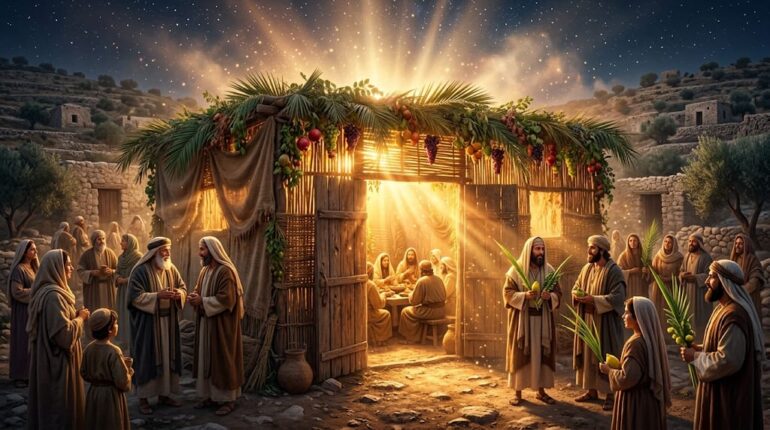
The central rituals associated with Sukkot involve a reconnection with nature. The waving of fresh branches and living in a temporary hut made from natural materials is an effort to reunite with the holiness within nature.
These great primordial lights are being preserved for the future when it will be possible to fully reveal them.
Translation by Dr. Moshe Goldberg