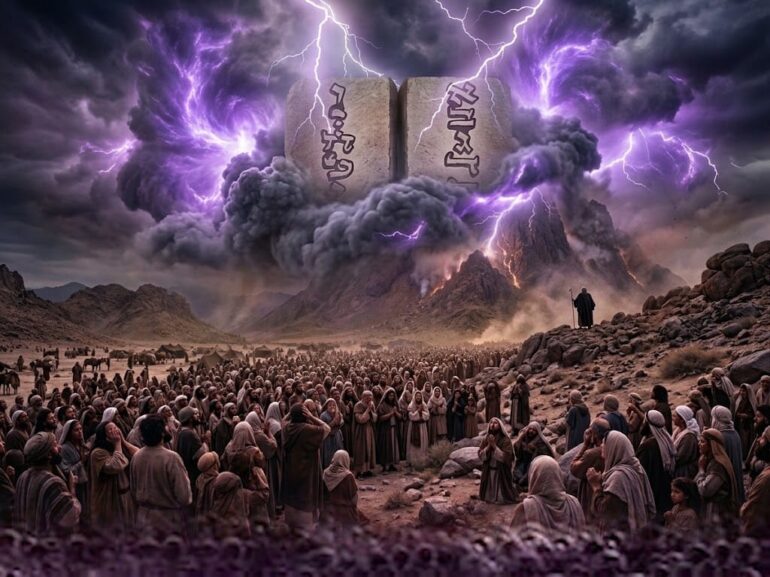
At Sinai, the Torah was given from heaven and not from the earth.
A tremendously powerful Divine voice emanated from the mountain peak. In order to avoid the threat of death, the people couldn’t climb or even touch the edge of the mountain.
When the Torah is given in such a way, it creates more fear in the soul than love. It generates trauma. The life conditions and level of human awareness that existed at that time were evidently such that no other way of giving the Torah was possible.
According to our sages, the Torah was lowered into our world before its proper time – that is, before conditions existed for fully integrating the Torah into life, without any feeling of coercion or sense that the Torah makes demands that run counter to natural human instincts.
If Divine guidance had waited another 974 generations, not only would the Torah have been received in a state in which humanity could fully identify with it, but the human soul would have actually had no need for external revelation. Rather, the mitzvot would have been observed without an explicit giving of the Torah, as in the time of the forefathers, who observed the entire Torah before it was given to us.
Rav Sa’adya Gaon explains that the reason for moving up the time of the Divine revelation was to prevent a long period of suffering that would have been the fate of humankind if the Torah had not been lowered into our world when it was.
But this means that it was also necessary to balance the traumatic event at Sinai with another event, which could potentially heal the damage caused by holding the mountain over the heads of the people (the first event took place outside of the Torah’s natural habitat).
This was the gathering that took place on Mount G’rizim and Mount Eval, which the Torah describes in Parshat Ki Tavo. Here, everything is flipped upside down. The people are at the top of the mountains, and the voices – human voices that emanate from the mouths of the Leviim – burst out from the earth.
This shows that the Torah of Eretz Yisrael stems from earthliness, from the vitality of life itself, without any sense of external coercion. This is a type of Torah that enhances our belief in our ability – after hearing the Divine word at Sinai – to coordinate our limited human understanding with that of the Creator.
The dual sources of the Torah, from heaven and from the earth, correspond to two sources of holiness that are described by HaRav Avraham Yitzḥak HaKohen Kook (Orot HaKodesh II, General Sanctity, chapter 23).
On the one hand, there is the “normal” form of sanctity that fights against nature. On the other hand, there is the perfection that will come about at the end of days due to the action of the “sanctity of nature” that will defend its position with great valor after having been shunted aside during our long period of exile.
In a way, this has led to the rise of the “secular” parts of our society that often speak in the name of having a “normal life” and doesn’t realize that its own driving force is the holiness hidden within nature.
In the end, both types of sanctity will achieve peace with each other and they will recognize that they share a common root.
Thus, those who received the Torah from heaven will recognize the wealth hidden in those who received it from the earth, and those who received it from the earth will lovingly accept the life-giving power embodied within the revelation of the heavenly Torah.