Since the collapse of the Soviet Union, the American State Department and CIA have worked tirelessly to undermine regimes in Eastern Europe, Asia, Africa, and Latin America that Washington deems uncooperative with the geopolitical interests of US global hegemony.
These efforts, which spawned a series of anti-governmental movements with varying degrees of success across the last 35 years, have been labeled by political scientists as “color revolutions” after the Georgian Rose Revolution, the Ukrainian Orange Revolution, and the Kyrgyzstan Tulip Revolution, each adopting a color or symbol as the flag of the resistance movement.
While not identical to the color revolutions, the Arab Spring protest movements in Egypt, Tunisia, Libya, Syria, and Yemen also received considerable material support through USAID, NED, and other NGOs, as well as political support from US President Barack Obama.
Additionally, the current conflicts in Syria, Yemen, and Ukraine have all been shaped by US involvement in the internal affairs of these countries.
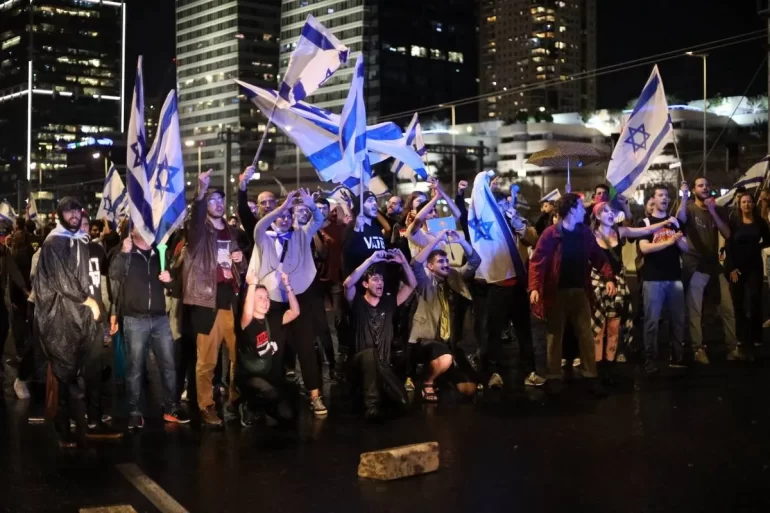
It is thus unsurprising that the House Judiciary Committee recently found that President Joe Biden’s administration was actively involved in funding NGOs that provided material support for the protests against Prime Minister Binyamin Netanyahu (Likid) and his government over the 2023 judicial reform legislation.
While many Americans and Israelis were shocked to learn that Washington would interfere so brazenly in the internal politics of an “allied” nation, breaking the mold of merely targeting unaligned states like in the color revolutions or the Arab Spring, those who’ve been watching Israeli politics for decades simply see this as a repetition of President George H.W. Bush’s 1992 effort to remove Prime Minister Yitzḥak Shamir (Likud) from office, President Bill Clinton’s 1999 effort to oust Netanyahu, and Obama’s failed 2015 attempt to do the same.
There’s also strong evidence that the political crises that destabilized Netanyahu’s coalition in 2019 and led Israel to four consecutive election cycles in two years was the work of Avigdor Lieberman (Yisrael Beiteinu) on behalf of Donald Trump.
But there are a number of key differences between previous US attempts to unseat Netanyahu and the most recent campaign.
Under Clinton, the US administration maintained deniability by sending James Carville, who had served the White House as a private contractor but was not officially sent by them.
Obama’s V-15 effort focused on voter mobilization, which gave his administration the ability to claim that they were apolitically supporting democracy, getting people to the polls without telling them who to vote for.
Under Biden, however, the report has shown that the State Department and USAID – both official organs of the US government – sent funds (often through multiple intermediaries) that was spent directly on training and organizing anti-government protests.
The report alleges that Blue and White Future received $4 million for protest activities and that the Movement for Quality Government received $42,000 for “Civic Activism Training” in Israeli schools. These two movements were among the largest and well recognized organizers behind the anti-government protests.
US-based organizations funded by USAID and the State Department passed on even larger sums to Israeli protest organizers, with the New-York based PEF Israel Endowment Fund contributing a whopping $884 million to Israeli protest organizations (including Blue and White Future and the Movement for Quality Government).
While these organizations have been quick to downplay the impact of US government funding, arguing that the sums received indirectly through the Biden administration are dwarfed by those contributed by private donors, only further investigations will reveal the full extent of the White House’s involvement in efforts to halt Israeli legislation and apply pressure to undermine the results of Israel’s democratic elections.
But if we are to learn from the color revolutions and the Arab Spring, it’s important to highlight not just material funding, but also political cover provided for the protests.
In May 2023, Washington conditioned brokering an Israeli-Saudi normalization deal on the Netanyahu government halting the judicial reform legislation.
At the height of the protests against the reforms, Tom Friedman wrote an op-ed in the New York Times, quoting Biden, saying, “His message to the Israeli prime minister and President could not have been clearer: Please stop now. Don’t pass anything this important without a broad consensus, or you are going to break something with Israel’s democracy and with your relationship with America’s democracy, and you may never be able to get it back.”
He further explained his agreement to do the interview as an effort to “make sure that Biden’s position is crystal clear to all Israelis.”
Days later, at the Aspen Security Forum, Secretary of State Anthony Blinken justified Biden’s comments, arguing that because the US and Israel are such close allies, “we share the concerns we have [about the judicial reform] with Israel.”
Of the protests he said, “We have seen Israeli democracy in all of its vibrancy. It is telling a remarkable story right now.”
Two years later, US support for Israel’s anti-government protest movement and its goals gains new meaning.
Like the Arab Spring, and the color revolutions before it, Israel’s judicial reform demonstrations join a string of other anti-government protest movements with alleged connections to the State Department, USAID, and NED, such as the protests in Belarus against President Alexander Lukashenko, protests against the “morality police” in Iran, and protests in Peru that ousted socialist President Pedro Castillo.
In all of these cases, whether Washington’s involvement has been proven or not, the confluence of interests between the protestors and US foreign policy is glaringly apparent.
When it comes to Israel, US interests are also clear.
Washington sees Israel’s supreme court as a means of maintaining cultural and political influence over Israel, despite the country’s demographic trajectory.
At the centerpiece of US foreign policy in West Asia has long been partitioning Israel into two separate states – each dependent on Uncle Sam for survival. While the Israeli public has grown increasingly hostile to the notion of a “two-state solution” in recent years, the supreme court represents an increasingly shrinking bourgeois elite that still supports the policy.
This ruling class that sees itself represented by the court is also deeply invested in promoting Western cultural norms in Israeli society and maintaining the US-Israel relationship that grants Washington a certain degree of control over Jerusalem.
It therefore stands to reason that the Americans would want to protect Israel’s supreme court from any legislative efforts to weaken its power or limit its independence.