Pesaḥ Sheni – the Korban Pesaḥ brought by Israelites who missed their first opportunity on the 14th of Nisan – differs from all the other mitzvot in our Torah.
“And there were men who were ritually impure because of contact with the dead, so they could not bring the Pesaḥ on that day… And those people said to him [Moshe]… Why should we be left out and not be able to offer HaShem’s korban at the proper time among the children of Israel?” (Bamidbar 9:6-7)
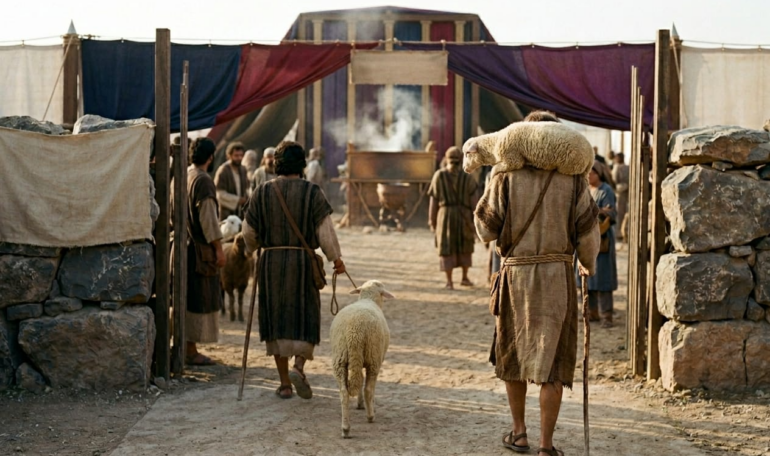
In order to alleviate their distress, the Torah commands that whoever cannot bring the Pesaḥ on the 14th of Nisan (the date we’re officially commanded to bring it), because they are either ritually impure or far away from the Temple, can bring it a month later on the 14th of Iyar.
By contrast, we do not find that a person unable to dwell in a Sukkah on Sukkot is permitted to do so later on. Or that a person forced to eat on Yom Kippur observes the fast at a later date.
Our sages teach that “if one is prevented from fulfilling a mitzvah, the Creator does not hold him responsible” (Avoda Zara 54a). If so, why should a person be obligated to bring a replacement sacrifice? What would be so terrible if a person simply misses the Pesaḥ because he or she was prevented from offering it by circumstances beyond their control?
The answer is that this case is unique, in that “one must see himself as if he has personally been freed from Egyptian bondage” (Rambam, Hilkhot Ḥametz U’Matza 7:6). And this takes place on the seder night, as part of celebrating the Pesaḥ festival.
But one who does not experience liberation from Egypt cannot be part of the nation of Israel, so to speak, and therefore cannot receive the Torah. He therefore has until the festival of Shavuot to correct the situation and to once again become part of the nation.
The initiative of the people to compensate for the incomplete observance of Pesaḥ takes place in the month of Iyar, on the day of the month when the initial Pesaḥ took place in the month of Nisan. The redemption on Pesaḥ was the result of an awakening from above, “I am HaShem – I and nobody else” (Pesaḥ Haggadah).
The time of the redemption in the following month, Iyar, was set by the request of the people, from below, which thus achieved its freedom as a result of its own initiative.
Based on this “Torah festival” in the month of Iyar, we also have “rabbinical festivals” which mark days in modern times during which we gained our liberation – Yom HaAtzmaut and Yom Yerushalayim.
Here again, a person might claim: “Because of circumstances, I cannot join in the efforts to achieve freedom… ‘A man who is impure or is far away’… (Bamidbar 9:10)”
From a nationalist perspective, “impurity” and “distance” can be viewed symbolically. National impurity could be a matter of transgressions and unworthiness. When the nation is full of sin, we cannot attain liberation. Another possibility is that we are in fact pure and worthy but far away, in a place that’s geographically far from our land.
A nation that cannot attain its independence in such cases can excuse itself and not incur blame for the consequences. But the Torah warns us not to give in to ideological temptation.
“But a man who is pure” – one who is privileged to be pure, observing the mitzvot and being filled with the fear of heaven – “and is not far away” – who lives in Eretz Yisrael – “and refrains from making the Pesaḥ” – but still does not desire independence… has thus cut himself off from the historical fate of the nation. A very harsh punishment is described in the verse: “That soul will be cut off from its nation.” (Bamidbar 9:13).
But even in a situation of ideological distance from the desire for independence, it’s still possible to repent, as is written in the holy Zohar (B’haalotkha) – the Mashiaḥ will also cause the righteous to repent.