
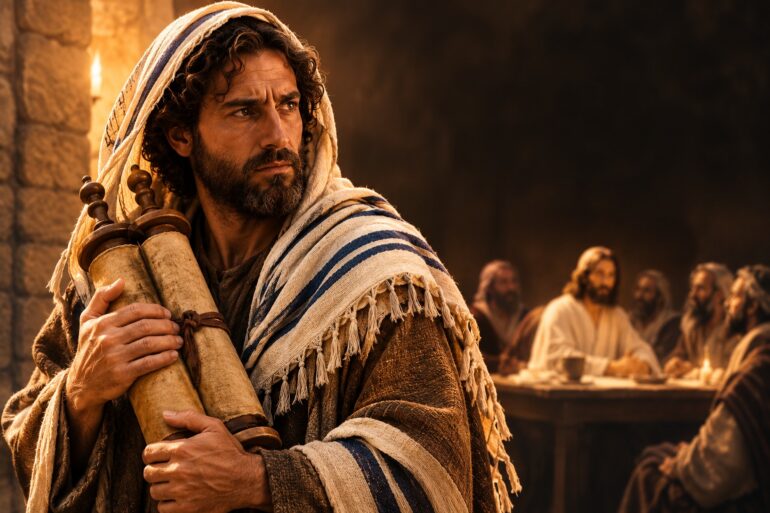
For nearly two thousand years, the Christian church has presented Judas Iscariot as the embodiment of Jewish betrayal.
He was portrayed as greedy, deceitful, disloyal and willing to sell his own teacher for thirty pieces of silver. He was even given the name Judas, closely resembling the name of the House of Judah. His character became a vehicle through which centuries of Christian anti-Semitism was perpetuated.
But what happens when we examine Judas – or rather Yehuda – through the values of the Torah rather than through a Christian narrative?
Throughout the Gospel accounts, we encounter a disciple who was willing to question his teacher. When expensive perfume was used to anoint Jesus, Yehuda questioned why it had not been sold and the money distributed among the poor. Rather than engaging with the legitimacy of his objection, the Gospel of John immediately characterizes him as a thief.
His concern for tz’daka is transformed into an accusation of greed.
By the night of the Last Supper, the Christian narrative increasingly presents Jesus in idolatrous terms. Imagine Yehuda sitting at that table, listening to his own teacher speak, recognizing that the movement he had joined was crossing into idolatry very quickly.
What was Yehuda expected to do?
D’varim 13 explicitly commands us not to follow a prophet who leads us towards the worship of another, regardless of the signs and wonders he performs. It further prohibits us from concealing such conduct, even when it comes from someone as close as our own soul.
Vayikra 24 establishes the precedent of bringing a blasphemer before the appropriate authorities for judgment.
Yehuda handed his teachers over to the sages – the Torah authorities. He followed the proper channels and placed the matter before those entrusted with administering Jewish law.
Up until this point, Yehuda had been taking note of the issues he witnessed, but the Last Supper was the final straw. It confirmed his suspicions that he might have been following an idol.
Where then was the betrayal?
The Christian narrative requires Yehuda to have acted out of greed. The thirty pieces of silver became central to his character, reinforcing the anti-Semitic stereotype of the money-hungry Jew. Yet we have no independent evidence that Yehuda was motivated by money or that such a transaction ever occurred.
If Yehuda was indeed a historical figure, rather than simply a literary construction of the Christian narrative, we should consider another account of his character.
A Jew who questioned his teacher. A Jew who refused to allow “miracles and wonders” to supersede the Torah. A Jew who recognized the danger of idolatry and possessed the conviction to walk away from everything he had become part of.
Perhaps the student understood the Torah better than his own teacher.
For those of us who have left Christianity, there is something deeply familiar about this reading of Yehuda’s story. We understand what it means to question teachings we once accepted, to recognize idolatry, to abandon deeply held convictions and to truly return to HaShem.
We also understand what it means to be called a traitor for doing so.
It is time we reconsidered Yehuda, not through the Christian accusations that have defined him for centuries, but through the Torah against which his actions ought to be measured.
Perhaps Yehuda deserves to be remembered as a symbol of tshuva, spiritual conviction, and the courage to reject idolatry – regardless of the personal cost.
Christianity remembers him as the disciple who betrayed Jesus.
Through the eyes of emuna, we can remember him as the disciple who refused to betray HaShem.
And in the spirit of tshuva, that is the Divine spark inside a dark place.