
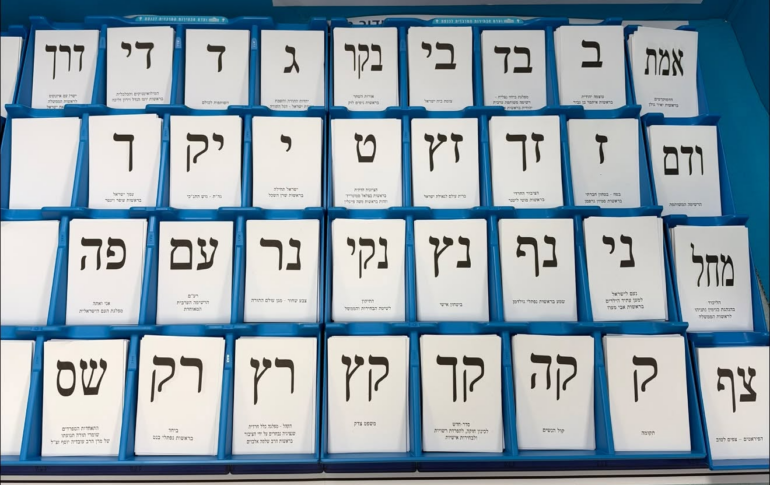
With Tuesday’s national election behind us, it’s a good time to take stock of how much Israel has advanced since the 2022 election and to explore what possibilities exist for the foreseeable future. On the surface, it appears as if no one truly won.
The current coalition, led by Prime Minister Binyamin Netanyahu (Likud), fell to 53 mandates – nine shy of the 61 that would enable them to form a new government.
The opposition bloc also underperformed, gaining only 48 parliamentary seats.
Palestinian parties, meanwhile, won an outstanding 19 seats. But what they’ll be able to do with this newfound strength remains to be seen.
After the horrific Hamas attacks on Simḥat Torah/October 7, 2023 – which should be primarily attributed to the 2005 Disengagement policy and the broader two-state paradigm – and three years of war, we see that Israeli society has developed in a healthy direction.
The campaign messaging from nearly every major Jewish party was a clear rejection of the international community’s two-state agenda.
To fully appreciate the significance of this, it should be noted that only a decade ago, overt rejection of dividing the land – something aggressively pushed for by the United States and its allies for over half a century – would lead to an Israeli politician being considered “fringe” and “unserious.”
But with the notable exception of the Democrats party, which won only eight mandates, these elections saw overwhelming rejection of the “two-state solution” from across the spectrum of Jewish political factions.
The extent to which most of the opposition parties presented themselves to the voters as representing what was until recently considered a hardline nationalist position says a lot about where the Israeli public – and our Overton window – has shifted.
The core issues dividing Israeli society are no longer territorial or security related but more about identity.
What kind of state should Israel be? A liberal Western nation-state that functions as a “villa in the jungle” (as Ehud Barak once infamously remarked) or a deeply Jewish state that could potentially integrate into the broader Semitic region?
Those who voted for the current coalition did so because they’re for the most part pleased with the changes of the last four years, including the efforts to reform Israel’s judicial system, and would like to see these advancements continue.
Those who voted for Jewish opposition parties largely did so because they’re genuinely concerned over the direction Israel is moving in and hope for what they call a “return to sanity.” They essentially want to see Israel as a liberal Western state fully integrated into the [crumbling] American-led global order without having to submit to US demands to surrender the mountains overlooking Israel’s densest population centers (mountains that also constitute the cradle of Jewish civilization).
What’s important to note is that these election results represent the absolute best the opposition bloc could hope for.
Naftali Bennett, Yair Lapid, Gadi Eisenkot, Avigdor Lieberman, and Yair Golan ran great campaigns (in the case of Bennett and Lapid, this required Lapid’s invisibility). A number of small parties that would have likely joined Netanyahu’s coalition failed to cross the electoral threshold, costing the coalition bloc a few seats. And nearly 100,000 Israeli citizens living abroad actually flew home to “save Israel” from the current government and the sociopolitical trajectory it represents for the country.
What the Jewish opposition factions and their voters need to internalize is that the Sate of Israel has already changed to the point where the coalition that’s served the public for the last four years should be seen as the new norm for the foreseeable future.
With a combined 48 seats, the opposition bloc has no serious path to forming a government – unless they’re ready to commit political suicide by leaning on the 19 mandates held by Palestinian factions. But this option seems increasingly unlikely after reports earlier today that Qatar may have invested significant funds to mobilize Palestinians with Israeli citizenship to vote.
Supreme Court Justice Noam Sohlberg, chair of the Central Elections Committee, wrote a letter to Shabak director David Zini dated Wednesday, instructing his agency to investigate these suspicions.
But despite the fact that Prime Minister Netanyahu has the largest bloc of factions supporting him at Israel’s helm, he still lacks the necessary 61 seats to replicate the government of the last four years.
Netanyahu now has two clear options.
If he wants to strengthen his bloc’s numbers in order to replicate the current coalition, he will need to find a way to take the nation back to elections as soon as possible. Another round will likely see a higher turnout in the Ḥaredi community, a lower turnout among Palestinian citizens, less small parties in the race (perhaps Betzalel Smotrich might include Ofir Winter and Avi Maoz on his list), and significantly less Israelis abroad flying in to vote.
But if he prefers to lower domestic societal tensions and make life easier for himself with foreign governments and Diaspora Jews, the prime minister will likely form a unity coalition together with Bennett, Lapid, Eisenkot, maybe Liberman, and hopefully Smotrich.
Assuming the prime minister intends to continue quietly working to bury the “two-state solution” and achieve greater independence from Washington, he would likely have an easier time accomplishing these goals without his “natural partners” – Ben-Gvir, Smotrich, and the Ḥaredi factions.
Excluding the Ḥaredi parties from his government would likely lower domestic tensions. For years, the Israeli media and opposition have relentlessly hammered at the fact that the Ḥaredi sector takes disproportionately from the public pie and benefits from a stronger welfare state than Israel”s other tribes, while not doing their part to carry the nation’s economic and military burdens.
While this is certainly a fair critique, it’s not something that can be fixed through brute force from the state. In fact, any attempt to coerce young Ḥaredi men into the army will only be met with fierce backlash because the Ḥaredi public genuinely believes that the Zionists seek to “fix” them through a military service that would weaken their commitment to Torah and Jewish tradition.
The Ḥaredi draft issue took center stage in the Israeli political discourse for much of the last three years, not because anyone actually has a real plan to force Ḥaredi men into the army but rather because the media and opposition factions saw this contradiction as the easiest to antagonize to destabilize Netanyahu’s coalition.
In fact, most of the noise surrounding Ḥaredi issues over the last three years was really the media and opposition using it as a wedge issue to destabilize the coalition and foster public anger against Netanyahu.
So even if the Ḥaredi parties are left out of the next coalition, we shouldn’t expect any dramatic efforts to force them into military service.
Excluding Itamar Ben-Gvir and his Otzma Yehudit faction would clearly soften Israel’s image abroad and allow Netanyahu more diplomatic maneuverability. Diaspora Jewish leaders, like Western politicians and journalists, have been so repulsed by Ben-Gvir’s sensationalist anti-Palestinian antics that they would likely celebrate his exile to the political wilderness.
Betzalel Smotrich, who’s actually more of a direct obstacle to Washington’s two-state agenda than Ben-Gvir, could potentially remain in a unity government so long as Ben-Gvir is out. Netanyahu could argue to Trump that the Likud – Israel’s largest party – entering a coalition with only opposition factions and none from his own bloc could look to his voters like conceding too much.
By including Smotrich, who actually knows how to collaborate like a professional and make the prime minister’s job easier, Netanyahu could present a more balanced and acceptable unity government to his base.
But Moshe Feiglin (Zehut), who’s reentering Knesset thanks to a technical merger with Smotrich’s Religious Zionism faction, might be harder for Netanyahu to include. Like Ben-Gvir, he’s likely to create too many unnecessary headaches for the prime minister. Excluding him would be easier.
There is, however, a third option Netanyahu could pursue. But it would require many of his partners – especially Smotrich – to broaden their thinking.
The current coalition could reach 61 mandates by including Mansour Abbas’s United Arab List faction.
Abbas actually indicated earlier today that he’s been in contact with figures from both blocs.
“Everyone is speaking with us, not just from the ‘change bloc,’” Abbas told Channel 12, inferring that he’s been approached by the pro-Netanyahu camp.
While adding UAL to the current coalition would undoubtably meet with stiff opposition – primarily from Smotrich, Feiglin, and Ben-Gvir – the move would actually have many merits beyond simply reaching 61 seats.
For starters, Netanyahu would be able to maintain his current coalition without the “far-right” stigma of the last four years complicating his diplomatic efforts abroad. From the perspective of outsiders, including a Palestinian Muslim party would balance Otzma Yehudit’s presence in the coalition. It wouldn’t necessarily change the Western left’s perception of Israel but it would allow for Western governments to engage with Netanyahu’s government in ways they wouldn’t now.
Some might argue that after years of attacking Naftali Bennett for including Abbas in his short-lived plutocracy government, Smotrich and Ben-Gvir couldn’t possibly sit together with Abbas without appearing like liars and hypocrites to their voters. But they could legitimately argue that there’s a difference between soft liberal westernized Israelis sitting with an Islamic party and Israelis fiercely committed to the Torah and land of Israel sitting with that party.
Such a move would require Netanyahu to educate his coalition partners to the fact that Western governments pressuring Israel to surrender territory are actually greater threats than Palestinian or Muslim Knesset factions. Perhaps they could even be convinced that including UAL in the coalition would actually help shield Israel from Western criticism and pressure.
It’s also worth noting that UAL and many of Netanyahu’s political partners hold similar positions on social and cultural issues. Finding areas of cooperation wouldn’t be too difficult.
Abbas’s inclusion in this coalition could actually be a revolutionary step in remaking Jewish-Palestinian relations.
Sitting in a government with Jews who are actually deeply knowledgable and connected to their identities and culture could potentially change how Palestinians understand Israeli society. Until now, Israel’s relationship with the Palestinians has been monopolized by the nation’s most disconnected and westernized Jews. Our current moment could be an opportunity for the “extremists” to “steal the Arabs” from the Liberal Zionists.
The ability for leaders in Israel’s national camp to sit together with Abbas and UAL will reveal the extent to which they see themselves as objects versus subjects – the extent to which they are sheep concerned with the agendas of wolves versus wolves themselves able to advance their own agendas through partnership with other wolves.