For nearly three years, Israelis have been inundated with incessant calls from opposition figures and journalists for the establishment of an independent commission of inquiry to investigate Israel’s failure to prevent the horrific Hamas attack of Simḥat Torah/October 7, 2023.
Understanding that any commission headed by representatives of Israel’s westernized judicial establishment would aim to lay the blame at his feet and weaponize its findings to take down his government, Prime Minister Binyamin Netanyahu (Likud) has so far resisted all pressure to establish such a body.
While the heads of all relevant Israeli security agencies have since been replaced, Netanyahu remains in office and is even competing in the current election cycle with every intention of continuing in his role as prime minister.
Yet a central component of the campaign to unseat him has been an effort to portray him as directly responsible for October 7.
In recent weeks, the public has been presented with a number of dubious reports that the prime minister had been alerted in advance of the Hamas attack.
The Wall Street Journal reported on Sunday (echoing an earlier report in The Atlantic) that Egypt’s intelligence chief, Abbas Kamel, called Netanyahu days before the invasion to warn him that Hamas was poised to attack.
The alleged call was said to have followed two previous Egyptian warnings, the second of which was delivered in person by Kamel in September of 2023.
These reports in the foreign press came just two weeks after Haaretz claimed that United Arab Emirates President Mohammed bin Zayed had called Netanyahu personally in late September to warn him of the impending Hamas attack.
The prime minister took to social media on Monday to deny the reports.
“In the months leading up to October 7, Prime Minister Netanyahu did not meet or speak with Abbas Kamel, who was then head of Egypt’s General Intelligence Service, and no Israeli intelligence official conveyed an Egyptian warning to the prime minister,” he wrote on X.
The prime minister further stated that he plans to file a libel lawsuit in response to the allegations.
It’s hard to imagine anyone believing that these stories emerging just weeks before Election Day is merely coincidence. These reports could have surfaced at any point over the past three years. The fact that they’re hitting the news cycle now is clearly a transparent effort to influence the elections. And the fact that these reports are appearing in foreign media outlets indicates that it’s not only Israel’s westernized ruling class that desperately wants to bring down Netanyahu’s government.
The timing of last Friday’s announcement by the United Nations that it has expanded its list of companies linked to Jewish communities in the West Bank, just after several Western governments – led by Britain – announced an import ban against Jewish products from the territories, is also meant to manipulate Israelis into fearing that their current political leadership makes them vulnerable to international sanctions.
The hope in Western capitals is that Israel’s upcoming election will result in the formation of a new government formed by the Zionist parties currently in opposition.
Even if the opposition faction leaders, who recently met to coordinate their campaigns against Netanyahu, aren’t willing to publicly support Israel’s partition into two states, Western leaders are hopeful that they’ll at least step back from the current government’s overt efforts to kill and burry the two-state paradigm.
The problem, however, is that polls have been consistently foretelling that neither the block of parties currently in power nor the Zionist factions currently in opposition can reach the necessary 61 parliamentary seats to form a coalition.
If current polls are accurately predicting the actual election results, the most likely scenarios would either be a Netanyahu-led coalition that includes factions currently in the opposition (likely in place of Itamar Ben-Gvir’s Otzma Yehudit and the Ḥaredi factions) or another election cycle in which Netanyahu remains the interim prime minister.
Because neither of these outcomes would satisfy the international community’s need to revive the “two-state solution” (obviously more pressing to Western leaders than Palestinian humanitarian concerns), foreign governments and journalists appear to be contributing however they can to influence the elections against the Likud and its partners.
At the moment, the two-pronged strategy appears to be to portray Netanyahu as directly at fault for the failures of October 7 and to scare Israelis into believing that the current coalition is increasing Israel’s vulnerability to economic sanctions and international isolation.
The irony in all this is that it’s actually the two-state paradigm that Western nations are so desperate to sustain that’s most responsible for the Hamas invasion of 2023.
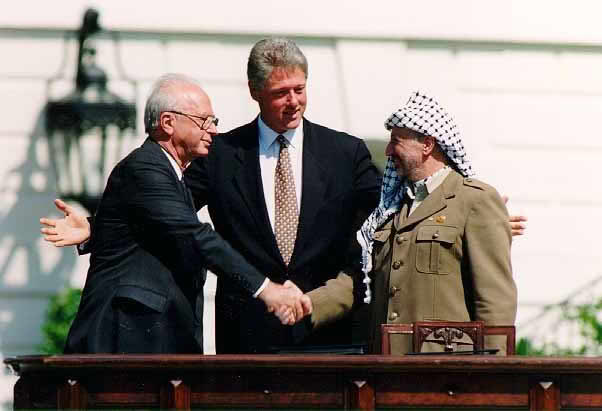
When speaking about the conceptzia (the mistaken military doctrine that enabled the October 7 attack), it’s important to keep in mind that Israel’s entire pre-October 7 security doctrine was built around the Oslo Accords and its derivates. In fact, Hamas would not have been in any position to invade Israel’s south had Israel not surrendered the Gaza region as part of the 2005 Disengagement.
Any serious commission of inquiry into October 7 would reach the obvious conclusion that the two-state paradigm imposed by Western leaders on Israel caused Israeli security officials to adopt a faulty military doctrine that endangered the country. Everything that took place within the context of that paradigm – itself part of the current international order – should be understood as a derivative of the paradigm.
And everything the maligned and silenced “orange camp” that unsuccessfully struggled to resist the Disengagement warned would happen ended up happening. But instead of acknowledging that the resistance had been correct and seeking to include the sector of Israeli society it represents in the national leadership, the opposition seeks to politicize and weaponize an investigation into October 7 that’s rigged to place blame on Prime Minister Netanyahu – thereby excluding his coalition partners who represent this sector.
If one wants to argue that Netanyahu being prime minister at the time of the Hamas attack ultimately makes him responsible, we don’t need a commission of inquiry to know that.
If one wants to argue that the prime minister bears responsibility for voting for the Disengagement policy in 2005, then we should also assign blame to every other political figure and media outlet that supported the policy – especially those who aggressively promoted it while working to malign and silence all opposition. And we should make clear that the policy itself, and the conceptzia/ideological paradigm that caused so many Israelis to support it, is what actually bears the most responsibility for what happened on October 7.
Getting this right is what will protect Israel from repeating past mistakes and help our political leaders find the courage to resist foreign pressure.