
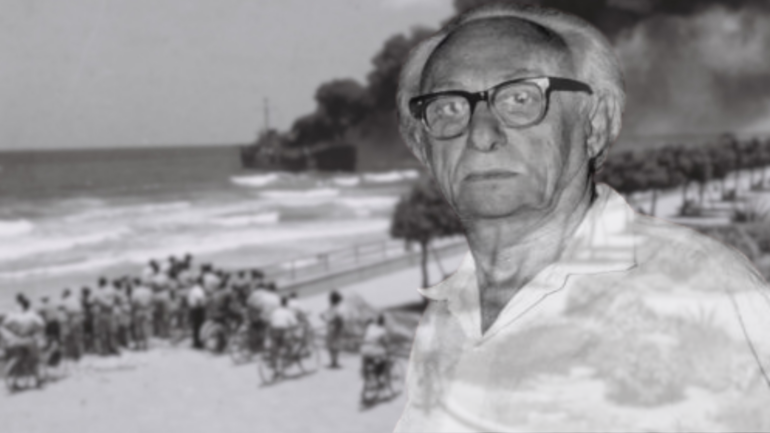
Old wounds were reopened in Israel this week after divers located the wrecked remains of the Altalena, a ship that had belonged to the pre-state Etzel (National Military Organization) militia that was attacked and sunk on the orders of Prime Minister David Ben Gurion.
The vessel had been carrying much-needed weapons to the fledgeling Jewish state during the 1948 War, at a time when the United States had imposed an arms embargo on the region and Britain was arming the Arab armies invading the country.
Etzel commander Menaḥem Begin had agreed to hand the majority of the weapons over to the newly established Israeli army but insisted on keeping 20% of the arms for ill-equipped Etzel fighters in Jerusalem.
Ben Gurion, however, demanded that all of the vessel’s cargo be surrendered to the IDF and threatened military force.
After a short confrontation at Kfar Vitkin, the ship ultimately ran aground in Tel Aviv and was attacked by the Palmaḥ (Strike Companies) under the command of a young Yitzḥak Rabin.
Because Begin had been aboard the ship at the time of the attack, many at the time believed it to be an attempt to assassinate him – especially given the fact that he was Ben Gurion’s most threatening political rival at the time.
Ben Gurion, on the other hand, presented the incident as one in which the Etzel was planning a coup d’état against his leadership.
Begin survived but sixteen Etzel members and three IDF soldiers were killed in the incident. The arms were lost.
The next day, Begin spoke to the nation from a clandestine radio station, openly wept on the air over the blood shed between Jews, and called on his comrades to restrain themselves from retaliating.
Ben Gurion saw the Altalena Affair and the actions he took as having been essential for establishing a unified army under the command of Israel’s political leadership. He further referred to the cannon that sank the vessel as the “Holy Cannon” and said it was so sacred that it “deserved to stand close to the Temple if it is built.”
Begin, on the other hand, believed that he saved the State of Israel at its most vulnerable moment. Later in life, he would say that his greatest accomplishment was not returning fire on the Palmaḥ and preventing a civil war. He hoped he would be remembered for this following his death.
But Dr. Israel Eldad, the leading theoretician of Leḥi (Fighters for the Freedom of Israel), offers a deeper perspective of the affair that critiques the approaches of both Begin and Ben Gurion.
Below is Dr. Eldad’s scathing analysis from his memoir, The First Tithe, translated by Z’ev Golan and published by the Jabotinsky Institute in Tel Aviv.
For the Three Crimes of Altalena
1. A Seesaw, Not a Lever
In the future, who will remember that Altalena was the pen name of the young Jabotinsky? The name Altalena will be remembered for generations as the ship, and it will become a concept and a symbol like “Bastille” or “Potemkin,” though it was no Bastille and no Potemkin.
Even fewer people will realize that this tragic name was born of a comical error. Jabotinsky writes about it in his autobiography: “Altalena. I must admit that I chose this name by virtue of a humorous mistake: I did not yet know Italian well enough, and I thought that its translation is ‘lever’—afterward I was told that the correct translation is ‘seesaw.’”
A seesaw and not a lever. Altalena—born of error.
Just as I have not used this book to debate the British, I will refrain from spoiling things now by vainly trying to convince those who fired the artillery at her that the Altalena was not a rebel ship being used for a putsch. Just as there is no point in trying to convince someone who is not interested or who does not want to be convinced that Abba Ahimeir and Avraham Stavsky did not kill Arlosoroff. The forgers of this new Altalena libel were weaned on the same dark blood as the forgers of the earlier Arlosoroff libel. If the Arlosoroff trial had been in their hands, they would have hanged the accused with the same calm or the same enthusiasm with which they murdered those on the Altalena. And this truth about them must be studied and known so that there will be no future surprises. If I or others have declared one hundred times that they are “Vichy,” and the declaration is not a demagogic curse but a political comparison, then we must expect this Vichy to reach its own ultimate conclusions, and we must be ready to reach the ultimate conclusions about this Vichy, too.
Therefore, when I write of the three criminals involved in the Altalena affair, I will write least of the main criminal: the artillery regiments under their Mapai, Mapam and Palmach flags.
Discovering the reason for the order for these regiments to open fire on the IZL arms ship Altalena is certainly important. All sorts of reasons deserve consideration except for the one they use, which Begin very logically derided: his alleged plans for a “putsch.” Perhaps the kindergarten children of Hashomer Hatzair will believe that. It will not be one of the reasons given serious consideration. The truth is somewhere in the roots of all the possible reasons: The desire to eliminate someone (the IZL and its soldiers) who may be or may become a competitor for power, though not necessarily at this moment as the arms are being unloaded from the ship. The desire to prevent the IZL from saving the day by supplying the army with arms for battle. The desire to eliminate Begin personally, the Commander in Chief of the IZL, who is on the deck of the ship. The desire to show strength, at home and abroad. Whatever the reason. It always comes down to the root: Preservation of the existing regime.
In addition to the material reasons and their domestic political root, of no less importance is the spiritual reason, and the potential that existed before the order, and the rejoicing afterward.
It was like the unburdening of all the hatred that had collected in their blood all these years. Hatred for the one serious competitor to their power: Jabotinsky and Betar. Hatred for those who showed the ridiculousness of that which they saw as heroic: the self-restraint during the Arab riots of 5696–5699 (1936–1939). Hatred for those who did not reduce themselves to the level of being the dogs of the British secret police; the hatred of dogs for wolves. Hatred for those who did not surrender with them after Yagur and the Black Sabbath, hatred for those who riveted upon themselves the world’s attention and its money, ruining the appeals by and for which the establishment lived, hatred for those who drew upon themselves the attention of important political entities throughout the world, something which the “Political Office” of the Agency failed to do in all the years of its existence with its “policy” of sentimental lobbying. The clouds of hatred gathered and gathered over many years. They tried raining into the sea of verbal abuse but this was not enough. They tried raining into informing on our boys and turning them over to the British police. They tried raining scattered reactions, beginning with Shlomi in Herzliya and ending with Yedidya Segal, by way of countless kidnappings and sadistic tortures, by way of splitting open the skulls of children posting newspapers and broadsides—and this was not enough. And by way of the Bartholomew’s Eve plan that was not executed. Until they took power by the force of our good hearts and poor minds, and now they have the opportunity to unburden themselves all at once of the burden of this hatred, the weight of all these repressed desires, now they have their first opportunity to impose the holy authority which they have been throwing at us unsuccessfully for so many years. Now they will take revenge upon us for our consistent refusals, for the IZL’s refusal after Moyne’s assassination, for the Underground’s refusal after the death of the “Struggle.” The Underground’s surrender on the day the state was declared and its enlistment in the Defense Forces not only did not reduce this hatred, they increased the hatred. First, because these actions proved our weakness, and secondly, because they left the desire for revenge unfulfilled.
Now the one cannon in the hands of the “legal” government spit not only murderous fire but also the feeling of murder and revenge for all the many humiliations we caused them simply by existing during the Underground years. This was the great unburdening, relief. And where is the great artist who will paint Ben Gurion’s face as he gave the order, and the face of Yitzhak Sadeh and the face of Galili and the face of the man who fired the artillery and the faces of the Palmach men and women who danced and sang in the cars returning from the slaughter, as they drove down Ben Yehuda and Allenby Streets in Tel Aviv. There was cruelty in Dir Yassin, too, when the IZL and Lehi fought in that Arab village, but there was no rejoicing and there could not have been any because there was no background of such hatred, such overflowing sadism seeking relief.
Because I saw the rejoicing in the cars with my own eyes, and I heard with my own ears Jewish girls laughing over the blood, and because I understood what had happened and its roots, my blood boiled when I heard Menachem’s weeping, and I argued for that which I did during the blood and fire.
A discussion of the details of this event, including the negotiations that preceded it between the IZL and Ben Gurion, would not be of much value. Recounting the negotiations is pointless; the bill is what matters here, but there is not yet a court to which the entire bill can be presented. The entire bill, for it will not be understood if it is presented on the basis of its final (final?) chapter, entitled “Altalena.” It will only be understood if it is presented as a whole, beginning with the blood libel of the Arlosoroff trial and continuing the entire length and depth of the years that followed. Nonetheless, we have a responsibility to take account of the dead and defeated, for the lesson we ourselves learn is far more important than preaching to others, or making accusations. Therefore: May the scalpel made red hot in fire and in pain, in blood and in shame, the scalpel made red hot in the fire of mercilessly clear thinking, may this scalpel begin its work.
2. Who Has Not Learned to Laugh?
We began trying to contact Menachem as soon as the news reached us. Not because there were fifty-two crates on the ship filled with our weapons. (Avraham Stavsky had kept his promise to Natan Friedman. Stavsky loaded some arms purchased by Lehi onto the Altalena.) We knew we were faced with problems far more serious than the unloading and transfer of our crates. We wanted detailed news and we wanted to coordinate Lehi’s response with the IZL. But Menachem was impossible to reach. We were told he would not be in Tel Aviv for two or three days. We knew at once that he was at ground zero.
When loudspeakers blared that Menachem was going to deliver a speech from the ship’s deck, facing Tel Aviv’s Rehov Frishman, my first reaction was short: “A show!” Of course, I did not know the show was going to be a tragedy. Even a great rhetorical talent must draw a line and acknowledge that certain circumstances should not be exploited for rhetoric. It seems to me that a speech from the deck of a ship loaded with arms expresses a weakness for showmanship. More so: Menachem’s very boarding of the ship seemed to me theatrical, and the day after Ben Gurion sank it (Ben Gurion’s Struma) my first question to Menachem was: “Menachem, what did you do on the ship? What did you do on the ship?”
The 4:00 p.m. show on the seashore did not go on. Instead came the unburdening of all the hate and desires, focused by Ben Gurion in an order to fire at the ship. I imagine that the speech Begin had prepared was strong, firm, convincing. Certainly more than the speech he delivered following the disaster (I do not like that word, but this time it fits).
I assume that Begin’s calling people to the beach had no practical import. Had Begin really intended to conquer the city, as Ben Gurion claimed, then there would have been some logic to the speech, but because, to my great sorrow, Begin did not have any such intention, there was no logic, and the call could not have any practical effect on the unloading of the arms. So I cannot rid myself of the impression that the main reason for the speech was for its theatrical effect.
In addition to this first crime—that the man responsible for the IZL was on the ship—a crime that endangered the ship and that mortally endangered the man—and the glory of which was in no way worth the possible damage—came crime number two: the restraint.
And I know this is the deepest and most dangerous point I touch with my scalpel. And I know the strength of the argument that fighting back might engender “a civil war, with the enemy at the gate!”
Nonetheless.
He who was as convinced as Menachem Begin was that the arms on the ship were arms of salvation was obligated to bring the ship ashore any way possible. And there were only two ways: either by surrender, turning the arms over immediately and accepting all Ben Gurion’s conditions, or by a forceful breakthrough. As long as one could still hope to solve the problem by negotiating—okay, keep bargaining. But the moment the order to fire was given, and the intention to sink the ship made clear, one’s holiest and wisest obligation was to respond with fire and unload the arms by force. One can go further and argue that even if there had been no original intention to rebel against Ben Gurion’s regime, such an intention was justified after Ben Gurion issued the order to murder those on the ship. When such an order is given, the moral and civil foundation upon which a government rests is undermined.
But even if one is in no way willing to accept this revolutionary conclusion, even if one is really the kind of “patriot” we all were in the fog that shrouded our minds and hearts, even if one is not thinking of himself and his own organization, but rather only of the precious and desperately needed weapons for the defensive war against the invaders, even then, especially then, one is obligated to rescue the arms come what may, even by force.
If our minds had been working as they should have been during those hours, or actually during the days since the dispute over the ship began, then we could have launched a quick, cutting maneuver by land and by sea and forcefully unloaded the arms. At the worst, both sides would have suffered losses and not just one side, ours. Afterward, if one wanted to be a great “patriot,” he could leave the arms on the beach and walk away, thereby saving in one action the state, the Mapai government and the arms, while winning for himself the wreath of a “patriotism” that is far above the normal revolutionary. The principle “civil war—never” may not be so appropriate for a serious revolutionary movement convinced that its path and only its path will save the nation and the homeland. But even if the principle is appropriate, it depends on a fundamental condition: that both sides accept it. If one side refuses to stop before the border called: Shedding brothers’ blood, while the other side declares day and night: “Anything but a civil war,” and “we do not seek power,” then not only is the latter side not preventing bloodshed, but just the opposite: It is inviting bloodshed.
If the artillery commanders knew that Begin was going to respond in kind, they would never have dared to give the order to fire. They would not have dared, because they would have known that they risked sinking together with their “power” in the seesaw ship called the State of Israel, if a civil war really were to break out. And they would not have dared to fire had they known that their blood might also flow this time, and quite a lot of it, considering the large amount of arms on the ship and the great sympathy on shore. They bombarded the ship because they had been repeatedly promised from its deck: We will not return fire.
I dare suppose that if the ship had opened fire, then even if the Palmach heroes had not immediately fled, the stature of the negotiators—the Pinkases, the Rokaches, the Gruenbaums—would have gained, as people saw them negotiating between two warring sides, instead of between the one side murdering the second side which restrains itself out of supreme patriotism. I am not daring enough to suppose that then the road would have been opened for the Underground to join the governing coalition, though I have no doubt that chances are greater for a coalition between two battling sides than for a coalition between a victorious murderer and a restrained, surrendering murder victim. I will say that if Ben Gurion was unwilling to include Underground members in any national coalition (actually—thank God for this), it was not because he was afraid of them but because he was not at all afraid of the self-restrained people of the Altalena. The self-restraint of the “Seesaw” (let’s call the ship by its translation) gave Ben Gurion more power than any vote.
That in the verbal dispute with Ben Gurion about his earlier agreement to allow the ship to unload its cargo the IZL had factual proof of its claims, logical proof, moral rectitude, and it demonstrated supreme patriotism—nothing helped. Nothing helped: The masses were with the victorious cannons. Out of fear, out of admiration for forcefulness and strength, or out of . . . pity for the vanquished. Because ultimately, pity has an effect opposite that which the one arousing pity assumes it will have.
Thus we reached the third crime of that day: the crime of weeping.
Begin’s voice spoke from out of every window and every cafe, the same voice which only a few weeks earlier, on the day before independence was declared, had expressed strength and generosity. Now the voice was broken. And the public is interested in the arguments and evidence less than it is shocked by this fact: The Commander of the Irgun Zvai Leumi is weeping publicly.
Many men and women, boys and girls, wept with him. Just the opposite from what they should have been told to do. The soldiers of the IZL and the IZL sympathizers and Jews everywhere waited for a short announcement forged of steel. Tears flowed instead. The tears flowed from the heart and from the blood, and they will be forgiven by all those who wept with Begin that night. On that night the Commander of the Irgun Zvai Leumi was obligated to weep, to weep over many things, privately, but that night he was obligated to strengthen hearts, not to break them, not to soften them. “We are broken,” one of the IZL commanders told me the next day when I went to IZL headquarters to see Menachem, “broken.”
And I am still not sure when Ben Gurion won his great victory: the moment the fire flowed from his artillery or the moment the tears flowed from the eyes of the vanquished. The murderers washed their hands with these tears and said, “Indeed, it was not pleasant, but it was worth it.” For they are not at all sensitive. They are very cruel, and very knowledgeable about tactics, and they know the nation’s sheeplike spirit. They know that these tears, these warm, boiling tears, melted the ice which had formed in people’s hearts, the ice of fear and the ice of hatred. It was melted and it flowed, melted and flowed, on and on, into the nearby sea, to the black boat that will bear the remains of the burnt weapons, together with the remains of the broken strength, together with the remains of the hatred.
Psychologists may try to explain this phenomenon of mass psychology, but the phenomenon is a fact. Weeping shocks but accomplishes nothing. Laughter is much more potent than weeping. And Menachem never learned the powerful laughter which causes enemies to tremble; he never learned this laughter, though his hero Jabotinsky taught it. During Begin’s speech, I felt and said and said again: Jabotinsky would not have responded by weeping. Under no circumstances. He was made of true steel. And there is no way Menachem will be able to claim: Rosh Betar stood behind me and gave me the order: “Cry!” And if Begin had listened with all his soul to the spirit of Rosh Betar, he would certainly have heard, if not a voice condemning such patriotism, then at least a strong, deep voice: “Bite your lip and be silent, till the day comes. . . .”
Altalena should have been a lever, as Jabotinsky originally thought. Under the artillery bombardment it became a seesaw, with a broken body. Ben Gurion was unable to take its soul. Its soul was lost with Begin’s weeping.
Only after the heavy smoke cleared from the skies of Tel Aviv, only after our hearts calmed following the shock of the explosion and the shock of the tears, only after we were able to consider the whole affair in its entirety, was something else discovered no less deep and no less shocking than all the above, but on a completely different plain, something that preceded these events in Tel Aviv but that shares, somewhere in the depths, the same roots as all the events that followed it. Only from the speech and from that which was written afterward did we learn of the order that had been sent to France to delay the ship’s sailing. And this is emphasized over and over and repeated again and again in Begin’s book, The Revolt, for he is a man of truth and will not deny it. He will not deny the mistakes he made, should he recognize them; obviously he has less reason to deny the mistakes he made that he does not recognize as mistakes.
Begin admits that he issued an order to delay the arrival of what the IZL called these “arms of salvation,” not even under Ben Gurion’s instructions, but as his own decision: “Whatever our attitude to the truce might be, I explained to my comrades, we are not entitled to bear the responsibility for the possible consequences of a breach.”
This confession is a unique document. It was made in order to prove that not only did Begin not want to rebel, but that the ship only sailed after instructions came from the government’s Defense Ministry to bring it as quickly as possible. But Begin unintentionally reveals to us how the Underground had degenerated with amazing speed from a proud, vigorous liberation movement to a sort of innocent lamb afraid to break a U.N. order, afraid to take responsibility for bringing arms, “arms of salvation,” until after instructions are received from the government and the Defense Ministry—that is to say, from those who only yesterday and who again tomorrow we repeatedly accuse of defeatism and surrender. Only after they give permission, does the Commander of the Irgun Zvai Leumi say:
“We thanked God that the government understood the situation, weighed what had to be weighed and disregarded what in the circumstances it was forbidden to take into account. At once a coded message went out to the Altalena where as we later learnt, it aroused even greater joy. Instead of ‘Keep away’ it was now ‘Full steam ahead.’”
Begin’s behavior resembles in every way his behavior in the King David Hotel matter. There Begin laid the responsibility for the great and decisive operation on the shoulders of Sneh, and here, too, he places the crown of courage and the political and military wisdom to act against U.N. instructions on Ben Gurion’s head. So Ben Gurion appears steadfast not only regarding internal relations, he also appears courageous and steadfast regarding foreign entities and the United Nations, and again Ben Gurion is able to sit and read of and enjoy the weeping of his enemy, and the laurels he has surprisingly received from Begin, when Begin portrays himself as not courageous enough to break the cease-fire even when it comes to arms of salvation.
What happened? How did the ravaging lion become a good, innocent lamb? How can he fear to take responsibility, he who yesterday took full and much more difficult responsibility when he hanged British sergeants? What lies at the root of this change?
I would not have included this analysis of the Altalena affair in this book if it did not serve as an additional proof of the basic root of the tragedy: the incompleteness of the national revolutionary theory. An incompleteness which led to self-abasement before the state and before its formal manifestations, even though its content is the same as yesterday, even though its presidents are yesterday’s “collaborators.” The formalist approach creates the kind of patriotism that obligates one to stand at attention while a thief sings the national anthem during a robbery. Only this can explain a “holier than the Pope” attitude and a fear to take responsibility for breaking a cease-fire ordered by the United Nations.
The IZL Commander’s telegram to France is a shocking document which attests to the early and speedy, very speedy, collapse of the Underground. It collapsed in body and soul. This should not have happened even with the establishment of the State of Israel.
And I refer not only to the IZL. The same is true for Lehi. But the Lehi’s own “Altalena affair,” even though its roots grew in this period, lies beyond it, and should be part of a Second Tithe.
3. Not-Lenin
The next day I went to see Menachem. I do not remember whether I went with the knowledge of our Central Command. I run to Menachem before going to see the still-burning ship. I have no further interest in the ship. I run to save the living, I run to save the power. I do not enjoy funerals and in cemeteries I like to walk alone, alone, calmly.
I reach the IZL’s fenced-in, fortified headquarters. Even the guards outside are falling apart. It is evident in everything. Near the roadblock, a tall officer approaches me and asks in a broken voice if the time to unite has not come yet. He is broken and, I know, not by Ben Gurion.
Menachem’s voice is broken and it is no wonder. After such a speech the wonder is that he is still able to speak at all.
I have not come to offer comfort. I have not come to preach. I have come to ask: What next? And when he answers, as he does with fatalistic words and tone, I make my proposal.
We do not owe allegiance to this kind of “government.” We should take advantage of this murderous affair and with all our men open a road to Jerusalem. Jerusalem is in danger, in Jerusalem there is still foreign rule. The authority of “the state” does not include Jerusalem. Here we are superfluous and foreign. Our place is there.
Menachem does not believe it is possible to break through, though perhaps it would be worthwhile; Menachem suggests uniting our forces in Jerusalem and proclaiming a “Free Judea” there. He asks Avraham (Haim Landau): How many men do we have in Jerusalem? Seven hundred. To me: And you? Three hundred. Together, one thousand men—this would be a force.
I propose that the united force take immediate action against the Arab strong points as far as Ramallah (according to a plan that Meir had devised). But Menachem, when it comes to Jerusalem, ironically leans toward ensuring administrative control of the city itself. I argue for early outward conquests, which will raise our prestige in the city now being shelled, and also increase our self-sufficiency in food, in case Israel decides to lay siege to the city (we discuss this possibility).
I am speaking in complete seriousness. But very quickly I see that Menachem is hesitant. Is it any wonder? His soldiers were slaughtered yesterday before his eyes. Is it any wonder? He has just finished weeping with a broken heart and has not yet healed that heart. Menachem says he will consult with his Command; we will discuss it further.
Suddenly word comes that Military Police are approaching the site. And this is at a time of mass arrests, accompanied by acts of brutality, in many places throughout the country.
What will happen here? I ask.
Here we will defend ourselves.
Yes? So what are you doing here? They’ll finish what they did not succeed in doing yesterday. They’ll murder you.
Perhaps. But I will stay with the last of my soldiers. Here he is. Here he is; the same noble Menachem. Here he is; the last romantic among the world’s freedom fighters. Here he is; the man who wanted to return to Nazi-occupied Warsaw, the man who did not want the stain of desertion on his name.
Menachem, what kind of heroism is this? This is running from battle. Menachem, Lenin would not have acted this way. Lenin hid in a forest far from any fire and from there he directed the revolution and won.
Perhaps—and his voice is broken to pieces—but I have decided not to leave my soldiers.
Is this beautiful? Of course. It is a continuation of his remaining on the Altalena’s deck. They had to carry him off the ship against his will. The subject is worthy of a glorious epic. Greatness of spirit has not passed from the world. Menachem is one of its last representatives. But do we need material for epics or leaders to direct the Hebrew revolution?
I get out of there and only say to Avraham, over and over, “Take him from here, take him from here! Take him by force!”
I do not know whether he spirited him away. I do know that the Military Police did not go there.
Apparently, they somewhere-out-there realized that whatever they might do to him would be less than he had already done to himself.
Only after I left them did I go to the shore. I climbed on to a roof on Rehov Jonah Hanavi and I saw the dying Altalena, and I saw the residents of Tel Aviv returning to the areas they had evacuated.
And smoke, a great deal of smoke, at first very black, very thick, rising and spreading, spreading, and it too fades.
There is not even any smoke left.
4. All That Night in Bnei Brak
Without talking about it, without having a need to talk about it, we knew, all of us in Lehi, from the top down, from those who sympathized with the IZL to those who did not, that Ben Gurion’s attack on the Altalena was not an action against the IZL, but against the Underground. It is an old score being settled. By chance, the IZL happened to be the target. Natan’s heart bleeds with the blood of Avraham “Abrasha” Stavsky; Natan had loved him. His good friend Samuel Merlin was also wounded. But in truth we are all bleeding; we are all wounded, and we are all ashamed of the tears.
On the morning of the day of the Altalena, we gather in a beachfront apartment; and we, the three members of the Central Command, along with the most responsible of our officers now in the Israel Defense Forces, discuss the steps we must take.
At some point in the course of those days, I wrote an article for Mivrak titled “Without an Oath,” which reflected my views. The topic: the oath of allegiance every soldier must make to the army. I recalled the whispered Hebrew “Beli neder” (without taking an oath) a Jew adds whenever he promises something, even when he promises with the intention to fulfill his promise. Who knows what turns fate will take? Therefore, it is best to promise and to whisper at the same time, “without an oath.” Was a French soldier obligated to obey Petain’s orders just to fulfill the oath he had taken? No. There are circumstances that involve values more important than simple obeisance. If a government is not faithful to a state, it is forbidden to be faithful to a government.
But during the discussion of the various sharp steps that were proposed, we did not speak about the formal side, only of the practical. At least we spoke of practicalities; what went on in the hearts of the military officers who were present, I do not know; in any case, neither Dov nor Mazal, who make the decisions in our units, raised any problems based on a need for obeisance to army orders.
Everyone realizes we must act. We cannot stand idly by this blood. Our members in the camp are fuming. We have received a promise from Yitzhak Sadeh’s Staff that Lehi members will not be used in any action against the IZL. Indeed, very nice on the army’s part. But, the army officers had added, they will be watching us.
I make the extreme proposal. I want to exploit the situation to correct the damage we have done, the sin we heave committed toward Jerusalem. I propose that our members simply leave the base, get into cars and transfer to Jerusalem. Meir presses from there, unrelentingly, by messenger and in broadcasts: Men and explosives, men and explosives. If he had Uzi and Dov and Yoad and Danny, he would be doing great things.
Today is the opportunity, I argue. Dov can lead two or three hundred men to Jerusalem.
There is no opposition, in principle. We discuss the problem of arms. On base, we can easily take control of a few cars and leave. Our officers appear a bit confused, but the Central Command is unanimously in favor of the proposal. The officers will return to the Tel Litvinsky Base and we will meet at night in Bnei Brak.
At night, Tel Aviv is aflame and afraid. The three of us Central Command members try to make our way out of the city and get nearer to Tel Litvinsky. All the roads are blockaded; thousands of residents of Ramat Gan and other suburbs are stuck in Tel Aviv, unable to go home. The army has blocked the roads. The massive crowds push for hours before the army is forced to open the routes. We went to Bnei Brak. At the edge of Bnei Brak, on the road to Tel Litvinsky, is a detached house in which Gideon lives.
During the final months of 5707, I lived in the home of Gideon and Carny. (Carny! Whoever gave her that name knew her spirit and knew what Jabotinsky meant by the character Carny in his novel Samson. This is a daughter of Israel who is soft and proud, silken yet steeled when necessary.) Gideon has one hundred and one jobs—the extra one being the preservation of every piece of paper for the archives; we originally showed no understanding of the historical value of this job, but he understood and simply did it.
We had not scheduled the Central Command’s meeting with Lehi’s army officers for Gideon’s house because of the archives, of course, but rather because the house is near Tel Litvinsky and the surrounding area is quiet. But the Lehi Archives is a fitting place to hold this meeting, during which Lehi’s downfall will become so apparent. In this house, Lehi could have saved itself from the slide down the slope of the year 5708 (1948). Here the fate of the movement swung—up, down, up down. And finally the fate was decreed: to descend.
Tense and tired, we waited almost till the light of morning for our men to come from the base. Finally: They are coming.
But not as we had thought. Not by the hundreds and not armed and not in armored vehicles. They are coming, the few officers, and they are coming to tell us: We were too late. Our men are being watched by dozens of eyes. Their guns have been taken from them. Without guns, it will be impossible to break through to Jerusalem. Dov still offers comfort: Perhaps he will be able to take advantage of a training session with his platoon to simply move them all to Jerusalem. His voice does not inspire us to believe that he will be able to do so.
Some time later, Dov is part of a delegation meeting with Ben Gurion. When the “tall blond,” the scourge of the British, is introduced to Ben Gurion, the latter asks him: Are you ready to execute any order given to you by the commander (meaning Moshe Dayan) of the regiment you want to join? Dov replies: Yes, in accordance with my conscience.
What was in Dov’s and Mazal’s conscience that long night in Bnei Brak and Tel Litvinsky? Did they weigh their loyalty to the army, the brigade, the regiment against the possibilities in Jerusalem? Did they realize what the two of them could have done together with the dynamic third, Meir, what this trio could have done for her, for Jerusalem, with five hundred Lehi members? Did they consider that with one assault they could have taken the Old City and cleansed the northern and eastern parts of the city of enemy strongholds, as Meir had done in the west with his small group? To do—and afterward, if necessary, to stand before a military court for desertion, or for falling in the Jerusalem front, as Uzi the Redhead will have to stand, Uzi who simply left the army and went to Jerusalem and died for her.
Which is more important, Dov, Uja al Chfir or Temple Mount, which is more important? Did you weigh this? You did not weigh then, nor did Mazal weigh that night. Had you weighed, had you known, you would have decided as members of Lehi and you would have decided the fate of Jerusalem.
The night paled, and we paled with exhaustion from the tension. Jerusalem trembled that night from the falling shells, and she trembled as she kept watch: Will Dov and his platoon come?
Dov is no more. But Mazal (Yaacov Banai) is alive and he knows and maybe someone else knows, too: Who caused Jerusalem to wait in vain that night? Who caused the Lehi fire to die that night?
The night passed.
The Lehi Central Command is tired. We return to the city.
Heavy smoke. Smoke over the city. Smoke in the eyes. Our hearts smolder.
The members of Lehi did not desert, they did not mutiny. They did not leave the army. The IZL regiments returned to the army. “Altalena” is not a lever. It is a seesaw.
Neither is the “state” a lever. It is a seesaw.
For even the Underground ceased to be a lever. Just a seesaw.