Parshat Pinḥas offers a very precise and detailed list of korbanot for different times of the year.
Two sheep are sacrificed every day in the Temple. One in the early morning and one later in the afternoon.
This teaches us about the eternal link between the children of Israel and the Kadosh Barukh Hu. What took place in the morning is repeated in exact detail in the afternoon.
“I am HaShem, I have not changed, and you, children of Yaakov, have not been destroyed.” (Malakhi 3:6)
On Shabbat two additional sheep are brought, to signify the “extra soul” that we are privileged to possess on this holy day.
On Rosh Ḥodesh, the beginning of a new month, two bulls are brought, as a symbol of the power of fertility linked to the rejuvenated month.
This is added to the strengths of the previous month – one ram for the power and seven sheep for the sanctity of the times of the year, which is symbolized by the number seven, and is renewed at the beginning of every month.
In addition, one goat is brought as a ḥatat offering, in order to mend the imperfect reality of a changing world.
On Pesaḥ the same korbanot are brought as on Rosh Ḥodesh, because the month of Nisan is the first month of the entire year.
The same korbanot are brought on Shavuot in addition to others – seven sheep, two rams, and one bull, aside from a goat and a special shlamim offering for Shavuot.
This shows the bidirectional character of the service on that day, celebrating when the heavenly and the earthly were joined together in the giving of the Torah.
Rosh HaShana, Yom Kippur, and Shemini Atzeret differ from the other holidays – with sacrifices of one bull, one ram, seven sheep, and a goat – all to teach about the primal thought which was not preceded by any other, and is therefore represented by a single bull.
On Sukkot, aside from the seventy bulls which atone for the rest of humanity, the number of rams and sheep is doubled to teach us that Sukkot brings with it a type of “additional soul” – twice what we receive on the other festivals.
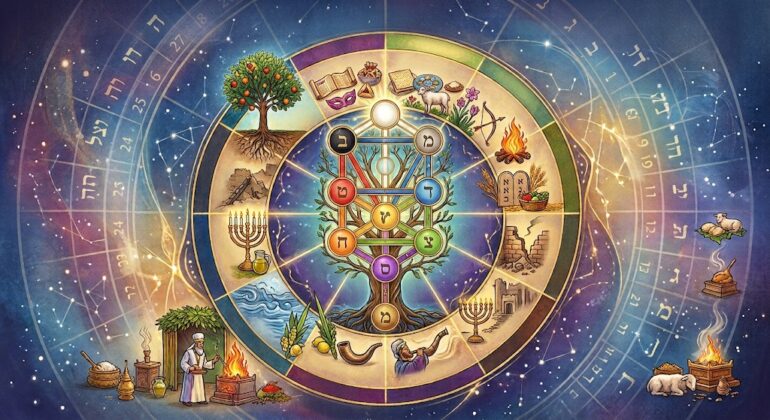
The list of festivals and their korbanot corresponds to the ten s’firot – ten attributes, or emanations – through which HaShem reveals Himself and continuously creates our worlds.
The simple korban hatamid, a symbol of the constant abundance we receive from the Creator, corresponds to the s’fira of keter.
The additional Shabbat musaf, brought on the day that reminds us of Creation, corresponds to ḥokhma, wisdom, which served as the basis for the way HaShem created and creates the world.
The Rosh Ḥodesh musaf, a symbol of constant renewal, represents bina – the source of the renewal of time that gives Israel the power to sanctify time during the year. This is related to the line in the liturgical poem Bar Yoḥai about the “green line renewing the new months.”
The other festivals that were instituted as a result of Israel’s Exodus from Egypt, correspond to the seven s’firot for building up reality.
The first day of Pesaḥ is ḥesed, marking when we were taken out of Egypt without any merits to our credit.
The Seventh of Pesaḥ is g’vura, marking when Egypt was punished.
Shavuot is tiferet, represented by the giving of the Torah.
Rosh HaShana is netzaḥ, marking the revelation of HaShem’s eternal kingdom.
Yom Kippur is hod, corresponding to the service of the High Priest.
Sukkot is yesod, marking when the covenant is renewed with the joyous festivities of Beit Hasho’eiva.
Simḥat Torah corresponds to malkhut, when the Divine King is blessed.
This explains the set order of Divine guidance by the Creator and the way this is revealed through the times of the year and their unique korbanot.
Translation by Dr. Moshe Goldberg