
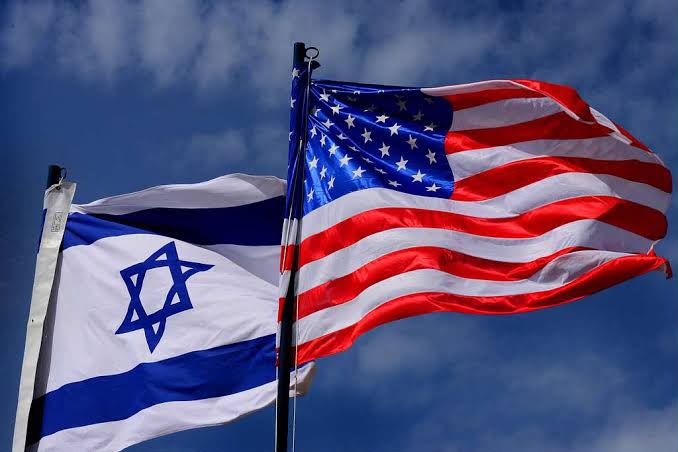
On March 21, 1975, a single brief letter changed the course of Israeli history.
The letter, sent from United States President Gerald Ford to Israeli Prime Minister Yitzḥak Rabin, notified Jerusalem of the president’s directive for “an immediate reassessment of U.S. policy in the area, including our relations with Israel” amidst an impasse in American-mediated Israeli-Egyptian shuttle diplomacy.
The Reassessment Crisis, as it became known, was short-lived; Israel balked almost immediately.
By September, the Sinai II Agreement was signed between Jerusalem and Cairo, the concession of the offshore Abu Rudeis oil fields to Egypt – the first of many such territorial forfeits in the half-century of humiliation that would follow.
Now, following the regional wars of the last couple of years, it is time to do ourselves what Washington has been threatening us with explicitly and implicitly for the last fifty years; it is time for Israel to reassess its relationship with the United States.
The primary lessons that must be learned from these wars is that Israel cannot go to war with the United States, either as a proxy or as a full partner, and expect to win a decisive victory. These things are mutually exclusive.
Israel experiences its enemies as existential threats while the United States experiences Israel’s enemies as crucial pieces in a delicate, critical regional balance; a regional balance on which the petrodollar system, US dollar hegemony, and the exorbitant privilege of the US rest.
The United States cannot afford a decisive Israeli victory in the region, as such a victory that would remove the existential threat (and reliance) from the oil-producing states, open the door to oil trade in non-dollar currencies, and throw the entire US economy into doubt.
There is no kinder, gentler America waiting for Israel around the corner. No, not even if Secretary of State Marco Rubio becomes president.
The divide that consistently emerges between Washington and Jerusalem – in both red and blue administrations – is not the product of anti-Semitism, corruption, or stupidity from particular and replaceable actors. Rather it is the product of very real structural contradictions between US and Israeli interests.
It is time to acknowledge that the the United States and Israel don’t share any civilizational mission; there is the Israeli mission to survive and develop in a chaotic region, and there is the American mission of maintaining its global financial hegemony chiefly by managing this very same regional anarchy in West Asia.
Decisive victory, security, and independent development for Israel are not compatible with partnership with a [waning] global hegemon whose financial system depends on stalemate, insecurity, and regional dependence.
It is therefore time to reassess Jerusalem’s foreign policy, including relations with the United States, to better safeguard Israel’s interests in the region and across the globe.