The Red Heifer is the instrument through which a person is purified.
The most severe form of impurity results from a living person encountering death. While an inanimate object cannot cause ritual impurity because it never had any life, death is the opposite of life, and the shock of contact with it upsets life.
The severity of “tuma” (“ritual impurity”) is ranked according to the affinity between the individuals involved. An Israelite corpse causes impurity both via touch and by being in the same tent (or other structure). But a gentile corpse can only pass on the impurity of death through direct contact.
Similarly, a woman who gives birth to a boy is impure for only seven days, because she carried within her a living body that left her.
A woman who gives birth to a girl, however, is impure for fourteen days because that female child is likely to carry other life with her in the future. Therefore the time of her impurity is twice the time for the birth of a boy.
Purification from the impurity of death takes place through the ritual of a Red Heifer, via a process of “resurrection.”
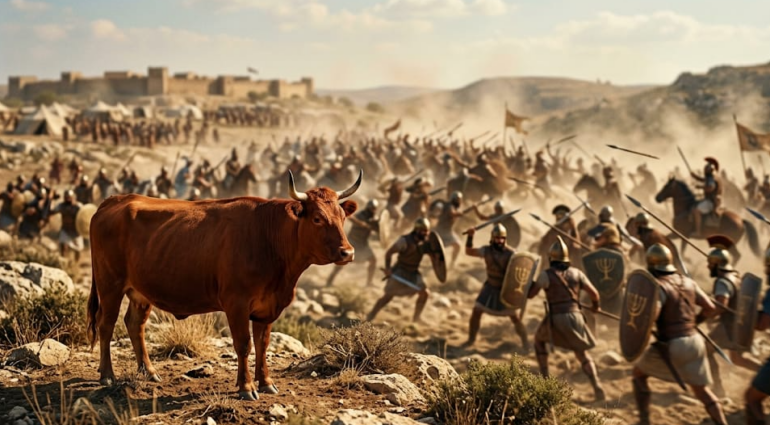
“Let them take for you a completely red cow on which no yoke has been placed, and give it to Elazar HaKohen, and let him slaughter it.” (Bamidbar 19:2-3)
Let them take a cow for you: the word in Hebrew is “para” from the root meaning fertility, but not a bull. When pregnant, a cow gives more life than a bull. And it is a cow and not a sheep, in order that it will possess extra vitality.
Red: This is the color of blood and of life.
Complete: This symbolizes a complete and perfect life.
On which no yoke has been placed: In this way, it has never been diminished during its lifetime.
Let him slaughter it: Slaughtering is a cancellation of life.
“And let him burn it completely – its skin and its flesh, together with its blood and its dung” (Bamidbar 19:5): Everything is burned, even the animal’s waste.
Outside the camp: Outside the area of life. And it is transformed into ashes (“eifer“). As opposed to dust (“afar“), ashes can’t be used to grow anything and can’t be kneaded into a mixture. Ashes remain separate from everything else.
Death also impacts the plant kingdom. The biggest of all trees is the cedar, and the smallest is the hyssop.
“And let the kohen take some cedar wood and some hyssop, and a purple thread, and throw them into the fire of the cow.” (19:6)
These two species, cedar and hyssop, are the opposite ends of the spectrum in the world of plants. “Tolaat” – translated above as a thread – also means a worm. The cow and the worm are the opposite ends of the spectrum of animal life. And a worm is all that is left of a human being in the end.
We see that the greatest examples of life have been transformed into symbols of death. They are all thrown into the fire of the cow.
A living person consists of a body and a soul. The body can be thought of as a sealed clay vessel. The soul is like an infinite flow of fresh water. Man can be thought of as a vessel which contains fresh water.
We take the ashes, the remainder of death, and we “resurrect” it using the fresh water of the soul, poured into a clay vessel, like the body. And that explains why this water is used to purify a person from the impurity of contact with death.
This is the mystical inner meaning of the purification of the Red Heifer.
But if the matter is so simple, why did King Shlomo say, “I said I would be wise, but it is distant from me” (Kohelet 7:23)? (we are taught that he was referring to the Red Heifer)
The answer is that the secret remains hidden, in that it is not clear how life can rise up out of death.
The secret of the transformation from death to life and from life to death still eludes us. This is similar to the secret of how a living soul exists within the physical body, as the Rama explains on the blessing recited after a person relieves himself: “And He acts in a wondrous way – He links a spiritual entity to a material object.”