
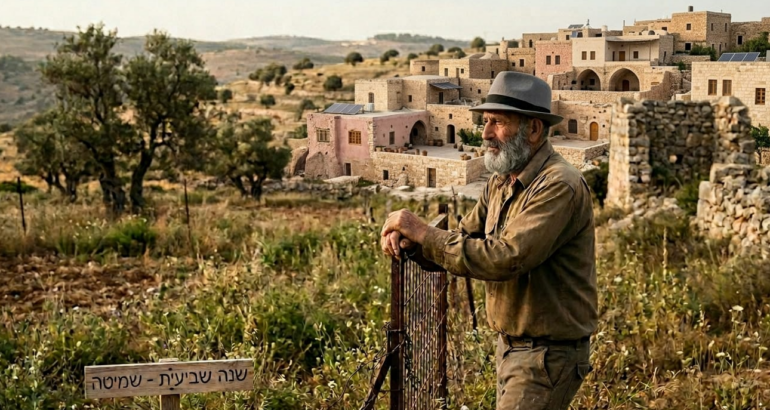
“The land shall not be sold in perpetuity, for the land is Mine, for you are visitors and residents with me.” (Vayikra 25:23)
The law that prevents permanent sale of the land draws its basis from the essence of man’s status in the world.
On the one hand, man is a resident of the world as a natural creation.
“For you are dust and you will return to the dust.” (B’reishit 3:19)
But on the other hand, man is a visitor from the perspective of his soul, which is the daughter of a King and yearns – with a metaphysical yearning that can never be fully satisfied – to return to her Father.
This is also what Avraham said to the people of Ḥet: “I am an alien and a resident” (23:4). But his attempt to bring the people of Ḥet to recognize this fact – by expressing that he was “with” them – failed. They felt that he only spoke the way he did because he was a “minister of HaShem” while they were “people of the earth.”
Rabbi Yehuda HaLevi expresses the idea very well, as follows: “I am as a visitor and a resident on the earth, even though my final resting place will be within it.”
HaRav Yehuda Ashkenazi (Manitou) would explain this verse in such a way that’s very close to its literal meaning: If you feel like visitors in this world, you are residents. But if you feel like residents in this world, you are visitors.
Since the Kadosh Barukh Hu sent Himself into exile – so to speak – in order to allow creation to continue on an autonomous path (as is known to the masters of Kabbala as the secret of Divine restriction), He acts in this world as a “Visitor.”
In order to cling to Him, it is necessary for us to emulate this trait of His and to feel like a temporary visitor in this world. This is the basis for the very Torah’s frequent statement that HaShem loves the stranger – because the stranger has an understanding of the position of the Kadosh Barukh Hu. That is why the children of Israel were born as sojourners, outside our own land. And even after we conquer it, we don’t take full possession but rather leave behind margins on the side of every field, and sometimes even avoid agricultural labor for a full year.
But in spite of all this, we are taught a special law in Parshat Behar – that houses in a walled city can be permanently sold. This is a hint that an urban culture can create a new framework for living, one that does not have natural constraints, where man can live a full life that is based on a permanent link to the land, without this causing him to forget the existence of HaShem.
A city is a new way of organizing space that corresponds to the dimensions of mankind, created in the image of the Creator. Here life can be built up around moral values and not only based on competition within nature. This is meant as a challenge for urban society and not necessarily a plan for life.
In our times, the existential challenge for the people of Israel is to maintain our hold over the land. We don’t currently face the dangers of an exaggerated attachment to the land. At a time when we’ve seen some signs of our hold on Eretz Yisrael weakening, we are tasked with strengthening our connection to our soil.
Therefore, the sale of land during the seventh year for the purpose of bypassing some of the laws of Shmita help us to better live according to the larger objectives of the Torah, by helping us to maintain our connection to – and hold over – our land.