We often learn the reasons for the mitzvot from the stories in our Torah.
HaRav Yehuda Ashkenazi (Manitou) teaches us that the Torah embedded the reason for the commandment of the gid hanashe (sciatic nerve) within the story of Yaakov wrestling with the angel, in order to teach a general principle for all mitzvot – that their underlying meanings are hidden within the narrative sections of the Torah.
This is especially true for those stories dealing with the lives of our patriarchs and great leaders.
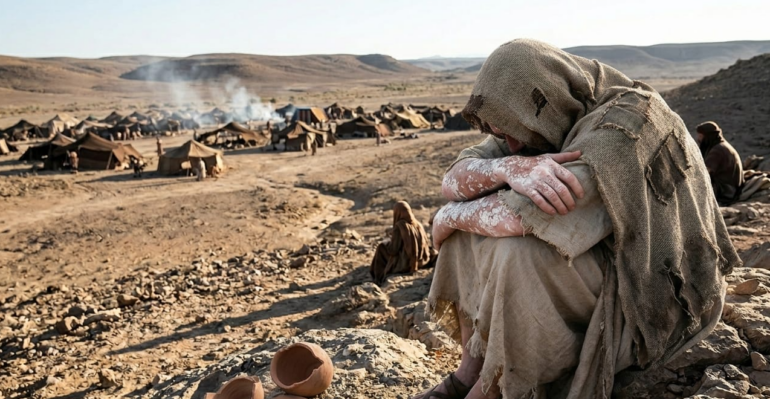
Who is the figure that serves as the original model of the metzora?
It’s actually none other than Moshe, the first person the Torah explicitly describes as afflicted with tzaraat.
The word metzora is even close to the word Mitzri (Egyptian), the term by which Moshe was called by the daughters of Yitro.
Tzaraat appeared on Moshe when he was asked to use his power of speech to bring Israel out of Egypt, and he doubted his ability, describing himself as “uncircumcised of lips” and “heavy of mouth” and “heavy of tongue.”
Thus, tzaraat comes as a result of a deficiency in the faculty of speech. From here we learn that the underlying reason for the laws of tzaraat is corruption of speech – particularly lashon hara (evil speech).
The purification of the metzora parallels Moshe’s life mission. From the “Egyptian” mode of speech and from the culture of Egypt, one must extract the worthy element, symbolized by the chirping bird (chatter like gossip as Rashi explains), which is slaughtered like the lamb of the Pesaḥ offering (corresponding to what the Egyptians revered), and then eaten.
In contrast stands the living bird, which is sent away dipped in blood, to be consumed by wild animals, like the scapegoat. The sprinkling of blood with hyssop by the one being purified parallels the placing of blood on the doorposts in Egypt.
The purified person’s waiting for seven days outside his tent parallels Moshe’s delay in returning to his people, after years of physical and emotional separation while in the house of Pharaoh and then later in Midian. Moshe’s return was delayed until he circumcised his son, thereby attaining a higher level that is reached on the eighth day.
There are three commandments that require a person to count seven days as preparation for an act of holiness on the eighth day: the purification of the metzora, the purification of a zav and zava, and the guilt offering of a Nazir.
These actually represent three types of moral failures that elevate a person to a higher level once corrected:
1. The metzora must repair the relationship between a person and others (ben adam l’ḥaveiro).
2. The zav and zava address the relationships between a person and themself (ben adam l’atzmo).
3. The Nazir addresses the relationship between a person and the Creator (ben adam l’Makom).
These three relationships – which are the roots of the prohibitions of murder, sexual immorality, and idolatry – reveal how one who stands outside of holiness can enter it with even greater strength following the process of purification.
There are also three commandments involving a seven day waiting period for representatives of the community before entering holiness on the eighth day:
1. Aharon and his sons at the entrance of the Tent of Meeting before the inauguration of the Mishkan.
2. the Kohen Gadol before the service of Yom Kippur.
3. The preparation of the kohen who burns the red heifer for purification from impurity of the dead.
These too correspond to rectifying the relationships between a person and oneself, with HaShem, and with others.