Within the Hebrew family that later evolved into Israel, we can see a duality appearing with the birth of Yaakov and Esav. This raises a question about the children of Israel’s very nature.
Could it be that the Israeli nation suffers from a flaw in our very roots, since we descended from only one of the twins while the other was excluded?
The fact that Esav remains absent from Israel’s national structure seems to imply that Yaakov was left without the vital forces that manifest in his brother Esav’s personality.
One could argue that the nation of Israel remained physically weak, with its mouth being its main strength.
“The voice is the voice of Yaakov.” (B’reishit 27:22)
Esav, on the other hand, with “the hands of Esav” (ibid), conquers the worlds of politics and culture without any significant opposition, but also without the moral partnership of the “simple man, a dweller of tents” (25:27).
This polarization between the spiritual and the physical, between this world and the world to come, seems to contradict the vision of a future world of harmonious unity that’s central to our understanding of HaShem’s Divine oneness.
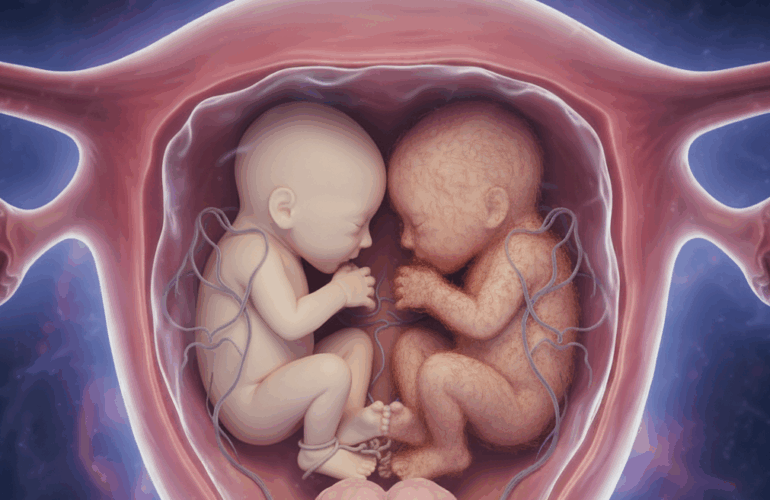
Our matriarch Rivka felt the tension between these two approaches during her pregnancy. When she passed the study house of Shem and Ever, Yaakov would kick. But when she passed a place of idolatry, Esav would kick.
“And the two sons agitated inside her, and she said: if that is the case, why am I like this (lamma ze anokhi)? So she went to inquire of HaShem.” (25:22)
As Rashi writes, “They [the twins] fought over the inheritance of two worlds.”
Each one wanted to have possession of both worlds (Maharal).
But since Esav was naturally inclined towards success in the material world, he was primarily concerned with trying to enter into the world to come – the world of lofty ideals and aspirations above our material existence.
And indeed Esav/Edom/Rome built up an entire theology with the sole purpose of rescuing the soul from becoming lost to oblivion.
The children of Yaakov, on the other hand, were confident as a result of our natural inclination towards the world to come. Our main desire was therefore to attain political power in the material world.
Rivka wasn’t aware that she was carrying two children. Assuming that there was only one fetus in her womb, she found it difficult to understand what she was experiencing.
Our sages offer an alternative explanation of “lamma ze anokhi?” – not “why am I like this?” but rather “why [is there a clash between] ‘this’ and ‘I’?”
In Israel’s mystical teachings, the concept of “Ze” (“This”) often refers to the Creator as the ruler of this world, while “Anokhi” (“I”) refers to Him as ruler of the world to come.
Perhaps the child Rivka was carrying was connected to “Anokhi” – the name describing the Creator in the world to come, where He can be encountered face to face.
Or perhaps the child was connected to “Ze” – the name of the Kadosh Barukh Hu as the G-d of this world.
She therefore went to consult with the Creator, asking to be told exactly what kind of relationship with HaShem the child would have.
The answer was that “There are two nations in your womb” (25:23). One belonging to “Ze“ and the other belonging to “Anokhi.”
When Esav despaired of finding HaShem, when he was feeling “weary” from his own transgressions (see 25:30), Yaakov asked to buy his portion of this world in return for “this red material” (25:30).
Esav preceded his disciple Friedrich Nietzsche by saying, “Behold, I am going to die” (25:32) – the concept of the Divine had died for him – and the result was “why do I need this (ze)?” (ibid)
He relinquished all claims.
As a result of Yaakov’s efforts to take possession of the earthly material level, in addition to his natural spiritual talents, he created a unique synthesis of the voice of Yaakov and the hands of Esav, and was thus transformed into “Israel” – a prince of G-d – who brings the vision of Divine unity back to the world.
Many years later, in a dream, Yaakov saw that he had the ability to unite the different ends of the world together – in a ladder linking heaven and earth.
At that point he was able to say, “G-d is here in this place (Ze), and also in I (Anokhi)… ” (28:16)