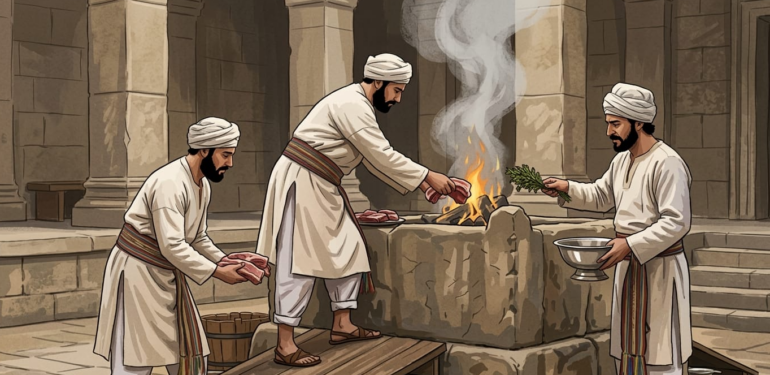
The sequence of the korbanot in Parshat Vayikra is: ola, minḥa, shlamim, ḥatat, asham.
But the sequence in next week’s Torah portion, Parshat Tzav, is: ola, minḥa, ḥatat, asham, shlamim. The shlamim appears to be moved from the middle of the list to the end.
It seems clear that the earlier a korban appears in the text, the more important it is from the perspective of the Divine will.
The ola, where the entire korban is offered up to HaShem, and the minḥa, consisting of grains that are offered or eaten by the kohanim, indicate a person’s complete desire to come close to the Creator, without any personal interest or ulterior motive (such as eating the substance of the korban).
This is an idealistic act that corresponds to the basic trait of a korban as an offering motivated by pure love.
“…when a man offers from within you a korban to HaShem…” (Vayikra 1:2)
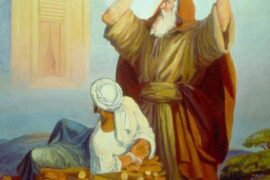
The person’s innermost desire is to offer up himself as a sacrifice to the Creator. But just as HaShem commanded Avraham at the Akeidat (binding of) Yitzḥak, “Do not stretch out your hand” (B’reishit 22:12), because He ultimately wants life and not death, so too for all of the descendants of Yitzḥak we are taught that all the Creator wants is the intent of a person to give up his life, but not the actual sacrifice of his life, which can be replaced by cattle or sheep and brought as a korban.
The shlamim is a more complex korban, where the person bringing it participates in the “meal” at the Divine table. The Altar “eats” and so does the person who brings the korban. But for this situation to be worthy, it is necessary for the person eating to be at a moral level worthy of the Altar.
This type of service is limited to the level of the children of Israel, who are capable of Divine intentions with respect to eating. It’s not relevant for the other nations, who can only bring an ola sacrifice, since they have not yet reached the stage of being able to incorporate their own bodily pleasures into serving the Creator.
The ḥatat and the asham are korbanot meant to atone for transgressions. They are brought as a result of failure and the need for correcting a situation. These korbanot are necessary only as a result of a problematic situation, and they therefore come at the end of the list in Parshat Vayikra.
But the above sequence featured in Parshat Vayikra is only relevant in the case of a person wanting to bring a korban based on idealistic desires.
Rashi teaches that this “refers to sacrifices that are given as a donation” (Vayikra 1:2) and this is closely related to the subject of Parshat Vayikra, which begins of a series of passages of “The Torah of Moshe.” These passages, which begin with “And He called out to Moshe” (1:1), describe the labor of a refined person who is led by his intellect and is capable of resisting sin.
Parshat Tzav, by contrast, can be seen as a direct continuation of Parshat Tetzave. This is based on an analysis by Rav David Zvi Hoffman, who concludes that Tetzave and Tzav were given as a single continuous passage, where the part linked to the appearance of the Sh’khina was written down in Sefer Sh’mot (in Tetzave) while what is relevant for later generations was written down in Vayikra (in Tzav).
Parshat Tzav emphasizes the obligatory aspect of the korbanot and should be seen as part of the “Torah of Aharon” – which is most relevant for a person who might fail and succumb to sin.
Moshe and Aharon had different understandings of the purpose of the Mishkan. From Aharon’s perspective, people are by nature prone to mistakes and therefore require a means of gaining atonement in order to spiritually clean themselves from transgressions.
This is actually a central part of the role Aharon and his descendants – the kohanim – play. Through the priestly service, the sons of Aharon help the people of Israel to atone for their sins.
But Moshe – who may not have been as close to the people as Aharon but remains forever unmatched in his level of prophecy – saw the Mishkan differently. He related to it primarily as a vehicle for the people of Israel to come close to the Creator.
For Moshe, it wasn’t so much about helping the people atone for their failures as it was about raising them up in HaShem’s service.
Therefore the ḥatat and the asham come before the shlamim in Parshat Tzav (Aharon’s perspective), because before a person has atoned for his transgressions there is a suspicion that he will not bring a shlamim with the correct idealistic intention.