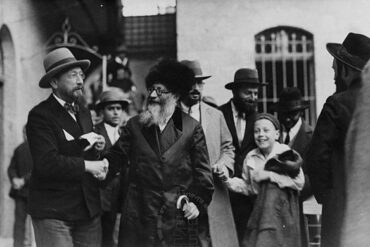
When the Nazis threatened to invade British Mandate Palestine during World War II, US President Franklin Roosevelt urged Palestine’s Chief Rabbi Yitzḥak HaLevi Herzog to remain in the United States for his own safety.
But Rav Herzog rejected the president’s pleas, responding: “It has been handed down to us that there will only be two destructions; a third destruction will not be!”
He not only said this, but he also immediately returned to the land. This was not a random statement; it was a testament to a profound truth and a redemptive secret whose beginning is in the Torah and whose end is in history: once the “revealed end” has begun, the process of redemption is irreversible and has no interruption.
This unwavering conviction is not just a relic of the past. It is a living truth that has echoed through generations.
In the early 1960s, my parents made the audacious decision to leave the United States, a place of seemingly endless opportunities, and ascend to the land of Israel. This was at a time when the common Israeli joke was that the last person to leave the land should not forget to turn off the lights at the airport, reflecting widespread skepticism about the young state’s future.
My parents were driven by a deep inner conviction and an unshakeable belief that the future of the Jewish people lay here in our land. Over time, their certainty proved true, and even family members who initially opposed their decision later joined them, along with tens of thousands of others.
I seek to touch upon this principle of emuna and connect it to the beating heart of the Divine commandment to settle the land of Israel. I will take you on a journey through the depths of commentary, wisdom, and mysticism to understand that our connection to the land is an eternal and unbreakable bond.
From “Dispossession” to “Inheritance”: A Dispute that Touches the Soul
On the surface, the commandment in Parshat Mas’ei appears straightforward: “And you shall drive out the inhabitants of the land… for unto you have I given the land to possess it.” (Bamidbar 33:52-53)
But Rashi and the Ramban, two of our greatest giants, approach the verse very differently.
Rashi sees the act of “dispossession” as a pragmatic prerequisite: “If you dispossess the inhabitants of the land, then you may dwell therein.”
For Rashi, driving out the land’s inhabitants is a necessary condition for a secure existence.
The Ramban, however, raises the discussion above pragmatic considerations. He interprets “you shall possess” not as a condition for settlement, but as an outright positive commandment from the Torah to possess and settle the land. It is no longer a matter of free choice whether to conquer the land or live in Assyria or Babylon; it is a Divine command that cannot be challenged.
The Land Weeps & the Soul is Torn
Our sages teach us that separation from the land is a tragedy for the Jewish soul.
The Sifrei tells of sages who set out to leave the land, but on their way, “their eyes filled with tears and they rent their garments.”
The separation tore at their souls, and their entire being cried out: “Living in Eretz Yisrael is equal in weight to all the mizvot of the Torah.”
Why?
As our sages teach, the Torah is not merely a collection of personal obligations, but a Divine plan for building a complete national society governed by its precepts. This plan can only be fulfilled properly and holistically in the land of Israel.
Therefore, “whoever resides in Eretz Yisrael is like one who has a God, whilst whoever resides outside of it is like one who has no God.”
The land is not just a geographical place; it is the nation of Israel’s soulmate.
The Land’s Moral Purity & the Loss of Right to Live Here
The land is not a passive possession. It’s alive and sensitive to the actions of its inhabitants. The TaNaKh teaches us that the shedding of blood “defiles the land” (Bamidbar 35:33).
This blood wounds the land and prevents the Divine Presence from dwelling within it (Bamidbar 35:34).
The prophet Yeḥezkel even attributes the exile itself to this defilement: “I poured out My fury on them because of the blood they had shed on the land, and because they had defiled it with their idols” (Yeḥezkel 36:18]).
These sources make it clear that the connection between a people its their land is conditional on a fundamental moral contract.
The land, in its sacred sensitivity, is understood to “vomit out” those who engage in acts like murder, idolatry, and forbidden sexual relations. While not the focus of this article, it is also important to note that, according to the Noaḥide laws, even gentiles are obligated to refrain from such acts, especially when residing in the land of Israel.
Above all, HaRav Kook teaches us that this connection cannot be understood solely through human rationality. It is a mystical and essential bond found deep within the nation of Israel’s soul, from which stems the “hope for salvation” that even gives strength to the Torah in the Diaspora (Orot, Eretz Yisrael 1).
But while HaRav Kook acknowledges that Jewish life in the Diaspora receives power and inspiration from the land, he emphasizes that Jewish life in the life constitutes salvation itself (ibid).
This brings us to a crucial point: the unique match between the Jewish people and our land is like a tropical plant that can only flourish in a tropical climate.
Just as a plant’s true essence can only be realized on its native soil, so too can the Jewish people fully express our unique spiritual quality and bring the world closer to the Creator only in the land of Israel — the land that the Creator chose as His dwelling place.
The long period of Jewish exile, therefore, was an anomaly, a necessary but temporary situation that is now ending with their return of Israel to our land and the rebuilding of our national framework for the third time in history.
The Eternal Song of Redemption
All the redemptions that preceded us were painful. The Mekhilta teaches us that the songs recited about them were likened to a woman, like the pangs of childbirth that are followed by pain and suffering. Indeed, the redemption from Egypt was followed by the destruction of our first Temple, and the redemption from Babylon by the destruction of the second Temple. But the song of future redemption is likened to a man, for “that future redemption will not be followed by subjugation.”
This is a Divine promise that after this redemption, there will be no more destruction or sorrow.
The prophets and sages repeated this promise explicitly:
- The Pesikta Rabbati promises that this redemption will be an “everlasting salvation.”
- The Midrashim promise that Jerusalem will be built and will stand forever.
- The Arukh and Tosafot explain that of the three Temples, only two were destined to be destroyed, while the third “will stand forever.”
This eternal promise is not only about the Temple, but also about the entire process of redemption, as the Temple is the pinnacle and culmination of the rebuilding of Jerusalem. The bond between the people and the land is one of eternal redemption, based on a Divine promise that this connection will never again be severed.
Conclusion: An Eternal Call
From the return to Zion to our present day, we are witnesses to the fulfillment of these prophecies.
The story of Rav Herzog and the unwavering emuna of my parents is not merely a tale of courage but an act of profound belief in an eternal truth. The commandment to possess, live in, and settle the land of Israel is not just a mitzva; it is a privilege, a right, and, above all, a call to the soul to take part in an unending process of redemption.
This is the ultimate promise: the current redemption is an eternal one. It is an “everlasting salvation” and there is no longer any room to fear a future destruction.
Despite all the difficulties, trials, and pain, we know that the building of the land is an eternal building, and that the Divine promise “I will build you up and not destroy you” is an everlasting command that is being fulfilled in our time.