
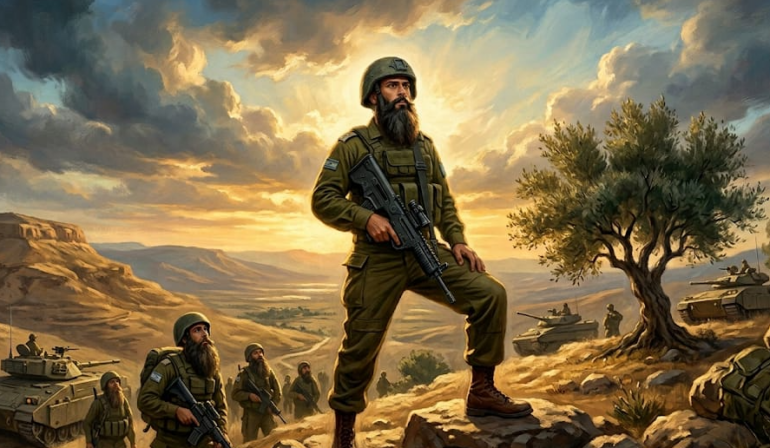
War is an unfortunate part of our reality.
From the earliest periods of human history, there have always been wars. Despite humanity’s lofty stature in Creation, people have always busied themselves with schemes of how to dominate – and even kill – one another.
This gave the philosophers a lot to ponder throughout the ages, with some even idealizing the concept of war. Some argued that war is a positive and constructive means of forging strength and advancing human progress.
The people of Israel never accepted this approach. We’ve always seen war as a terrible event. But we still can’t escape an important question: After the fact, what significant role have all the wars of humanity served?
HaRav Avraham Yitzḥak HaKohen Kook emphasizes that the reason for war is not connected to the Divine guidance of the world but rather stems from mankind’s evil inclination. When the social and legal restraints are loosened and the evil inclination runs wild, the Kadosh Barukh Hu utilizes the wars which take place for history’s highest ideals.
This is why the Creator is called “the Master of War.” He makes use of war to spread righteousness and as a basis for building up the world that will arise in the wake of the war. Together with all of this, He also sows the seeds of salvation.
With respect to the harm caused by the wars, we say every day that “He creates cures, is awesome and praiseworthy, the master of wonders” (daily morning tefilllot before reciting Sh’ma Yisrael). And as part of this, “every day out of His goodness He renews the actions of Creation,” and He brings new light to the world.
Israel also fights wars. Of course it would be better if we could perform our mission without waging war. But when we do encounter war, we must not hesitate to fight. And that is why we have both obligatory and optional wars, with many rules for organizing each.
In the first war, between Kayin and Hevel, Kayin was the guilty party but Hevel also shared the blame, in a weak sense.
It is written, “And Kayin rose up against his brother Hevel.” (B’reishit 4:8)
If Kayin rose up, this means that beforehand he was lying down. According to the Midrash (B’reishit Rabbah), Kayin was lying down under Hevel, who was about to kill him, based on the principle that “If one rises up to kill you, defend yourself by killing him first” (Sanhedrin 72a).
Kayin said to him, “If you kill me, what will you tell our father?” So Hevel freed Kayin, who rose up and killed him. Hevel’s mistake was to assume that the murderer abided by the same values that he did, and he spoke to the murderer instead of killing him.
The hidden ethical complaint of the nations of the world to us is: Do not act like Kayin, act like Hevel! If you use the weapons of Kayin, your end will be like his! However, the Torah emphasized that the human ideal is not the character of Hevel but that of Shet, “another child, to replace Hevel, for Kayin killed him” (B’reishit 4:25).
This is the type of person about whom it is written that Adam “gave birth in his image” (5:3). This is an updated version of Hevel that knows how to utilize the weapons of Kayin. It is the true archetype of Israel (the voice of Yaakov able to adopt the hands of Esav when necessary).
Coping with the reality of wars and their laws elevates us to higher ethical horizons. And that is why much of Parshat Ki Tetzei includes laws of war, especially the holy war against Amalek, in an effort to eradicate evil from the world.
Our success in these wars will reveal to all humanity that the source of righteousness lies with the nation of Israel and not with counterfeit morality of those who attempt to pressure us to surrender to our enemies.
Translation by Dr. Moshe Goldberg