Since Aharon and his sons sat at the entrance to the Mishkan for seven days, the day of the dedication should in fact be called the “eighth day.”
But since it is also called “the first day – when the joy was equal to that of the day when the heaven and the earth were created” (Megilla 10b), we can also consider it to be the eighth day of Creation.
In the Creation narrative, our natural world is called the “seventh day” and this day is not yet finished, as is clear from the fact that nowhere is it written, “And it was evening and it was morning, the end of the seventh day” (as is written for each of the first six days).
The “seventh day” is the time when HaShem stops modifying the laws of nature in our world and no longer interferes directly with the organized order of Creation.
Instead of the Creator, mankind performs the labor, acting almost as a “Shabbos Goy” for HaShem.
From the human perspective, this is a weekday and we are the ones performing the labor instead of the Creator, who is “resting” on His Shabbat. The six thousand years of the “seventh day” are divided into six separate historical eras, corresponding to the days of the week.
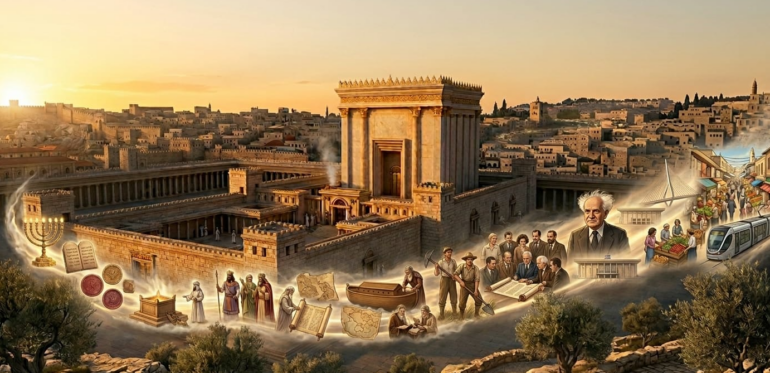
A precursor of the “eighth day” also exists in our world. The Temple, a place of direct contact between the Creator and His creatures.
The Temple belongs to the “eighth day” and therefore the laws that apply there differ from those of our world. Korbanot are brought on Shabbat and the kohanim wear shaatnez (cloth combining both animal and plant materials), among other things. This corresponds to the words of the sages, that the mitzvot will be annulled in the end of days (Nidda 61b, Vayikra Rabba 9:7). The main element in the Temple is the face-to-face meeting with HaShem at the end of days.
The seven days when Aharon and his sons waited in anticipation serve as a repeat of human history and a preparation for the “eighth day.”
If we had been found worthy, the dedication of the Mishkan would have brought the world into the “eighth day.” But this didn’t happen for two reasons:
1. The actions of Nadav and Avihu
2. The fact that the Temple had not yet arrived at its destined final site – Jerusalem
So the broader world remained in the “seventh day” with a single point of contact with the “eighth day” – the Temple.
Since the mitzvot of the Torah of Moshe will be annulled on the “eighth day,” one might think that in the Temple it wasn’t necessary to listen to Moshe. There the Torah of Aharon reigned, separate from the Torah of Moshe. And Nadav and Avihu felt that they could decide for themselves what to do. This same concern continued through the generations, when the Kohen Gadol would enter the Kodesh Kodeshim alone and there would be no way to know whether or not he had followed the detailed instructions of the sages.
In the Talmudic Tractate of Yoma, it is written that “two Torah scholars, disciples of Moshe” told the High Priest to swear that he would not change anything of what they had taught him. Evidently, there was a concern that the High Priest would be tempted to detach himself from the Torah of Moshe.
How can this be prevented? He would be asked to take an oath. The root of the Hebrew word for oath is shin–bet–ayin, which also means seven – the Kohen Gadol would be brought back into the “seventh day,” even though he had started to enter into the “eighth day.”
In terms of personal satisfaction, the High Priest would like to remain in the “eighth day” but for the good of the nation we ask him to return to the “seventh day” in order to pass along to us something of the flavor of the next world.
Note that the peak of Yom Kippur is when the Kohen Gadol leaves the Holy of Holies and not when he enters: “How wonderful it was for the High Priest when he left the holy area in peace” (Yom Kippur Mussaf).