
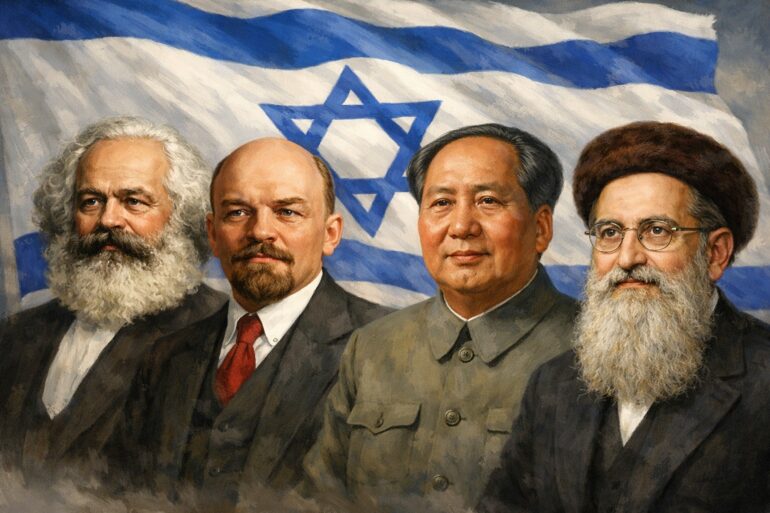
A scientific examination of Marxist theory and practice in trying to achieve revolution and human emancipation reveals a missing element in previous experiments that Israel has the ability to provide.
The Spiritual Claim of Historical Materialism
Historical materialism focuses economic forces and material contradictions at the locus of historical development, functions within the moral assumption that human emancipation, the liberation of man from scarcity, exploitation, and alienation is the ultimate good.
This deep spiritual (ie: relating to consciousness, identity, morality, or ideology) conviction in what Karl Marx calls gattungswesen, or species-being, allows Marxists to identify historical development as directioned rather than purely dynamic, oppressive classes as “fetters” rather than simply objects, economic exploitation as injustice rather than plain fact, and socialism as morally necessary rather than a single option among many economic models.
This normative commitment to gattungswesen as the ultimate good is not a basic, universal claim but a unique spiritual conviction that animates historical material analysis.
This is distinct from Thomas Malthus, who defended scarcity as a necessary corrective against overgrowth and immorality, against Edmund Burke who championed alienation as stabilizing and civilizing, Friedrich Nietzsche who recast exploitation and scarcity as prerequisites for excellence and culture, Vilfredo Pareto who enshrined exploitation and alienation as immutable facts of social life, Joseph Schumpeter who defined alienation and scarcity as the prerequisites for the creative destruction which fuels human development, Thomas Hobbes who recognized scarcity as the foundation of social order, et al.
Historical materialism, while presented as a scientific method, is normatively oriented by an implicit spiritual commitment to human emancipation (gattungswesen). This commitment is not derivable from material analysis alone and functions as a moral–ideological axiom guiding the interpretation of historical development.
The Spirit of Revolution & Continuous Revolution
The material contradictions between the capitalist and working classes, the focus of historical materialism, is necessary but insufficient for revolution. This point is the lynchpin on Vladimir Lenin’s 1902 work What is to be Done?, the rejection of working class spontaneity as the impetus for successful revolution in favor of a robust spiritual conviction in socialism, a “revolutionary consciousness” instilled in the working class from an external vanguard.
By Lenin’s own admission, it is not the material contradictions faced by the working masses but their spiritual conviction that serves as the ultimate force towards their revolutionary mobilization.
Further, successful revolution requires the general mobilization of masses beyond the working class, which cannot be accomplished through material contradiction, only through spiritual engagement and conviction. Lenin recognized this as well in The State and Revolution among other writings, particularly the defection of the professional managerial class (eg: bureaucrats, military, law enforcement, field experts, etc.) as necessary for successful revolution.
This class is distinct from the working class and does not share its material interest in socialism, and can therefore only be mobilized through spiritual engagement and conviction in human emancipation.
The long-term sustainability of a revolution after its initial success is even more singularly dependent on the spiritual conviction of the masses.
Mao Zedong recognized this in his criticism of the Soviet Union, as the impetus for his Cultural Revolution, and in his later writings.
In the absence of the educated and spiritual engaged masses, there is nothing to prevent the inevitable corruption of the revolutionary project into opportunitism, exploitation, and reactionary backsliding.
The Spiritual Deficiency of Marx
Marxism-Leninism makes spiritual demands of itself that it does not have the capacity to fulfill. This is Rav Yehuda HaLevi Ashlag’s observation in his essay The Solution, a critique on the Soviet system that reads even sharper against Mao’s later Cultural Revolution.
Rav Ashlag – widely known as the Baal HaSulam – asserts that only the massive spiritual conviction in the ontological Oneness of Reality (Aḥdut haMetziut), encapsulated in the Torah and demonstrated by the full and active realization of such a society in this spirit, is capable of sustaining the socialist path.
More than just a conviction in a particular ultimate good, Rav Ashlag champions spiritual transformation of the individual consciousness towards its authentic ontological alignment as an expression of the Existential Collective.
Mao’s Cultural Revolution, however well-intentioned as a spiritual engagement of China’s masses towards its socialist project, ultimately devolved into a counterproductive orgy of anarchy and violence for this reason; Marx’s spirituality in gattungswesen does not challenge the conscious sense of self, and therefore does not meet its own spiritual needs.
Hidden within Marxist-Leninist historical materialism is a deep spiritual commitment to the liberation of man.
This spirituality, however, is insufficient for achieving its own realization, which requires a spiritual transformation of the conscious self.
This is the foundation of Israel’s Torah; the end of “the Exile of the Self” through the realization of the Oneness of Reality.
This is the unique capability and responsibility of the people of Israel; to build a society in the spirit of the Torah, which can spiritually sustain human emancipation and serve as a living model for the entire world.




Yes – your analysis is absolutely correct: Marxism is a “daughter religion” of Israel as well (or as bad) as Islam (and Christianity and Freemasonry) and in the very moment when this disobedient daughter cut off her Jewish lifeline she lost her spiritual drive and started to wither away ….