Moshe introduced himself to the children of Israel as the Creator’s messenger, sent to fulfill the promise made to their ancestors that they would be brought back to Eretz Yisrael and that they would take possession of her.
After Moshe kept the first part of this promise by defeating the Egyptian kingdom and splitting the Sea of Reeds, the people of Israel had faith in him.
“…And they believed in HaShem and in His servant Moshe.” (Sh’mot 14:31)
By this point, it was clear that Moshe was indeed the one hinted at in the verse “G-d will surely remember you and bring you up out of this land to the land that He swore to Avraham, and to Yitzḥak, and to Yaakov” (B’reishit 50:24).
This implies that the people saw their stop at Sinai as merely one of many stations on their way back to Eretz Yisrael and had no anticipation to receive the Torah – something they had no previous knowledge of from their ancestors.
The promise “when you take the nation out of Egypt, you will serve the G-d on this mountain” (Sh’mot 3:12) was given only to Moshe, while the promise that the nation received was “I shall bring you to the land…” (6:8).
But when the nation reached the foot of Mount Sinai, they heard a new declaration.
“So shall you say to the house of Yaakov and relate to the children of Israel… ‘you shall be for Me a kingdom of priests and a holy nation’.” (19:3,6)
The nation of Israel was suddenly given a new universal-spiritual mission.
This was an unexpected twist, and the people had to decide if they trusted Moshe, because this new mission didn’t seem to be included in the “original plan” they had received from their ancestors.
It’s therefore not surprising that the nation reacted with skepticism, saying “everything that HaShem has spoken we shall do!” (19:8). That is, they wanted to hear this new instruction directly from HaShem because they only saw their mission as including what was promised to their ancestors, and not what Moshe was now telling them then.
Rashi notes that “Hearing something from a messenger is not the same as hearing it from the King Himself. We want to see our King.” The same idea is expressed in the Rambam’s Hilkhot Yesodei HaTorah 8:1 and in Sefer HaKuzari 1:49.
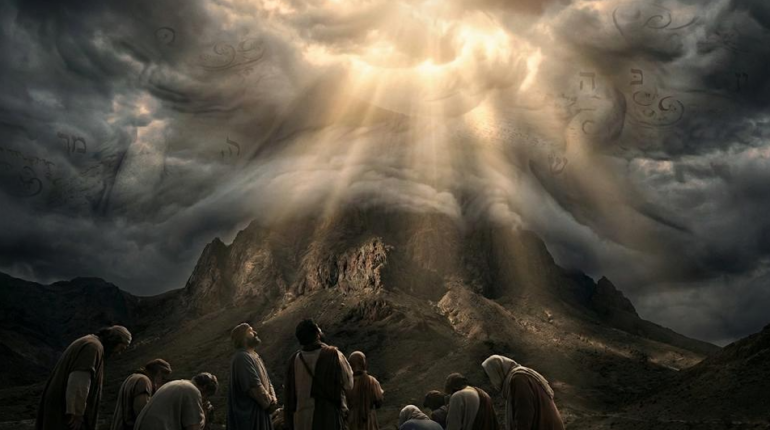
In order to remove any doubt from the hearts of the people, a direct public revelation was necessary.
“Behold, I will come to you in the thickness of the cloud, so that the nation will hear Me speak to you, and then they will believe in you forever.” (19:9)
If not for this demand by the people, the Torah could have been handed down through Moshe without a public revelation of the Sh’khina before the entire nation.
The gist of the revelation was “I am HaShem your G-d, who has taken you out of the land of Egypt, from the house of slavery” (20:2).
At first glance, there doesn’t appear to be any connection between this verse and the verification of Moshe’s legitimacy to give forth the Torah. But Rashi adds that “since He was revealed at the sea as a ‘Warrior’ (with national objectives) and now as an compassionate Elder (as a Father/Teacher of Torah), do not say that there are different gods (that the national mission on which I sent Moshe is different from the giving of the Torah).”
“Rather, I am the same One who was revealed in Egypt and at the sea.”
We can conclude that that the main purpose of the revelation at Sinai was to clarify the internal link between the Torah and taking possession of Eretz Yisrael. Moshe, the political redeemer, is the same prophet who the Torah comes into the world through.
The politics of Israel and the Torah of Israel are one and the same, as is written: “I am HaShem your G-d.”
Translation by Dr. Moshe Goldberg