“Who is this G-d whose voice I should listen to?” (Sh’mot 5:2)
If we can look passed the blasphemous nature of Pharaoh’s question, we should be able to admit that his demand has some logic.
After all, Pharaoh held a position more powerful than any that came before. He was the leader of the most enlightened society of its time, which would influence the direction of all subsequent history. And Moshe demanded from Pharaoh that he surrender Egypt’s economic base, the slaves, thereby initiating the empire’s collapse.
Even worse than this – these slaves would be the ones who would lead and direct humanity’s progress from then on. And Pharaoh was supposed to accede to these demands merely because Moshe spoke to him in the name of an unknown Deity?
It was actually very reasonable for Pharaoh to reject this demand.
Pharaoh’s reply was as follows: I will accept your demand if you prove to me that it is correct. What is needed to do this is for HaShem to be revealed to Pharaoh. And that is indeed what was accomplished in the process of the plagues, whose stated purpose was that “Egypt will know that I am G-d” (7:5).
Egypt and not Israel was actually the primary target of the revelation.
The plagues emphasized Israel’s unique position, contrasted with Egypt’s, in order to justify the demand for Pharaoh to give up his empire’s position in human history.
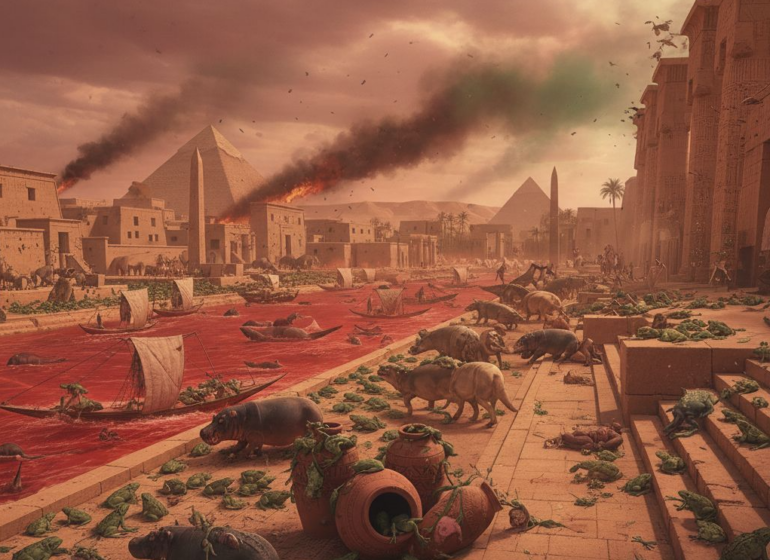
The Plague of Blood, which damaged the Nile – the great natural force upon which Egypt was based – didn’t harm Israel. This demonstrated the capability of Israel to overcome natural stumbling blocks, a skill that was acquired from Avraham, who “crossed the river” to the other side.
The Plague of Frogs was based on being willing to sacrifice – the frogs were willing to enter hot ovens in order to do the Creator’s bidding – and this is characteristic of the tradition of self-sacrifice that Yitzḥak taught the children of Israel.
The Plague of Lice, which demonstrated the Creator’s power over creatures too small for demons to have influence over (Rashi), was based on the power of Yaakov – who was given the title of “G-d” by the Holy One, Blessed be He (see Megilla 18). Israel’s unique status results from the traits that came to them from the ancestors.
But it is yet possible to claim that in spite of their unique traits, when they went down to Egypt in the days of Yosef, the nation of Israel agreed to combine their experience with that of the Egyptian Empire.
The reply to this claim is that the Hebrews maintained a separate cultural existence in Egypt, even dwelling in the territory of Goshen specifically in order not to mingle with the Egyptians. The proof of this idea was the Plague of Wild Animals, where Goshen was kept separate.
“Where My nation dwells, and the wild animals will not come there.” (8:18)
That is, this was done in such a way that Egypt and the Hebrews did not mix together.
One might still try to claim that since we are all human beings, we must continue to participate in the same historical processes.
The Plagues of the Epidemic, Boils, and Locusts, which harmed Egypt but not Israel, occurred because of the ethical downfall of humanity in the generation of the Flood.
In addition, the idol worship at the Tower of Babel was symbolized by the throwing of black soot towards the sky in the Plague of Boils. And the illicit sexual behavior of S’dom was punished by a mixture of fire and water as in the Plague of Hail, where fire was mixed in with the icy hail.
In summary, the plagues demonstrated the ethical gap between the nations of Israel and Egypt.
Translation by Dr. Moshe Goldberg