Once again, as Jews around the world were blissfully immersed in the timeless experience of Shabbat, geopolitical developments took a major step forward.
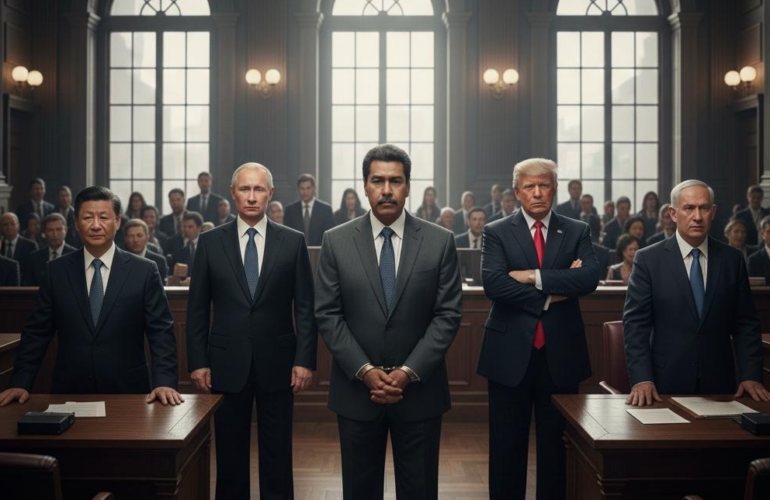
At 01:00 in Washington DC on Saturday, President Donald Trump’s aptly renamed “Department of War” began an invasion of Venezuela and kidnapped President Nicolás Maduro with plans to try him in New York for drug and terror operations.
Trump has since then announced that the US military will maintain a presence on the ground until a transition to democracy is completed.
While many have celebrated this move as a step towards stability and peace, a closer look indicates that this may be only the first step in an escalating global conflict.
The Trump administration has been presenting its position on Venezuela as a revival of the Monroe Doctrine, with the White House releasing a statement to that effect a month ago.
In 1823, the Monroe Doctrine was a fledgling America’s attempt to assert regional hegemony, laid out in President James Monroe’s penultimate State of the Union address.
On the tailwind of Latin American independence movements, Monroe called on European powers to refrain from re-exerting overt or covert influence in the Western Hemisphere, respecting it as Washington’s sphere of influence, while Washington would refrain from meddling in European affairs, or undermining the few remaining European colonies.
Monroe framed all such interference in the hemisphere as a direct threat to US security, despite lacking the necessary military power to enforce such a declaration.
Attempts by Trump to revive the Monroe Doctrine ignore a few critical facts.
First, the US is no longer an aspiring regional hegemon, but rather a global empire in decline as its decades of unipolar dominance seem to be receding.
Claiming Monroe’s mantle is laughable when there’s not a corner of planet earth that isn’t under the influence of Trump’s Department of War.
Similarly, while the “Trump Corollary” claims to be an update of the “Roosevelt Corollary” that aimed to prevent European imposition in the face of a Latin American debt crisis, replacing European powers with Russia, China, and “globalist institutions” (in which both have considerable influence), it glosses over the role of NATO in the current war between Russia and Ukraine, and Washington’s ties to South Korea, Japan, and Taiwan, all within what could reasonably be considered China’s geographical sphere of influence.
By targeting not only foreign military power but also foreign trade and infrastructure, Trump is ultimately trying to monopolize the economies of the hemisphere, freezing out non-hemispheric competitors in an effort to isolate Brazil and undermine its membership in BRICS – a bloc of nations aimed at reducing economic dependence on Washington and the US Dollar.
By recognizing that Trump is insisting on total domination of the Western Hemisphere, while maintaining pressure on global rivals through emboldening countries in their spheres of influence, we can better understand the context of American actions in Venezuela.
While nowhere near as serious a threat as it was during the Cold War, Vladimir Putin’s Russia has maintained considerable influence, framing itself repeatedly as a champion of the Global South and counterweight to US hegemony.
The current war in Ukraine – widely understood to be a proxy war between Washington and its NATO allies on the one hand and Moscow on the other – has demonstrated that despite battlefield losses and the high economic costs of the war, Putin has no intention of folding.
But a recent drone strike near Putin’s residence has provided the White House with new leverage.
While CIA assessments indicate that the strike targeted a nearby military facility rather than Putin himself, Trump advanced a different narrative on his social media.
By reposting editorials claiming any such attack would be “more than justified,” the US president signaled that the era of respecting Moscow’s “red lines” is over.
By flaunting international norms by kidnapping Maduro in Venezuela, Trump is likely also signaling to Putin that his obstinance will not be tolerated, and that the time has come for a ceasefire – on American terms.
Yet China, not Russia, remains Washington’s primary rival on the global stage. And the fall of Caracas is a calculated blow to Beijing.
By toppling Maduro, the leader of one of China’s most significant oil sources outside the dollar-dominated global financial system, Trump is demonstrating that despite its impressive advances, the People’s Republic hasn’t yet built the global infrastructure to defy the United States.
This message was made even clearer by the presence of high-level Chinese diplomats in Caracas at the time of the attack.
Were China to attempt to invade Taiwan and finally remove the American-backed administration that claims to be the legitimate ruler of all of China, a justifiable step according to the framing of the Monroe Doctrine, Washington could unilaterally close off the Malacca Strait to all oil bound to China.
And without the guarantee of a Venezuelan “backdoor,” China’s ability to maintain an offensive against Taiwan in the face of US air and naval support would crumble as their strategic reserves are depleted by a total maritime quarantine.
At the same time, however, any failure by Beijing to act in Taiwan reveals the weakness of their position and the hollowness of their posturing.
In such a scenario, China would have one last resort to replenish their oil supply – Iran.
As the regional leader of the anti-American bloc in West Asia, Iran has spent years positioning itself as China’s primary “sanction-proof” energy partner. It is therefore unsurprising that in the same week that Washington struck Caracas and justified strikes on Moscow, Trump declared that his Department of War was “locked and loaded” to intervene in Tehran if the regime responds with lethal force to growing protests across the country.
Iran must decide if its new transcontinental rail corridor, designed to bypass the Malacca Strait and serve as a lifeline for Beijing, is worth the risk of a Venezuelan-style American intervention.
Even without effecting regime change, Trump’s message to the Islamic Republic is an echo of the one sent to Maduro: the old rules of engagement don’t apply when defending American interests, and standing with Washington’s chief adversaries is a dangerous move.
But what does this all mean for Israel?
While President Yitzḥak Herzog, Prime Minister Binyamin Netanyahu, and Foreign Minister Gideon S’ar have all lauded Trump for toppling Maduro, Israelis must recognize that the Trump Corollary to the Monroe Doctrine holds a warning for us as well.
As Jerusalem is going public about investing over $100 billion in developing military self-sufficiency to decouple the IDF from US dependency, the operation in Venezuela reminds Israeli allies and enemies alike that Washington isn’t to be crossed.
While shifts in US public opinion around foreign aid to Israel make this particular development a political necessity for both nations, Trump is warning Jerusalem that it must maintain a measured pace in decoupling from dependency that never crosses the line into open approaches to Beijing or “non-dollar” defense partnerships.
In this new era, the price of American support is total alignment, and any attempt to seek an “insurance policy” with China is bound to be viewed as a breach of terms.
As we just witnessed the most aggressive expansion of American hard power in a generation, the world is waking up to a reality where the Monroe Doctrine has no boundaries.
What took place in Caracas wasn’t just a regional intervention, but the opening act of a global “Department of War” that recognizes no “red lines” except its own.