The United States has kidnapped Venezuelan President Nicolás Maduro and his wife Cilia Flores while launching airstrikes against their country early Saturday morning.
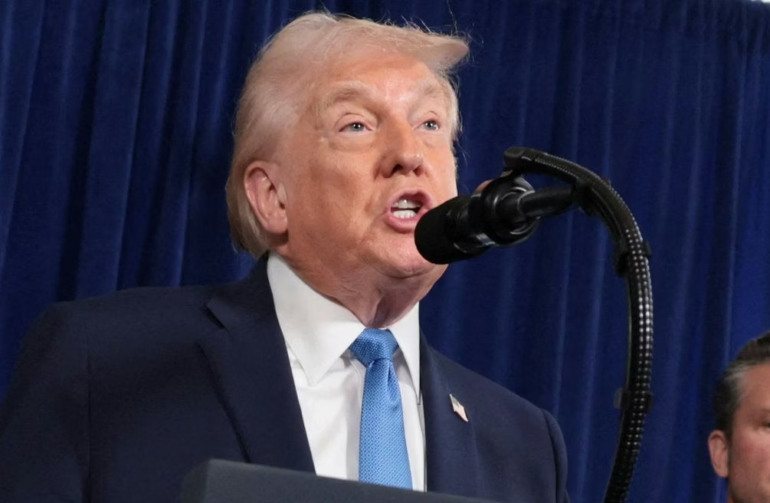
During a press conference, President Donald Trump said his government would run Venezuela until there can be a “proper” transition of power.
“We are going to run the country,” Trump said from his Mar-a-Lago residence and club in Palm Beach.
Tensions between Trump and Maduro had escalated sharply in September, after the US began attacking vessels off the coast of Venezuela, killing more than 100 people, in what Trump described as an effort to thwart drug smuggling.
But we shouldn’t take Trump’s depiction of Maduro as a “narco-terrorist” seriously. Venezuela isn’t even close to being a main source of fentanyl or any other drugs that have caused so many American deaths in recent years. And while Trump has been attacking Venezuelan ships, he also pardoned an actual drug kingpin – the former president of Honduras, Juan Orlando Hernández.
Trump mentioned Venezuela’s oil reserves more than once during the press conference (Venezuela possesses the world’s largest proven crude oil reserves).
“In terms of other countries that want oil, we’re in the oil business,” the president said plainly.
“We’re going to sell it to them. We’re not going to say we’re not going to give it to them. In other words, we’ll be selling oil, probably in much larger doses, because they couldn’t produce very much because their infrastructure was so bad. So, we’ll be selling large amounts of oil to other countries — many of whom are using it now — but I would say many more will come.”
Trump added that American oil companies will spend billions of dollars to fix Venezuela’s oil infrastructure. His plan for the country includes “taking a tremendous amount of wealth out of the ground.”
Regime change in Venezuela has been a US foreign policy goal since Hugo Chávez won the presidency in 1999 and initiated a program of wealth redistribution towards the nation’s poor and working class. Chávez partially nationalized the Venezuelan oil industry to underpin his program. As US aggression increased, he and his successor Maduro pivoted towards Beijing, selling oil at below world market prices to the People’s Republic of China.
A serious analysis of Trump’s actions against Venezuela can’t be divorced from the rising tensions between the United States and China.
The world’s largest oil reserves in a region Washington considers its “backyard” being sold at cut-price rates to its principal geopolitical rival was an insult that couldn’t be ignored.
Trump has had his sights set on unseat Maduro for years.
In 2019, the first Trump administration threw its support behind Juan Guaido, an opposition figure who attempted to oust Maduro in a failed coup. Maduro was indicted the next year in a US court on corruption and drug trafficking charges.
While oil reserves are important in US calculations, Maduro’s abduction is clearly part of a broader attempt to shore up American dominance in the Western hemisphere.
Such a brazen move to kidnap the leader of a government that has forged closer ties to China sends a clear message about what Washington is prepared to do to maintain its hegemony.
But while the main story might be US-China tensions, region dynamics also play an important role in the timing of the attack.
The first 25 years of the 21st Century was dubbed the “pink tide” as left-leaning governments rose to power across Latin America. These governments often used Beijing’s need for their natural resources to lift millions of people out of poverty. But this began to falter around 2011 when the Chinese economy’s growth began to slow and many leaders of the tide were forced to turn to austerity policies.
In the last decade, the regional political pendulum has swung back to the right. But unlike the pre-pink tide right, the regimes that now rule in Argentina, Bolivia, El Salvador, Bolivia, and Chile are far more hardline and inspired by Trump’s MAGA movement in the US.
Since Chávez’s initial electoral victory, Venezuela’s right has openly supported American intervention. A rightist regime in Caracas will likely make itself pliant to American corporate and geopolitical interests while selling off assets to predatory Western companies.
Opposition Leader María Corina Machado, the Venezuelan right’s most prominent public figure (and recent recipient of the Nobel Peace Prize) told the world what to expect.
“We will bring rule of law. We will open markets. We will have security for foreign investment and a transparent massive privatization program that is waiting for you.”
But Trump said at his press conference on Saturday that it would be “very tough” for Machado to lead Venezuela, adding that she “doesn’t have the support within or the respect within the country.”
Trump also noted that Venezuelan Vice President Delcy Rodríguez had been sworn in as interim president.
Despite calls from Rodríguez for Maduro’s immediate release and criticism of the US action as “brutal aggression” on Venezuelan state television, Trump assured reporters that Rodríguez had already spoken to US Secretary of State Marco Rubio and was “essentially willing to do what we think is necessary to make Venezuela great again.”
Whatever the future of Venezuela will be, the kidnapping of Maduro marks yet another step towards a more naked US imperialist aggression. Under Trump, the liberal mask has been removed and there appears little need for even the pretense of “international law.”