
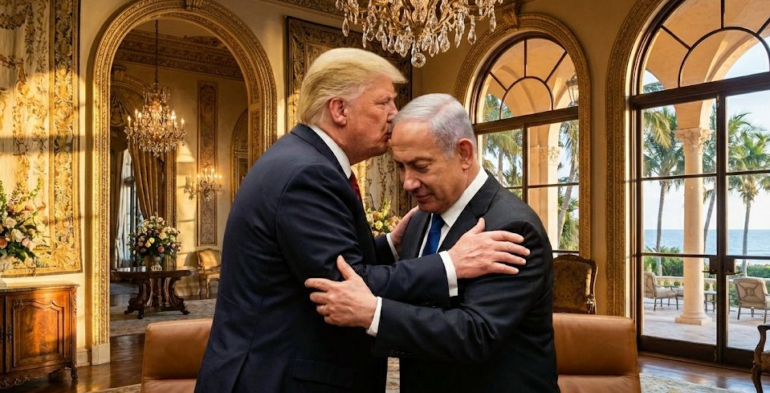
Following a highly publicized meeting this Monday between Prime Minister Binyamin Netanyahu (Likud) and United States President Donald Trump at the latter’s Mar-a-Lago club in Palm Beach, a public disagreement has emerged around the question of how well that meeting went for Israel.
Amit Segal of Channel 12 News put an extremely positive spin on the meeting, explaining that Netanyahu had received everything he wanted from the president.
“Israel is getting nine out of ten things it wanted, and Netanyahu, apropos the pardon, is getting eleven out of ten,” Segal argued.
Barak Ravid of Axios, by contrast, chose to emphasize the fact that Trump and his top advisers had urged Netanyahu to change Israel’s policies in the disputed Samaria and Judea regions.
The recent expansion of Jewish communities in the West Bank is something that defies decades of US foreign policy, which demands that Israel relinquish the territories won in the 1967 Six Day War.
While Israeli pundits and political figures have spent the last couple days debating whether Monday’s meeting should be seen as positive or negative from the perspective of Israeli. interests and security needs, it’s important to zoom out and challenge some of the core assumptions at the heart of this discussion.
The first question we need to ask ourselves is whether or not it’s healthy for Israel’s political leadership and media to relate to the United States as some kind of overlord with the power to decide if we can pursue our interests as we perceive them.
Even the constant references to Trump by Israeli and Diaspora Jewish leaders as the “most pro-Israel American president” imply there to be serious ramification to how a US president thinks about Israel and what he is willing to let us do – as if our survival depends on Washington’s approval and support.
Is this the reality? And, if so, should it be?
Regardless of whether we see Israel as a vassal or an ally of the United States, the next question we should ask is what a “pro-Israel” US foreign policy even looks like.
If the United States were to be a genuine ally that respects Israel as an independent nation – or even as a valued client state – it would want Israel to be as powerful as possible.
In general, this would mean not pushing Jerusalem towards policies that weaken Israel’s standing or capabilities.
But more specifically, following the events of the last two years, this would mean recognizing Israel as the regional hegemon in West Asia and capitalizing on this fact by granting Israel full autonomy to act as a formidable representative of American power.
If the State of Israel were to actually be perceived by those who craft Washington’s foreign policy as a dependable American ally with shared values and interests, US policy would cede the space and grant Jerusalem the latitude to represent Washington’s interests (along with its own) with full imperial backing.
But that’s not the reality.
Despite the fantasy held by many Israelis and Diaspora Jews that American leaders see Israel as some kind of special friend, Washington has consistently treated Israel as if it were nothing more than one client state among many client states, balanced against the clients of the US Empire’s rivals.
The Trump administration has been no exception to this rule. In fact, we see the extent of its disrespect and disregard for Israeli interests and security needs in its Gaza policies.
This is clearly demonstrated by Trump’s Project Sunrise – a plan absurdly premised on the notion that Gaza can be demilitarized by some International Stabilization Force (ISF) when it’s glaringly obvious that the only force with the will, capability, and capacity to disarm Hamas is Israel.
Either Israel will disarm Hamas or they won’t be disarmed. And if Hamas won’t be disarmed, it’s unlikely that Trump’s Gaza plan could meet with any success.
This being the case, some Israeli leaders have adopted the attitude that because Trump’s objectives are destined to fail, Netanyahu should dutifully play along and agree to move forward with the president’s plan in order to stay on his good side.
The problem with this approach is that the Americans know how to build international structures that institutionalize and lock smaller nations into bad plans (like the Oslo Accords).
Even if one could argue that Trump isn’t serious about his program for Gaza, Netanyahu’s agreement – even if based on the assumption the plan will fail – can allow the next US administration to inherit and more deeply institutionalize features of the policy that undermine Israeli interests and threaten Israel’s security (like international forces in Gaza).
Once entrenched and intertwined with the interests of several actors invested in the process itself (more than the actual stated outcome), these structures can become very difficult to dismantle.





Barak Ravid is a stenographer for someone in the DC deep state. He never questions just reporting what is “leaked”. I would say planted. Segal is a much better news source.