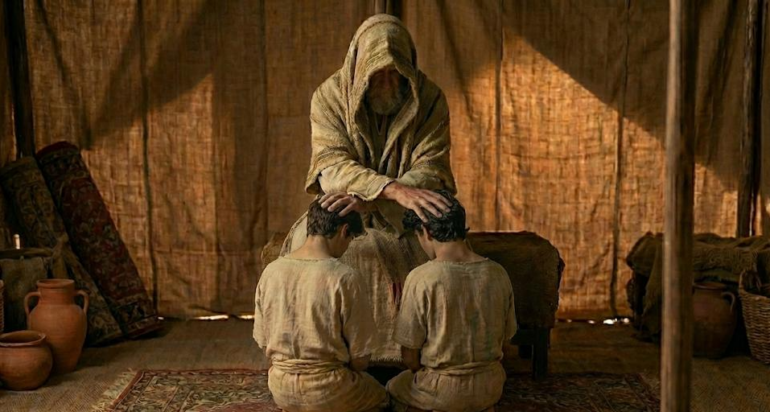
“And he called for his son, Yosef.” (B’reishit 47:29)
Rashi notes that: “He [Yosef] was the one who could accomplish the task.”
At first glance, this seems superfluous. What does Rashi add that we didn’t know before? Everybody should understand, without any commentary, that if Yaakov turned specifically to Yosef and not to his other sons, it was because Yosef had the power – as viceroy of the land of Egypt – to fulfill Yaakov’s request.
If we look at the actual verse in the Torah, we see that the cantillation note on the word “vayikra” (he called) is a “munaḥ” – a note that in this case marks a brief pause in the reading.
That is, Yaakov turned first to the Kadosh Barukh Hu because He has the real power. As an extension of this request, Yaakov turned to his son Yosef to fulfill the Divine Will. This indicates that the era of Yaakov being the earthly “Chariot of the Sh’khina (Divine Presence)” was coming to an end and that the time had come for Yosef to take over this role.
Based on this reasoning, we can explain the apparent contradiction in Rashi’s words on B’reishit 47:31.
“‘And Israel bowed down’ – When the time comes for the fox to rule, bow down to him.”
This implies that Yaakov bowed to Yosef, and that it was the proper thing to do. But the verse continues.
“‘At the head of the bed’ – He turned his head to the Sh’khina.”
This implies that Yaakov should not have bowed down to Yosef. According to the idea noted above, the real meaning of bowing “to the Sh’khina” is that Yaakov bowed down to Yosef, since the Sh’khina manifested itself through him during Israel’s exile in Egypt.
While it’s true that Yosef was not privileged to become a “fourth patriarch” of the nation since – following Yaakov – the entire family became holy and Israel includes within it all the sons of Yaakov, whose “bed was complete,” it’s also true that Yosef was given some of the traits of a patriarch in that both of his two sons, Ephraim and Menashe, became distinct Israelite tribes. In this way Yosef achieved the status of a firstborn son with a double inheritance.
What then is the essence of the dispute between Yosef and his father Yaakov about whether Ephraim or Menashe should come first? It appears that Yaakov may have attempted to correct the path that Yosef had taken.
Menashe’s name was symbolic of Yosef’s estrangement from his father’s house: “G-d has caused me to forget… all of my father’s house.” (B’reishit 41:51)
With this separation as a background, Ephraim appeared as a symbol of Yosef’s success that followed in the wake of this separation.
“G-d made me fruitful in the land of my suffering.” (41:52)
But once the family of Yaakov reconnected and all the tribes were linked together by bonds of love and reconciliation, the sequence had to be changed – Ephraim from then on must appear before Menashe. This demonstrated that success would be achieved through renewing the connection to Yaakov rather than by severing it.
Menashe was thus given responsibility not for forgetting but for enhancing the memories. This would take place generations later, when the tribes of Reuven and Gad ask to dwell on the eastern side of the Jordan River. Half of the tribe of Menashe would be sent with them to maintain the unity and the collective memory shared by all the tribes of Israel.
Translation by Dr. Moshe Goldberg