
Reuven appears in Parshat Vayeishev in a minor but important role.
At his birth, it is written, “And she [Leah] called his name Reuven” (B’reishit 29:32).
Rashi comments: “See the difference between my son and the son of my father-in-law.”
Reuven is different from Esav, Leah’s brother-in-law. Esav wants to kill his brother Yaakov, but Reuven for the first time in history is a firstborn who not only doesn’t try to kill his own brother but actually attempts to rescue him. It is written, “… in order to rescue him from their hands and bring him back to his father” (37:22).
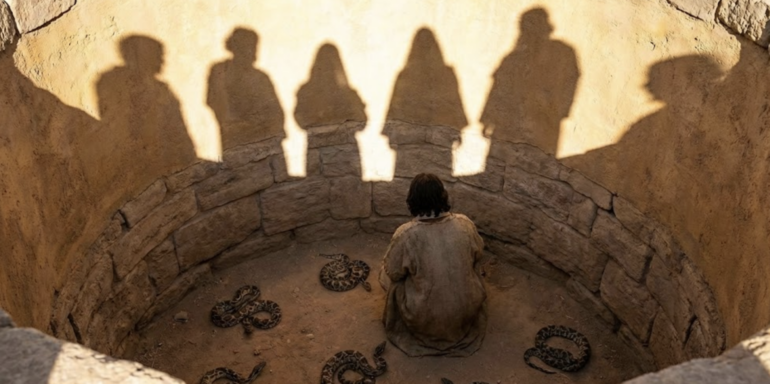
But in all the verses related to selling Yosef and the interaction between the brothers, Reuven appears as one whose rescue efforts fail. He proposes to put Yosef in the pit in order to later save him, but the result is that he is sold into slavery.
Where was Reuven while Yosef was sold? Our sages teach us that at that time he was “busy with his sackcloth and his fasting” – he was involved in penitence for his behavior with Bilha, a failing of his in Parshat Vayishlaḥ.
Reuven should therefore be understood as the first one to engage in tshuva (return, repentance).
But we see that private repentance can sometimes interfere with the larger picture of what’s best for the collective.
The fact that Reuven is involved in his own private tshuva prevents him from taking the necessary actions to change history for the better.
His brother Yehuda, on the other hand, appears as one who takes macro-level responsibility for the entire process.
“What good will come of it if we kill our brother?” (37:26)
He speaks of the mutual responsibility amongst all the children of Israel.
“He is our brother, our flesh.” (37:27)
Yehuda is less involved in personal repentance and more in advancing the historical processes in the right direction.
Excessive involvement with personal repentance, without any connection to the broader community and its needs, can often lead to confusion.
When Yaakov and his sons later struggle with how to respond to the behavior of the Egyptian viceroy (who turns out to be Yosef), Reuven says, “You can kill my two sons if I do not bring him [Binyamin] back to you” (42:37).
Rashi notes that Yaakov didn’t even respond to this suggestion.
“He said: ‘What a foolish firstborn. He talks of killing his sons. Are they his sons and not mine?'”
When a person lacks an broader view Israel, a perspective that encompasses all of history, it’s not easy for him to find correct solutions to the challenges life presents us with.
Similarly, when Yosef puts Shimon in prison and the brothers begin to repent for what they had done to him, Reuven’s “I told you so” feels very unhelpful.
“Did I not tell you not to sin against the boy?” (42:22)
This reaction, an example of “wisdom after the fact,” possesses very little value. But Reuven genuinely meant well, and therefore Moshe blesses his tribe: “Let Reuven live and not die” (D’varim 33:6).
In the end, repentance with a pure heart – even though it might not contribute in the short term to the progress of the entire world – is added to a final reckoning and is taken into account in the matter of resurrection.
Then the brakha of Moshe will be fulfilled in its completion: “Let Reuven live and not die, and let his population be counted.”