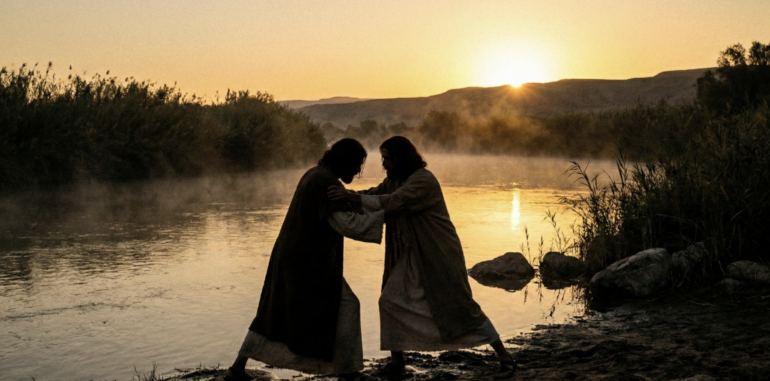
Yaakov on the banks of the Yabbok River.
1. The DNA of Nations: Who is the “Minister of a Nation”?
To understand the drama that unfolded on that fateful night, we must first grasp a fundamental concept in the psychology of nations. Just as every individual has a personality, character traits, and a unique “Self” that distinguishes them from others, so do nations (primordial national identities as presented in the Torah – not socially constructed ones).
Rav Naḥman Krokhmal (known as the RaNaK) defines this concept clearly: The notion of a “Minister of a Nation” (Sar shel Uma), as found in our sources, does not refer to a mystical demon or an imaginary entity. Rather it refers to the “spiritual essence” of the people—the overarching spirit that sustains them. In modern terms, it is the cultural and value-based DNA that unites millions of individuals into a single entity.
On that night, Yaakov was about to meet the “Minister of Esav.” This was the spiritual essence of a culture that sanctifies the power of the sword, every man for himself, and material success as the ultimate measure of a human’s worth.
The struggle was not merely between two men, but a head-on collision between two opposing worldviews.
2. The Mystery: Fistfight or Prophetic Vision?
The Biblical narrative leaves us breathless. Yaakov is left alone, and suddenly—”A man wrestled with him until the break of dawn.”
Questions immediately arise: Is this a story about an anonymous attacker lurking in the dark? Is it a prophetic experience occurring within Yaakov’s consciousness? And most importantly—what is the message?
Why, just prior to meeting his frightening brother, must Yaakov exhaust himself in a nightlong fight?
To decipher this, let we must go to the “field.”
Imagine a journalist standing on the sidelines, recording the voices and attempting to interpret an event through two completely different investigative approaches.
3. A Journey Log: Testimonies from the Struggle
Our reporter files two versions of the dramatic dialogue that took place. Each version reveals a different layer of reality.
Report A: The Blockade (The Psychological Approach / Rashbam)
In this version, the reporter identifies Yaakov as a man attempting to flee, and the Angel as an agent sent to forcibly stop him.
The Reporter Notes: “Yaakov looks terrified. He is trying to slip away under the cover of darkness to avoid confronting Esav, but a figure physically blocks his path.”
The Transcript:
Yaakov (trying to cross the ford): “I must save my family. Escape is the only option right now.”
The Angel (blocking his way): “You shall not pass. You are staying right here.”
Yaakov: “The Creator promised to keep me safe, but I will not take the risk!”
The Angel: “Precisely because the Creator promised, you are forbidden to flee. You are trying to avoid your destiny… I am here to force you to face your fear.”
The Result: The Angel strikes Yaakov’s leg to neutralize his ability to run. The injury is a penalty, designed to compel him to confront his brother.
Report B: The Clash of Civilizations (The Historical Approach / Ramban & RaNaK)
The reporter suddenly realizes that the story is much deeper. This is not an attempted escape, but a valiant stand against History.
Yaakov stands facing the representative of the future Roman Empire/Western civilization.
The Transcript:
The spiritual minister of Esav: “Yaakov, you are small. I am Power, I am the Sword, I am History… How do you, a dweller of tents, think you can survive this long night?”
Yaakov: “Your night is long (the exile is long), but my dawn will break. My power is not in the sword, but in the voice—’ The voice is the voice of Jacob’.”
The minister: “Beautiful words. But look, I am hurting you physically… I will take the best of your sons through persecution and assimilation. Here, I touch the socket of your hip.”
Yaakov (in pain but determined): “You have wounded me. You have killed my body, but you have not broken my spirit… We will suffer, but we will remain ‘whole.’ My spirit is stronger than your material power.”
The Ending: The minister of Esav surrenders to the spirit. He admits that Yaakov is not “crooked or deceitful” (Yaakov) but “Israel”—one who has wrestled with history and prevailed.
4. The Historical Angle: The Return to Zion & the Rising Dawn
This struggle did not remain at the Yabbok River. The Ramban (Naḥmanides) teaches us that this night symbolizes the long exile of Edom—two thousand years of darkness during which we were dominated by Western civilization – the 4th Empire.
The injury to the “hip socket” is not merely an anatomical anecdote. It is a symbol of the price in blood the Jewish people have paid. According to the Midrash Lekaḥ Tov, it represents those Jews who assimilated and could not withstand the pressure.
According to the Ramban, it represents the holy martyrs who gave their lives for Jewish identity and our Torah.
But today, as we read Parshat Vayishlaḥ securely back in our land, we are witnessing the end of the story: “And Yaakov arrived whole.”
Despite the injuries, despite the cycles of harsh persecutions culminating in the Holocaust, Yaakov survived the night.
The dawn has broken and Israel has returned home to our land.
We live in a generation where the promise has been fulfilled—the spirit conquered the sword and the nation has returned to its place — perhaps limping, but alive and enduring.
5. A Thought for the Future: The Paradigm Shift
In conclusion, we must ask ourselves a piercing question.
The Western Christian world – influenced by the “Minister of Esav” – tends to view Yaakov as a figure who needs to be “broken” in order to be fixed.
But the revolutionary Jewish reading offers the opposite perspective: The struggle was not designed to break Yaakov, but to build him. The Angel served as a “sparring partner”—a cosmic coach pushing Yaakov to the edge of his abilities to reveal his hidden strengths.
The name “Israel” was earned not by submission, but by struggling and prevailing.
The Question for Us:
Now that the dawn has broken and we are home, are we ready to fully embrace the name “Israel”?
Can we stop apologizing for our existence (the mindset of the fleeing “Yaakov”) and start leading with pride, carrying the banner of our unique spiritual message to the world (the mindset of the victorious “Israel”)?