
Ahead of his reunion with Esav, we see Yaakov experiencing fear.
Was this due to a specific transgression he had committed? A cursory glance at the Talmud might lead us to make this assumption.
“Rabbi Yaakov bar Idi asked: It is written, ‘Behold, I will be with you and I will protect you wherever you go’ (B’reishit 28:15). Why then is it written, ‘And Yaakov was very much afraid’ (32:8)? The answer is that he said: perhaps sin will influence the outcome.” (Sanhedrin 98b)
But this seems to be contradicted by Rashi: “I lived (‘garti’ has the numerical value of 613) with Lavan – but I kept the 613 commandments.” (32:5)
This implies that Yaakov was not guilty of any sin. We must therefore look for Yaakov’s transgression in the continuation of the passage.
Yaakov says that “I delayed my return until now” (32:5). He remained in the exile for a longer time than was necessary to complete his mission.
We can assume that Yaakov doesn’t stay an additional six years in Lavan’s house merely for monetary gain – to accumulate wealth out of greed – but in order to fulfill the promise given to Avraham.
“And afterwards they will leave with great wealth.” (15:14)
At this point, the Torah is very briefly noting one of the hidden goals of the exile; to gather together the holy values hidden within the cultures of the other nations – what is known in our Kabbalistic teachings as “gathering the sparks.”
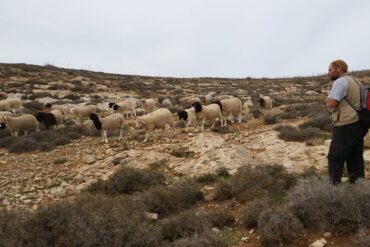
In Lavan’s house, these values are embedded within the sheep. Yaakov therefore remains with Lavan to ensure that he would not leave even one spark behind – so that this would indeed be Israel’s very final exile.
Since it can be very difficult to determine if any sparks remain, Yaakov puts himself in danger by taking upon himself a role that he, as a holy man, is willing to accept – to remain in exile for an extended period of time.
But then the danger grows, because of the great military power that Esav manages to establish before Yaakov’s return home. And this delay is what Yaakov perceives to be a sin.
With this in the background, it is possible to analyze Yaakov’s moral status as compared to that of Esav.
“‘And Yaacov was very much afraid’ – perhaps he would be killed” (Rashi).
The fear of being killed in war is natural. But the continuation of this comment is more difficult to understand.
“‘He was distressed’ – perhaps he would kill others” (ibid).
The word “others” (“aḥeirim“) is used as a nickname for Rabbi Meir (Ḥorayot 13:2).
The reason for this nickname (aside from historical events) is that it is a symbol of the hidden sanctity of Edom (Esav), which is linked to the birth of Rabbi Meir, who our sages identify as a descendent of the Emperor Nero, who the Talmud says joined the Jewish people in order to avoid attacking the Jerusalem Temple (Gittin 56a).
The very fact that there is holiness within the “other” brings with it the recognition that the opposite side has some independent value. Yaakov was afraid that if the “other” would be harmed, this might also cause harm to “aḥeirim” (Rabbi Meir – the future value that was destined to be extricated from Edom).
With such a position, it is impossible to succeed in war. And it is also difficult to enter Eretz Yisrael.
In order for him to overcome this, Yaakov is forced to fight by himself all night and to emerge victorious. Only with this advancement towards becoming “Israel” does he become capable of entering the land.
Translation by Dr. Moshe Goldberg