
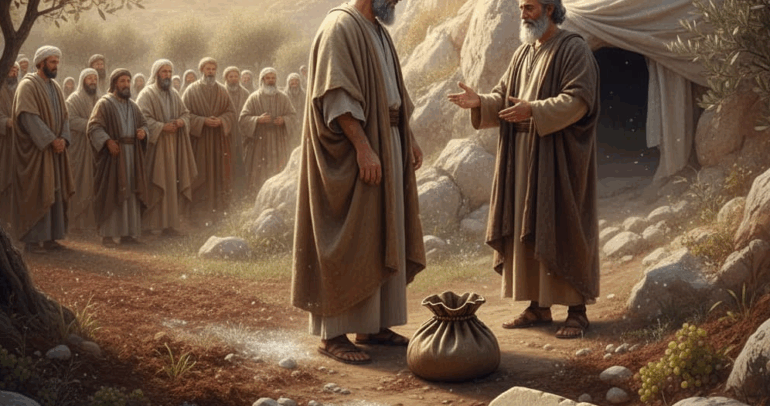
Our patriarch Avraham wanted to own property among the children of Ḥet, to be considered as a citizen of the land. When addressing them, he therefore emphasized their similarities.
“I am a stranger and a resident” (B’reishit 23:4)
From the perspective of his soul, Avraham felt like a stranger in the world. But from the perspective of nature, he was a resident of the world.
By saying “together with you” (ibid), Avraham also asserted that the people of Ḥet experienced this same tension. But they rejected this argument, which they saw as attempting to combine the two forms of human existence into one personality. By contrast, they understood the world to include two types of human beings; spiritual or earthly.
The people of Ḥet insisted that Avraham was a “prince of G-d” while they were “people of the earth.”
They therefore refuse to give Avraham ownership of a burial plot, which would grant him the status of a citizen of the land. They instead sought to merely grant him permission to use one of their burial plots, without any ownership rights.
Efron ben Tzoḥar offered to support to Avraham because he recognized the Hebrew’s ability to elevate mankind. In fact, his very name implies that he understood that, at the root level, humanity was pure and white (“tzaḥor“) and later took on the traits of dust (“afar” – similar to Efron). He anticipated that Avraham would uplift the world, as is written, “And the field of Efron rose up” (23:17), when he attached himself to Adam’s burial site.
A cave is not meant for for agricultural use but for burial. The primary function of a field, on the other hand, is for agriculture (after the fact, it could also be used as a burial ground).
Avraham only expressed interest in the cave, emphasizing that what he cared about was a burial site, a possession that, in the ancient laws, served as a sign of permanent citizenship. But Efron explained that the people of Ḥet wouldn’t allow this, and he therefore proposed that Avraham buy the entire field, which would include the cave as part of the purchase. But the people of Ḥet would then claim that the area was not actually a formal burial plot, but rather an agricultural field being used in an unusual way (as a burial plot).
Efron presented a brilliant solution to this dilemma.
Land is acquired by either paying money or performing an act of taking possession. If the transaction would consist of a transfer of money, the children of Ḥet would be able to claim that the property was merely agricultural land.
But if the purchase would be sealed by an act of taking possession, the status of the property would depend on how Avraham would use it. If he were to plant trees, the area would be a field, but if he were to bury someone, it would be a burial plot.
“In the eyes of the children of Ḥet” (B’reishit 24:18), the element of greatest importance was the money. As far as they were concerned, the transfer of money would complete the transfer of ownership.
But Efron told Avraham, “Listen to me” (23:15), clarifying that as far as he and Avraham were concerned, the money wasn’t important, “between you and me, what importance does it have?” (ibid).
Efron told Avraham to bury his dead, and that the transfer of ownership would take place afterwards. Avraham heeded Efron’s advice.
“And Avraham listened to Efron” (23:16) and, as a result, the purchase was understood in two different ways.
“And Efron’s field, the field and the cave in it, and all the trees in the field” – emphasizing the agricultural aspect of the transaction – “became a purchase by Avraham, in the eyes of the children of Ḥet” (23:17-18).
“Afterwards, Avraham buried his wife Sarah in the cave of the field of Makhpela in the area of Mamrei.” (23:19)
Only then, is it written, “And the field and the cave within it were transferred to Avraham as a heritage for burial, bought from the children of Ḥet.” (23:20)
Translation by Dr. Moshe Goldberg