There’s a serious dispute between the Rambam and the Ramban in regards to Parshat Vayeira.
According to the Rambam, the entire story of Avraham welcoming his guests, including the promise of the birth of Yitzḥak, and his subsequent defense of S’dom, took place as a Divine vision, without any of these events occurring in our material world.
The Rambam presents the verse that opens the entire event as proof for his argument.
“And HaShem appeared to Avraham…” (B’reishit 18:1)
According to the Rambam, this phrase indicates a prophetic revelation and serves as the context for everything that follows.
The Ramban sharply disagrees with this approach. Not only does he merely reject it, he uses unusually strong language to attack this position.
“These are things that are contrary to the written word. One is forbidden to listen to them and to believe them.”
What causes the Ramban to attack the Rambam’s commentary as posing a danger of spreading heresy and damaging our emuna?
HaRav David Cohen – a close disciple of HaRav Avraham Yitzḥak HaKohen Kook better known as the “Nazir” – suggests that the disagreement could be influenced by the fact that the Ramban lived amongst the Europeans and was understandably sensitive to the risk that the Rambam’s explanation could be exploited by Christians and used as a proof for their idolatry.
If they were to discover that a prominent Jewish commentator on the Torah imply that the Creator appeared to Avraham in the form of three men, it could be used as an argument to justify the Christian Trinity doctrine.
The Rambam, on the other hand, lived in Muslim surroundings where this wasn’t a concern. He was more focussed on combating superstitious beliefs that related to spiritual matters in terms of demons and ghosts, and could therefore have been more concerned with the ramifications of three angels visiting Avraham.
It therefore makes sense that the Rambam would attempt to abstractize the encounter with the angels.
When considering the Ramban’s strong attack on the Rambam’s position, we should keep in mind the possibility that the Rambam himself appreciated the danger of his approach.
If we postulate that the entire encounter was merely a prophetic vision, for example, how could the people of S’dom have attempted to harm the angels? Could they have entered the prophetic vision?
Yet a straightforward reading of the text could actually strengthen the Rambam’s view. Let’s look at the verses related to S’dom:
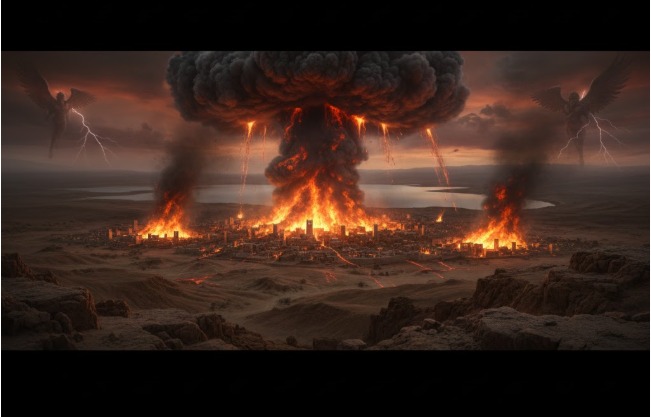
“And HaShem rained down on S’dom and on Amora sulfur and fire, from HaShem, from heaven. And He annihilated these cities, and the entire plain, and all the inhabitants of the cities, and the vegetation of the earth. And his [Lot’s] wife looked back, and she became a pillar of salt. And Avraham woke up early in the morning.” (B’reishit 19:24-27)
Could it be that the entire story of the angels, saving Lot, and the destruction of S’dom took place in a prophetic dream by Avraham? At the same time that S’dom was being physically destroyed?
Based on this, we could look at the Rambam’s approach to be claiming that Avraham’s vision of the angels descending into S’dom is an attempt by the Creator to give Avraham an experience of the events. In his dream, our patriarch could see how the people of S’dom would have treated the angels had they in fact come into the city.
We must ask ourselves if it’s possible for both the interpretations of the Rambam and the Ramban to be true. When our masters strongly disagree on the Torah’s prophetic message to us, are these ostensibly conflicting interpretations merely equally valid or could they simultaneously be correct?
It might be interesting to add to our mix the Ralbag‘s understanding of this narrative. Because he holds that no miracle could take place without the participation of a human prophet, he teaches that the three men who came to visit Avraham were actually human prophets.
According to this view, they came to give Avraham the news about both Sarah’s pregnancy and the Divine judgment against S’dom (the Torah therefore calls these men “angels” as a sign of respect for the heavenly prophets of the Creator).