
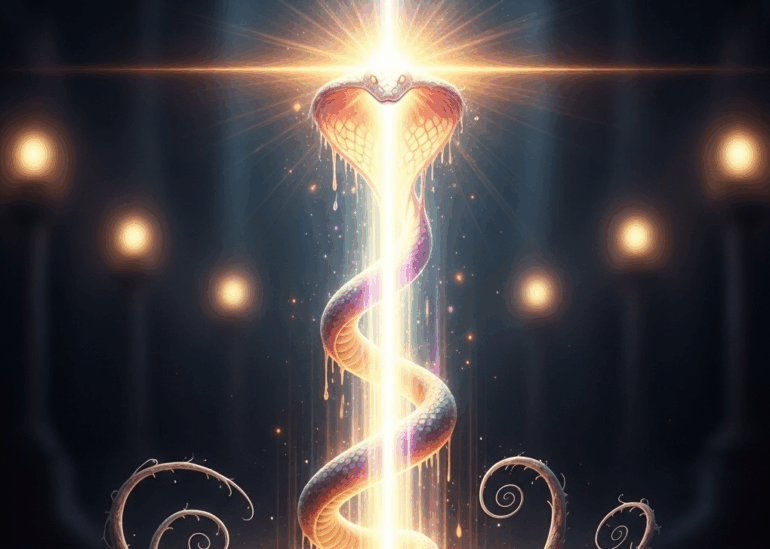
The story of the serpent in the Garden of Eden is a foundational narrative that holds a key to understanding the primal forces of creation, human nature, and the messianic process.
For many, the serpent is unequivocally understood as the embodiment of absolute evil – a malicious force aiming to cause humanity’s downfall.
But the understanding of our sages reveals a dramatic secret about lost potential.
The Curious Case of the Serpent & the Messiah: When Evil Became Destiny
The most profound shift in our understanding concerns the serpent’s very identity.
The serpent wasn’t pure evil. It represented the peak of natural and cultural development just before the creation of man in the Divine image. It was a sophisticated creature, capable of speech and possessing a deep – though entirely natural – intellect.
The hidden truth about the serpent’s essence is revealed through the Hebrew language: the words naḥash (serpent) and Mashiaḥ (Messiah) share the same numerical value of 358. This connection indicates that both concepts represent the same fundamental potential force.
Had the serpent made an effort to connect itself to Divine values, it would have received the Creator’s assistance in transcending mere natural intellect. The serpent in the garden was created with a lofty purpose – it was a potential messianic force that failed.
Instead of achieving its destiny, the serpent fell and became a force of opposition to humanity’s mission. Therefore, history’s ultimate goal does not require us to merely destroy the serpent, but to transform it into the Mashiaḥ.
The Gap Between the Intellect & Divine Dialogue
The transgression in Eden was not about acquiring knowledge but about the order of value that preceded it. The struggle is rooted in the distinction between two types of intelligence:
- Guile (orma): The serpent’s guile (orma) is defined as sophisticated thought within the confines of nature —a brilliant intellect detached from its Divine Source. This ancient philosophical position should be understood as the precursor to rationalist thought in the modern era, where truth is sought out solely through human reason.
- Wisdom (ḥokhma): This is the essence of man. True wisdom is defined not by intellectual capacity alone, but by a force anchored in connection with the Divine. The human capacity for wisdom is expressed through the ability to initiate dialogue with HaShem — to speak with the Creator (prophecy).
The serpent’s deception was convincing Adam to pursue the “Tree of Knowledge” (intellectual advancement) prior to anchoring his perception of reality in the “Tree of Life” (Torah). The correct order mandates the precedence of the “Tree of Life” – after which all the knowledge of the world can be safely consumed.
Eating Dust: The Punishment of Disconnection
This understanding illuminates the profound nature of the serpent’s punishment (“eating dust”).
This consequence is not merely physical humiliation, but also a severe spiritual penalty: the severing of the need to connect with the Creator.
The serpent represents a being satisfied with purely natural existence, feeling no need for supernatural blessing or Divine dependency. The serpent is therefore cut off from the true power and vulnerability of man – his perpetual need for tefillot and spiritual connection.
The Battle for Progress: From Ancient Egypt to Today
The conflict between the “serpent force” and the “Adam force” is a fixed cosmic pattern throughout history. Every time the world advances to a higher stage, the old stage resists the new development.
This resistance often stems not from absolute malice but from the inability of the previous, highly developed stage to contain the magnitude of the coming spiritual change.
Ancient Egypt serves as a potent example of this process.
Egyptian civilization represented the peak of cultural and technological development in the natural world. When the new spiritual stage of Israel began to emerge, the Egyptian civilization violently resisted it, acting as a historical manifestation of the serpent in that same battle between the highly developed “natural” force and the “spiritual” force meant to advance humanity.
The prophet Yirmiyahu even links Egypt to the serpent directly: “The sound of her is like a serpent going.” (Yirmiyahu 46:22)
We can also see this conflict expressing itself today between Western civilization (the fourth empire Edom) and the nation of Israel being reborn in our land. Like the snake and ancient Egypt, the West represents the most advanced civilization built on human intellect divorced from HaShem. Israel’s rebirth signals a new stage in human development characterized by a conscious connection to our Divine Source.
Full redemption requires the complete rectification of creation. As long as the world is unprepared, the Messianic forces must be held back, as a premature revelation would only manifest as a “false messiah”—another expression of the failed serpent force.
The process of redemption involves the constant struggle to bring the unfulfilled potential of the serpent to its destined perfected state of fulfillment.
War as a Moral Mirror: Is the World Ready for the ‘Messianic Era’?
Israel’s two year war against not only Hamas but also a host of other enemies demonstrates the complex ways in which the world evolves through crises.
The solidarity and sense of connection shown by those who fought for two years to bring our hostages home from Hamas captivity served as an inspiration to many around the world – many who saw a stark contrast between Israel and their own societies.
When the world considers taking an additional moral step forward, humanity might see the deficiency of the values that have dominated most of the dominant nations over the last two thousand years, while the Jewish people were powerless in exile.
But now that the children of Israel are once again sovereign in our land, it’s becoming clear that we can build a nation where everyone feels a shared sense of responsibility (even across borders and continents), as evidenced by the efforts of the Jewish people to bring our hostages home. Despite what some might claim, Israeli identity is not actually a socially constructed civic national identity but rather a giant family with a shared history and deep sense of collective responsibility.
Even the English word “nation” fails to translate the full meaning of the Hebrew word “am” – which Professor Dara Horn rightly describes as a “joinable tribal group” with a shared history, homeland, and culture.
What Israel demonstrated during this war is that even the way a nation acts in war can be deeply moral. This might explain why so many leaders of the current world order are determined to stop the State of Israel from becoming too powerful.
The big question today is whether or not elements of Western civilization will be able to support the children of Israel in not only returning to our ancestral home but also introducing the world to a new ideological paradigm in which the Israeli sense of connection and mutual responsibility expands to encompass all of humanity.
It’s a question that will weigh heavily on the world in the coming years.
This piece is based on the teachings of HaRav Yehuda Leon Ashkenazi (Manitou)






Thank you Rabbi Goldberg for this very deep analysis, it’s such a huge paradigm shift to finally be able to read the Holy Torah through the eyes of the Jewish Sages !