
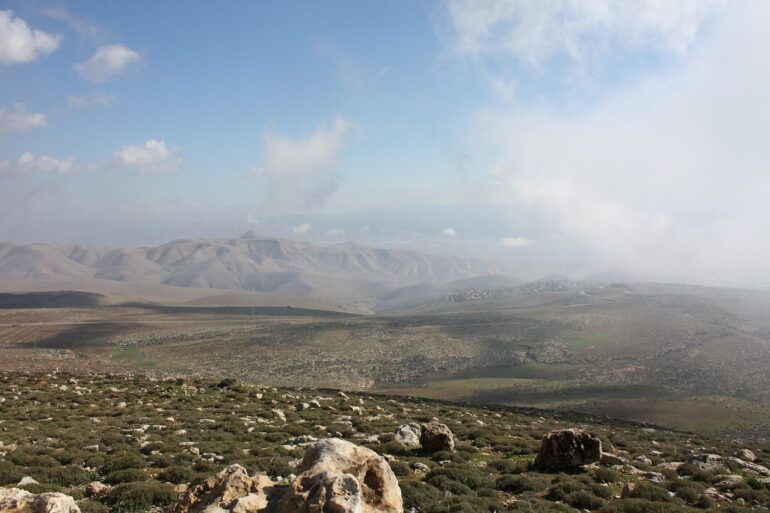
Many Israelis (and our Diaspora Jewish supporters) have for decades resisted the term “West Bank” in reference to the territories won from Jordan during the 1967 Six Day War. In fact, using the term has traditionally been seen as taking a political stance in favor of Israel surrendering these lands.
Israelis, especially in the national camp, tend to prefer the term “Judea and Samaria” (which actually predates “West Bank” in international language) to refer to these territories, referencing the inherent Jewish connection. It’s therefore not surprising that the recent embrace of the “Judea and Samaria” terminology by Trump administration officials has led to some celebration by rightist Jews.
As someone who lives in northern Judea, I acknowledge that this name more appropriately evokes the deep connection that Jews have had to our heartland for thousands of years. It is, as many point out, a more indigenous name for the place that I live (although technically speaking my home sits near the border between the tribal territories of Ephraim and Binyamin). But the stubborn inability by many to engage in discourse that references the West Bank, or to automatically shut down when the term is used, showcases deep shortcomings in those Jews fighting for the territorial integrity of our land.
The term West Bank, initially coined in 1950 following the Jordanian annexation, denotes the parts of our land conquered by Transjordan in the 1948 War. It constitutes far more than a riverbank but was labeled as the western bank of the Jordan River to legitimize a territorial claim by the Hashemite Kingdom of Jordan (the name change from Transjordan to Jordan was meant to express that the Hashemite kingdom was no longer limited to the territory east of the river that largely defined its identity).
The boundaries of the West Bank, the “Green Line” drawn as part of the 1949 Armistice Agreements, merely denote where the fighting stopped at the end of the war. They in no way reflect natural boundaries or express anything historically meaningful.
In replacing “West Bank” with “Judea and Samaria” as one geographic unit, Jews committed to resisting the partition of our country risk becoming more detached from our historic lands. The Jewish approach was generally to relate to Judea as a tribal region and Samaria (Shomron) as a city in the tribal territory of Menashe.
The notion of Samaria constituting a region with historically fluid borders really began in the Second Temple Period.
When the Israelite Kingdom split and the tribes of Binyamin, Shimon, and Levi remained with Yehuda in what became known as the Kingdom of Judah, Judea began to refer to the territory ruled by the Davidic Dynasty.
In truth, there are parts of the West Bank that are neither in Judea nor Samaria (such as the Jordan Valley). There are also parts of Judea that are not in the West Bank, and likewise parts of what’s been considered Samaria at various historic periods that aren’t part of the West Bank.
If West Bank simply means the geographic unit conquered by Israel from Jordan during the 1967 War (after Transjordan conquered it from Israel in the 1948 War), perhaps the best course of action would be to defang the term of its political connotations by simply using it in contexts that obviously refer to the cradle of Jewish civilization.
This would likely be far more effective than Jews constantly getting lost in the weeds of a fight over terminology.