
Last Tuesday, the IDF announced a new round of promotions among the top brass.
For those who had hoped that the appointment of Lt-Gen Eyal Zamir as chief of staff, coupled with the appointment of Yisrael Katz (Likud) as defense minister, would bring a significant change in the military’s approach to the ongoing regional war, this announcement paints a disappointing picture.
Of the seven appointees, six of the military officers received higher education abroad, four of them in the United States.
The predominance of American education, especially at Harvard, among high ranking Israeli generals is one of many indicators of Israel’s deep conception of military dependence on Washington. This is especially troubling as we continue to fight a multi-front war in which Americans have repeatedly attempted to reign in vital operations in order to protect US interests in our region.
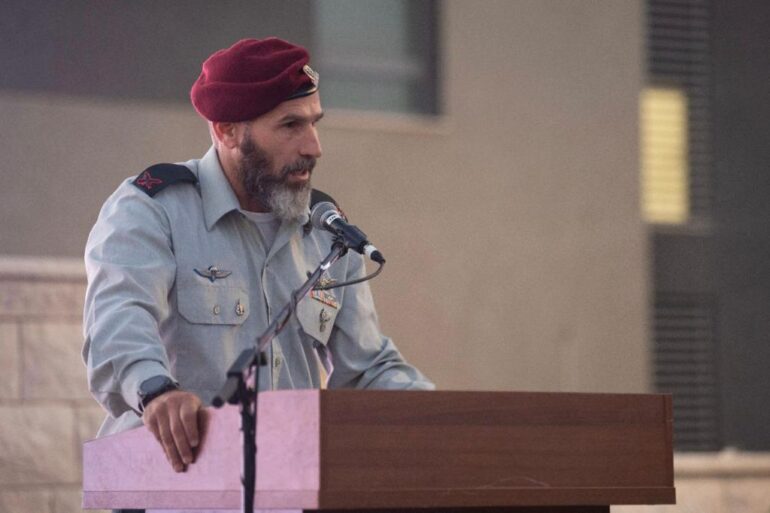
The most prominent of these generals is Dan Goldfus, who was appointed commander of the Depth Corps, responsible for all Israeli military activity behind enemy lines (beyond Israel’s borders).
After participating in the Recanati-Kaplan Fellowship at the Belfer Center at Harvard’s Kennedy School, he was appointed to command the 98th Division, a position which he held through the first year of the current war.
During this time, he made headlines for making an impromptu speech to the press, breaking military protocol and disdainfully calling to the political echelon, “you have to be worthy of us.”
While he was formally reprimanded by then IDF Chief of Staff Hertzi HaLevi, his promotion to the rank of Major General was announced only two months later.
While his battlefield leadership in Gaza during the war was admirable, this rapid series of promotions, despite the reprimand he received, have led many to raise an eyebrow.
Other high-ranking commanders who were reprimanded for engaging in politics, like Ofer Winter and Avinoam Emuna, were denied promotions. Some have explained this on the basis of institutional discrimination against national-religious commanders, like Winter and Emuna, pointing to criticism of Emuna wearing a beard, with no similar critiques of Goldfus’s equally long beard (their beards make different sociopolitical statements).
As the battle damage assessment from Israel’s war in Iran becomes clearer, the military and political establishments have stated that within the next few years, further campaigns will be required to halt Iran’s nuclear program. After US President Donald Trump brought the most recent war to a screeching halt, shortly after joining the campaign, with a ceasefire that many worry fell short of Israel’s war aims, it is worrying that Zamir and Katz appointed a Harvard-educated general with no qualms about publicly expressing disdain for the government to lead Israel’s next war with Iran.
But Goldfus isn’t the only Harvard alum who received a promotion.
Rami Abudraham, appointed to head the Technological and Logistics Directorate, is an alumnus of the Kennedy School’s infamous Wexner Fellowship, which some Israeli government ministers have criticized for promoting Western agendas.
While the IDF officially ended all partnerships with the Wexner Fellowship last year due to Harvard’s mishandling of campus protests against Israel, many see the protests as only a pretext for severing the relationship. The Wexner Foundation has been perceived with increasing suspicion in recent years, both due to Jeffrey Epstein’s role as a trustee and his alleged connections to former Prime Minister Ehud Barak – who himself was reported to receive over $2 million from the foundation.
Promoting another general who came through the fellowship that some view as having played a significant part in creating the conceptzia (the mistaken military doctrine that enabled the horrors of the Hamas attacks on Simḥat Torah of last year) is sufficiently concerning.
If Prime Minister Netanyahu is serious about his stated intention for Israel to develop greater munitions independence after American threats to withhold munitions held up the invasion of Rafah, Katz’s signing off on appointing another Wexner graduate to be the IDF commander responsible for the military’s arms and ammunition supply is not particularly reassuring.
This brings us to the most troubling of all of the new appointments.
Hidai Zilberman was tapped to head the IDF Planning and Force Design Directorate. In addition to studying at London’s Royal College of Defense Studies, Zilberman has spent the entire war in Washington, serving as Israel’s chief attaché to the American Armed Forces.
Considering that this position that has historically blinded Israeli generals to the material differences between Israeli and American security needs in the region, appointing Zilberman to be responsible for developing the IDF’s military capabilities as well as its military diplomacy is extremely dangerous.
Zilberman’s foreign connections aren’t the only stain on his resume.
As the head of the Planning Division (a branch of the Directorate he’s been appointed to head), he developed the IDF’s multi-year Gid’on plan, part of a series of multi-year plans advanced by former Chiefs of Staff Gadi Eisenkot and Aviv Kokhavi to develop a “smaller and stronger” military.
These plans, which reduced the IDF’s war-readiness, based on the dangerous assumption that multi-front wars were a thing of the past, directly contributed to the limited manpower and munitions supplies that have plagued Israel since the beginning of the current war.
These appointments are a done deal. But it’s imperative that the people of Israel make it clear to Katz and to the entire security cabinet that we won’t be led down the same erroneous path again. We must demand a more responsible IDF General Staff that is committed to developing Israel’s independent military capabilities, and learning from the fatal mistakes of its predecessors.