
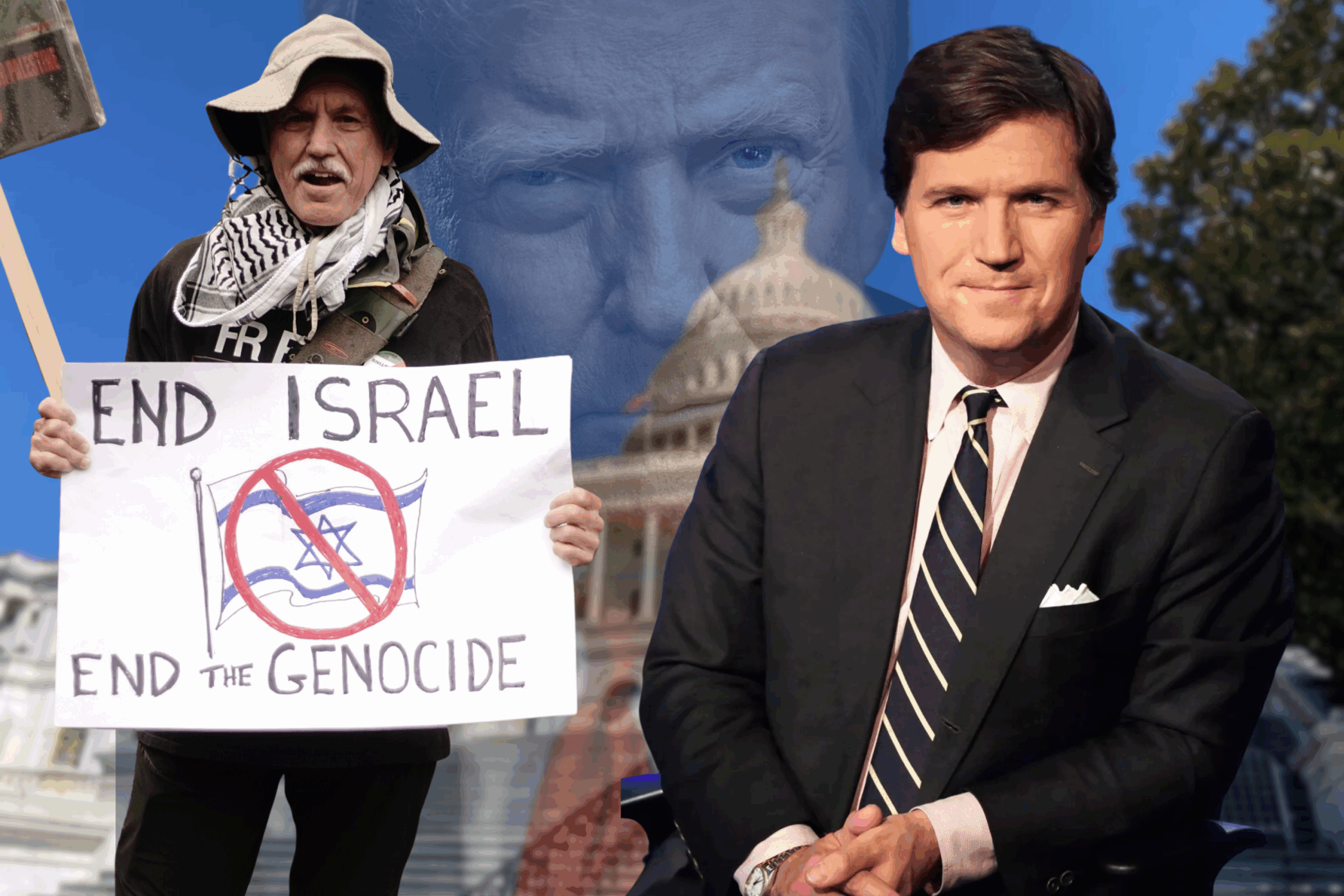
The Horseshoe Theory, a political concept that claims the far right and far left to have more in common with one another than with the liberal political center, appears to have gained traction in Jewish spaces with the rise of anti-Israel – and even blatantly anti-Jewish – figures on the American right.
According to this model, the extremes of the political spectrum curve toward each other, resembling a horseshoe, rather than diverging linearly.
Though intuitive at first glance, this theory is ultimately shallow as it flattens complex dynamics and obscures the distinct ideological, cultural, and historical roots of anti-Semitism in different political camps.
Worse, it risks depoliticizing real threats by placing them on a simplistic, symmetrical spectrum.
Since the Hamas attacks of Simḥat Torah (October 7) of last year, and the ensuing war in Gaza, Jews in the United States have faced an acute sense of insecurity.
Once diffuse and compartmentalized forms of anti-Jewish antagonism now appear more concentrated and emboldened. Both the revolutionary left and the populist right in the United States have, in different ways, contributed to an atmosphere of hostility and alienation for Jews.
On the left, the intensifying depiction of Israel as a genocidal settler-colony has often evolved into open hostility toward pro-Israel Jews, or even Jewish communal institutions. In one high-profile case, after two staffers at Washington’s Israeli embassy were murdered, a Marxist activist named Elias Rodriguez was taken into custody as the primary suspect.
The Anti-Defamation League’s Jonathan Greenblatt pointed to the influence of online personalities such as Twitch streamer Hasan Piker, accusing them of normalizing aggressive anti-Israel rhetoric among their audiences.
On the right, voices like Tucker Carlson and Candace Owens have grown increasingly hostile to Jewish communal power and US support for Israel.
At a recent Turning Point USA conference in Florida, Carlson’s breaking with a so-called taboo by lashing out at Israel and pro-Israel Diaspora Jews was met with roaring applause. And as these ideas propagate, acts of violence against Jews becomes more plausible.
While left-wing anti-Israel politics have propagated more rapidly in academic and activist spaces, important distinctions should be made.
The anti-Israel sentiment that emerges from segments of the left is often contextualized as part of a broader fight for justice and decolonization, framing Zionism as a form of settler-colonialism and drawing parallels between Israel and settler-colonial societies like the United States and Canada.
For principled leftists living in the imperial core with a sense of frustration at the overwhelming task of dismantling colonialism where they live, this view of Israel provides a model of settler-colonialism at a much earlier stage that still appears reversible. This, along with the urgency of realtime Palestinian suffering regularly plastered across the internet, accounts for the left’s disproportionate focus on targeting Israel.
We can argue that this perception of Israel is deeply rooted in a misunderstanding of Jewish identity that’s actually compounded by the Hasbara industry’s adoption of tropes that promote American exceptionalism and Jewish legacy organizations trying for decades to attain whiteness in American society. But it’s not hard to see how those concerned with fighting injustice come to this conclusion.
These anti-Israel attitudes are frequently rooted in structural critiques of power, capitalism, imperialism, and white supremacy, which have been embodied in Jewish political maneuvering in North America. Leftists by and large reject the premise of a Jewish national identity (and primordialist national identities more broadly), while operating in a worldview more similar to that of our ancestors when it comes to justice.
By contrast, right-wing hostility tends to be more explicitly conspiratorial, rooted in racial and civilizational anxieties. It often traffics in ideas of Jewish dual loyalty, globalist manipulation, and demographic replacement – narratives with deep roots in white nationalist and Christian supremacist ideology.
While the left may marginalize Jews in the name of justice, the right positions Jews as existential threats to the nation itself (the far right takes primordialist national identity for granted). Right-wing anti-Semitism’s premise is that Jews are an external force, a national identity in opposition to America’s true identity.
The Horseshoe Theory flattens these differences, as if the threat of a protest chant and the threat of a Synagogue shooting are emanations of the same basic instinct. But, in truth, they emerge from different genealogies of thought, with different goals and different modes of expression.
The most crucial error, however, is the assumption that the liberal political center can be a stabilizing force – one that can rescue Jews from the hostility of the fringes. In addition to now physically endangering the Jewish community, this misread has already come at the cost of our people’s identity, worldview, and value system – having had to conform each to the acceptable norms of liberal ideology.
As Jews must learn to navigate a rapidly changing political landscape, we must resist the temptation to salvage our comfortable role in the United States or the “Judeo-Christian” concept many Jews clung to for a sense of security.
To face the resurgence of Jew hatred in North America honestly, we must reject not only the false symmetry of the horseshoe but also the false safety of the political center. We must instead develop a political literacy that distinguishes between enemies, recognizes conditional allies, and acknowledges how Jews ourselves have often been complicit in our own misreadings of both the left and the right.
Rather than holding out hope that the Republicans might save American Jewry, or that normalcy will return to the Democratic party, we must reexamine what the fringes get right and challenge the power of the center.
The right’s conception of Jewish identity, while framed nefariously, does reflect the self-understanding of our ancestors for generations. Their worldview, however, is more similar to our historic arch-nemesis Amalek.
The left’s misunderstanding of Jewish identity, on the other hand, has led to many of our own prophetic values being weaponized against us.
Jews in North America have for the most part unfortunately opted to discard both of these truths, in favor of fitting into the liberal center power structure – something that only increases systemic anti-Semitism.
The 2028 US presidential election isn’t likely to be decided along classic political lines. There is a long-simmering crisis in the capitalist system that has now reached a boiling point. The next clash will be centered on class, and the fringes – not the center – are offering real answers.
This is not a battle between moderation and extremism, but rather between a broken unjust system and revolution. This system, which has long treated Jews as a cushion to absorb instability and protect elite interests, is now demanding its pound of flesh.
The populist right insists that a shadowy cabal, possibly linked to Israeli or global Jewish interests, is holding the American dream hostage. This rhetoric is quickly channeling classic anti-Semitic tropes into a uniquely American brand of political fascism.
The left, meanwhile, remains allergic to the notion of Jewish peoplehood, unable or unwilling to include Jews in its matrix of oppressed identities. Jews – especially those who express identification and support for Israel – are treated as white and therefore outside the moral circle of intersectional politics.
Normal is about to be redefined. And in that redefinition, Jews will have to make choices; not just about policy, but also about identity. About where we truly belong.