
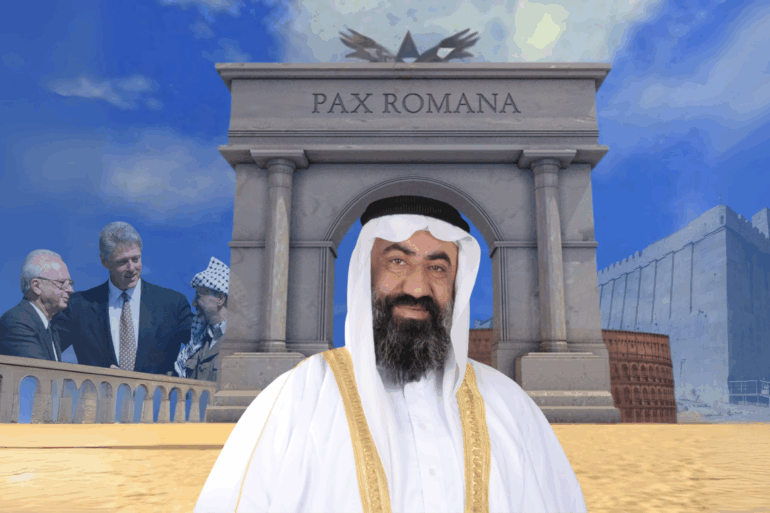
When relating to Sheikh Wadee’ al-Jaabari’s “Hebron Emirates” plan laid out in the Wall Street Journal on Sunday, it’s important that we examine it on three levels:
1. The external political level.
2. The deeper level of identity and mentality.
3. The even deeper level of motivation and intention.
The Political Level
Is this plan better than the other plans on the table? Yes.
Does it have a better chance of improving the relationship dynamics between Jews and Palestinians? Yes.
Does it better conform to our (VISION’s) conception of Jewish national interests? Pretty much.
So what could be the problem?
Identity & Mentality
Despite important sociocultural shifts in Israeli society, there are two strong indications that our political leadership – even in this current government – still functions inside the ideological paradigm of Western civilization.
The first is the fact that the values of security and stability (“law and order”) often appear to be prioritized in the public discourse above the values of justice and honor.
The second is that Israel’s leadership still largely thinks in terms of contracts and static agreements rather than in terms of fluid relationships between partners.
This is problematic because the interaction between tribes and clans are often fluid and based more on the strength of a good reputation than on the clauses and penalties spelled out in a written contracts.
The vision presented by Sheikh Wadee’ al-Jaabari could theoretically work out well if Israel were to adopt a mentality that values justice, loyalty, and honor over what’s written in official documents. If Israel could think and function like the large tribe (or collection of tribes) that we actually are more than as the Western nation-state that our ruling class wants us to be, this plan could succeed.
But not only has Israel’s leadership not yet adopted such a mentality – Israeli society has been conditioned by the country’s westernized elites to fear such a shift. In fact, many of our dominant institutions go so far as to defame and persecute the sectors of Israeli society that they perceive as becoming “too much like our neighbors.”
If Israel’s leadership continues to function as a pseudo-Western actor in an otherwise “savage” region (or as Ehud Barak infamously put it: “a villa in the jungle”), we will not only condemn ourselves to the role of “colonizer” in this land but we’ll limit any new peace initiatives to the conceptual boundaries of the Pax Romana.
In short, the only way for Shiekh Jaabari’s Hebron Emirate plan to succeed would be for Israeli society to engage in a postcolonial process that would help us catch up psychologically to Zionism’s material achievement and consciously embrace the many Semitic features of our identity that we’ve been conditioned to fear.
Intentions
An even deeper issues that needs to be addressed is the question of our motivation and intentions.
Why would Israel want to pursue this plan?
Is it merely to escape from the failed Oslo paradigm?
Is it a cynical tool to attain Palestinian buy-in for Jewish sovereignty in the West Bank?
What should our motivation be if not self-interest?
Just as the Western concept of nationalism is essentially an extended form of egoism, the Western peace of Pax Romana is one that encourages parties to each pursue their narrow self-interest and allows the strongest of these parties to benefit most. But Israel’s concept of shalom aspires for something greater.
Israel’s motivation should not be to merely benefit ourselves but rather to give. This requires a refocus from narrow Jewish nationalism to Hebrew Universalism.
The Zionist stage of our rebirth was necessary and successful. After thousands of years in gas form, the children of Israel have returned to being a national solid in our land. But now we must evolve to a new stage of our development where we work towards the collective benefit of humanity.
This must be what motivates any efforts to improve Israel’s relationships with other peoples, whether in our land or elsewhere.